
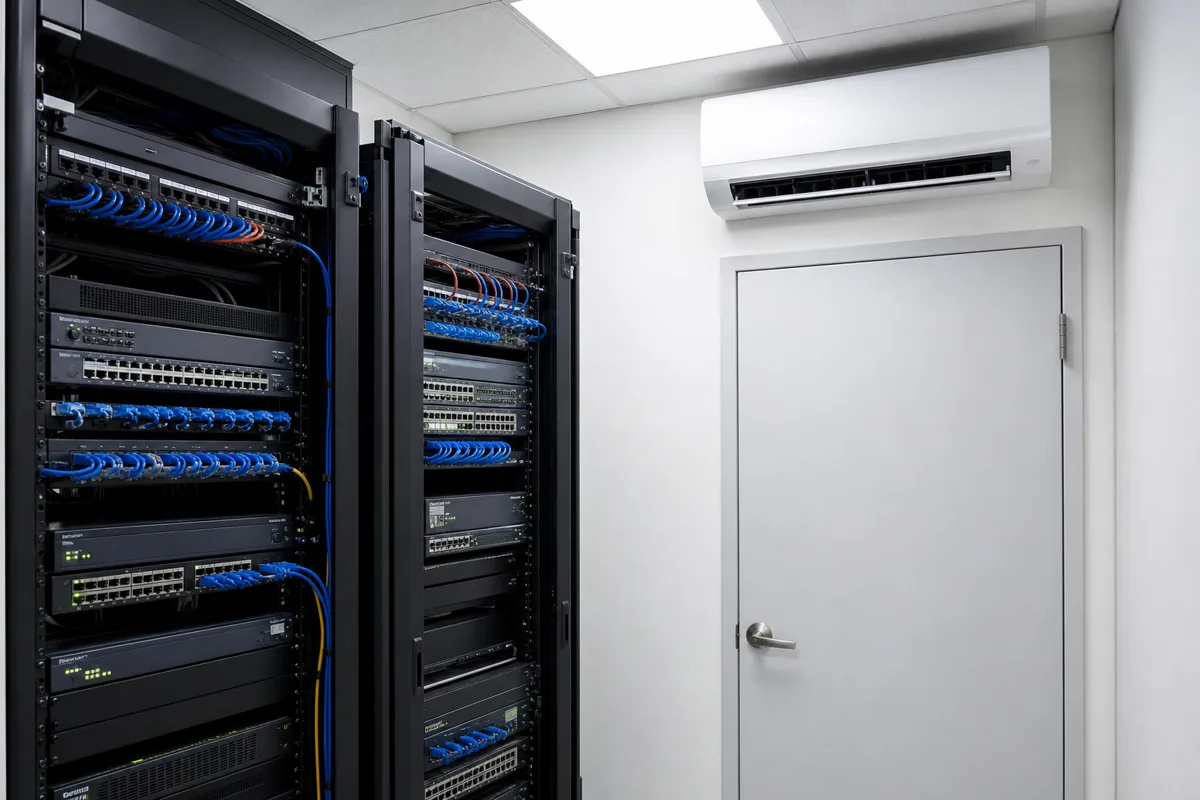
A comms room needs cooling sized from its electrical load, running every hour of the year, with a plan for the week the unit fails. For most UK comms rooms under about 10 kW of IT load, a dedicated wall or ceiling split with 24/7 duty rating is the right tool, sized from the UPS output rather than the room dimensions, with condensate pumped to a proper drain and an alert when temperature rises. Resilience does not require a second data centre: a second small split, or a monitored spare-capacity arrangement, covers most business risk at sensible cost.
Size from the load, not the room
Racks convert electricity to heat almost one for one. Read the UPS output or add up PSU draw at realistic utilisation: that figure in kW is the cooling duty, plus margin for solar gain, lighting and people if the room doubles as a workspace.
Comfort splits sized by room area will short-cycle and die young in a sealed IT room. Specify equipment rated for continuous low-ambient operation, because a comms room needs cooling in January when the condenser is at minus five outside.
- UPS output in kW is your baseline cooling duty.
- Continuous duty and low ambient kits are specification items, not extras.
- Set points around 22 to 24 degrees save energy over needless chill.
- Condensate needs a pumped route and an overflow alarm above hardware.
- Temperature alerting is cheaper than one weekend outage.
Equipment choices under 10 kW
A high-wall split above the door with the airflow washing the cold aisle is the default and the cheapest to maintain. Ceiling cassettes work in larger rooms with grid ceilings. Portables are an emergency measure, not a design, as the portable server room guide explains.
Above roughly 10 to 15 kW of load, or where humidity control matters, close-control units enter the conversation. The CRAC versus split guide sets that boundary honestly.
Resilience without the data centre bill
Two smaller splits with a duty rotation controller give N+1 for a fraction of close-control cost, keep running hours balanced, and let you service one unit while the other holds the room. That is the standard SME answer.
Add monitoring that alerts on temperature and on unit fault. The server room monitoring guide covers alarm choices; the cooling failure guide covers what to do in the bad week.
Cost shape and getting quotes
As a 2026 illustration, a single continuous-duty split for a small comms room commonly lands in the low thousands installed, with a duty-rotated pair in the mid thousands. Roof condenser access, long pipe runs and out-of-hours installation windows move the number.
Use the quote form with the UPS load, room photos and whether work must happen outside office hours. Installers who do IT rooms will ask about alarms unprompted; that is the tell.
Frequently asked questions
What size air conditioner does a comms room need?
Match the IT electrical load: a room drawing 4 kW at the UPS needs roughly 4 kW of continuous cooling plus margin for the fabric and any occupancy. Room floor area is almost irrelevant; the racks are the heat source.
Can I use a normal split in a comms room?
Only if it is specified for continuous duty and low outdoor temperatures. A standard comfort split will run every hour of the year in a duty it was not designed for, ice up in winter, and fail early. The equipment choice is a rating question, not a brand question.
Do comms rooms need two air conditioners?
Rooms whose failure stops the business should have N+1: two units with rotation so either can hold the load. Small cupboards with tolerant hardware sometimes accept one unit plus monitoring and a fast call-out contract. Price both before deciding.
Core buying guides
Start with these high-intent guides, then dig into the rest of the library.
Related guides
Sources and further reading
How this guide was prepared
This guide was written by the Local AC Installers Editorial Team. We compare official guidance, legislation and established consumer information, separate general information from project-specific advice, and show publication dates and sources. We do not accept installer accreditation claims at face value.