
Most detached and semi-detached houses in England can install one air conditioning outdoor unit without planning permission, because the equipment usually falls within permitted development if it meets siting, size and noise conditions. You do need permission, or another consent, far more often than sellers admit: flats and maisonettes have no householder permitted development for plant, listed buildings need listed building consent, conservation areas restrict street-facing walls, and every leasehold property needs freeholder consent regardless of what the council says. The safe sequence is lease first, planning check second, installer survey third.
The short answer by property type
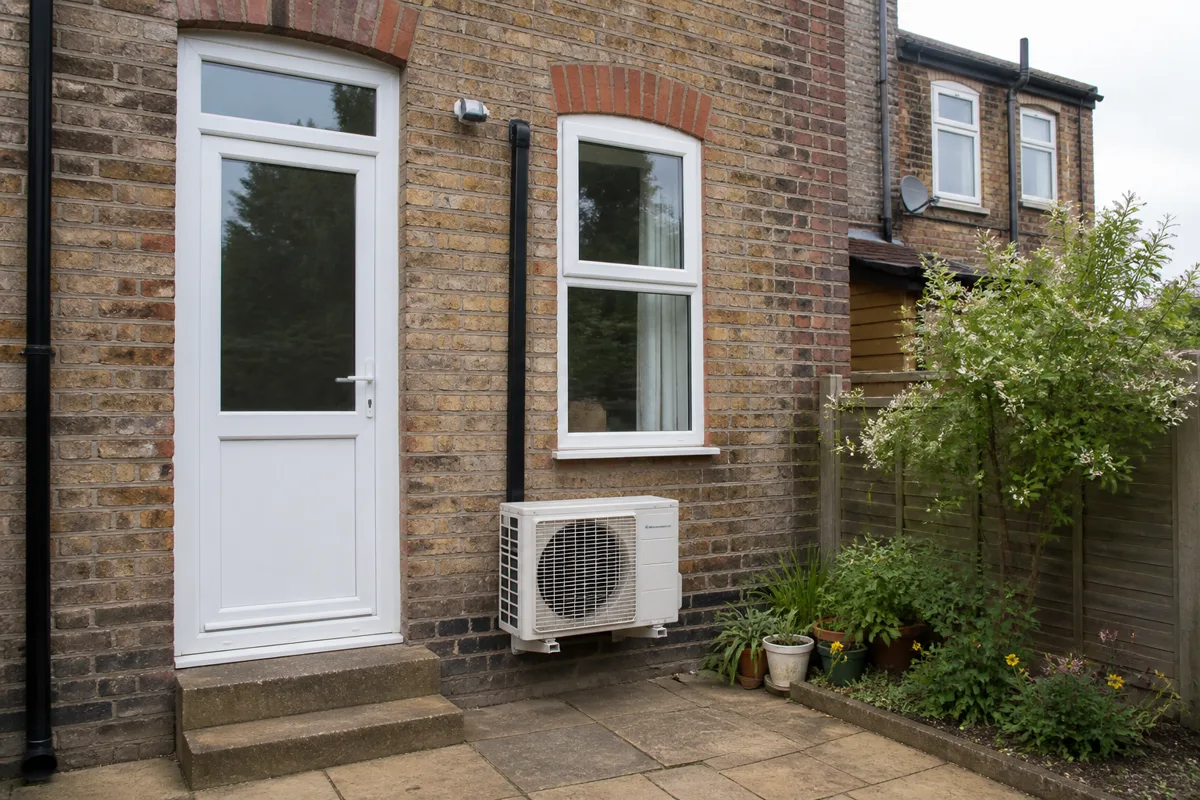
A freehold house with a sensibly sized outdoor unit on a rear or side wall is often the case that needs no application, provided the installation meets the permitted development conditions on size, position and noise, and does not sit on a wall fronting a highway in a conservation area. "Often" is doing real work in that sentence. The conditions are a list, not a vibe.
Flats are different. Householder permitted development rights do not apply to flats, so an external condenser on a block usually needs planning permission and always needs freeholder or management company consent. Commercial units follow their own regime. A shop lease often controls the outside wall even when the planning answer is straightforward.
- Freehold house, rear or side wall, one unit: often no application, if every condition is met.
- Flat or maisonette: assume planning permission plus freeholder consent.
- Listed building: listed building consent before anything touches the fabric.
- Conservation area: street-facing walls are the usual problem.
- Any leasehold property: the lease can veto what planning allows.
Cooling-only fails a condition people skip
The England route installers mean is Class G, the permitted development class for an air source heat pump on a domestic house. It is not a general permission slip for any white box that cools a room. One of the conditions is that the unit is not used solely for cooling. A cooling-only product does not meet that condition. A reversible unit, which can heat as well as cool, can meet it, and still has to meet every other limit.
Energy Saving Trust describes air-to-air heat pumps as machines that move heat with a refrigerant circuit and blow warmed or cooled air from indoor units. That description is not planning permission, and it is not a grant. Do not describe a cooling-led install as something the Boiler Upgrade Scheme pays for. Read the current Class G text on legislation.gov.uk for the proposal you actually have, because the conditions are amended from time to time and a forum summary goes stale.
Size, noise and a second outdoor unit
Installers talk about volume, distance from the boundary, the roof, and a noise calculation because those limits live in the class. An outdoor unit that fails the noise assessment at the nearest habitable room is not permitted development even if it is small and on the back wall. The number to care about is the one in the current statutory text and the planning standard it points to, not a rule of thumb repeated on a quote.
How many units you can add without an application is not the same for every house. A second outdoor unit on a house that is not detached often needs an application, where a detached house is treated differently. Two condensers for a multi-split, or a second split added a year later, is the moment to stop assuming and check. Article 4 directions and conditions on a newer estate can remove the rights entirely. None of that is fixed by standing the unit a polite distance off the fence.
Listed buildings and conservation areas
Class G does not apply to a listed building or land within its curtilage. Listed building consent can be required for fixings, holes and pipework even when the condenser is small or on a rear wall, because listing can cover the whole building, not only the front. Historic England's listed building consent guidance is the overview. The decision sits with the local authority.
In a conservation area, the usual trip is a wall that fronts a highway. A rear courtyard can be a different question from the street elevation, and it is still a question. New grilles, trunking and a roof-level plant are visible changes. A conservation officer noticing two core-drilled vents is not a myth. Put the proposed elevation in front of the council before anyone drills, if the building is protected.
Consents that are not planning
Leasehold consent, a freeholder's licence for alterations, and a landlord's permission in a rental all sit outside the planning system. A council email that says permission is not required does not bind a management company. The lease is often the consent that takes longer, and the one that gets refused when the outside wall is common. Lease advice on alterations is the place to start reading. Do not invent a spend threshold for a block consultation. If the building is a block of flats, ask the managing agent whether section 20 applies to the works.
Party walls and a neighbour's window are practical as well as legal. A condenser on a shared wall, or directly above the next house's bedroom, can be a planning problem, a nuisance problem, or both. Statutory nuisance can be investigated after you have installed, whatever the planning position was on day one. Quiet siting and a unit that is not hunting because it was badly commissioned are cheaper than a complaint.
Shops, offices and other commercial premises do not use the householder class. The planning question is about the building and the external plant, and the lease may still forbid it. A single small split in a shop is not automatically free of every rule, and a system whose combined cooling output is over 12 kW can bring air conditioning inspection duties that are separate from planning. GOV.UK sets those inspection rules out. They are not a reason to skip the outdoor position.
Get an answer for this address, not for houses in general
Read the lease or the title first. Then use the Planning Portal pages for air conditioning and for air source heat pumps, and the current Class G text, against the property you have. Then get a survey that states the outdoor position, the model and whether the unit is reversible. An installer who quotes without naming that position is guessing at the consent question.
If the answer is unclear, a lawful development certificate is the formal way to ask the council, and a pre-application conversation is the informal one. Neither is the same as a salesperson saying it will be fine. Use the quote form with the property type and photos of the wall you want to use. The replies worth reading are the ones that argue about that wall.
Frequently asked questions
Do I need planning permission for air conditioning in a house in England?
Usually not for one modest outdoor unit on a rear or side wall of a freehold house, because permitted development covers it if siting, size and noise conditions are met. Listed buildings, conservation area street elevations and larger multi-unit installations are the common exceptions.
Do flats need planning permission for air conditioning?
Assume yes for any external unit on a flat or maisonette, because householder permitted development does not apply to flats. You also need freeholder or management company consent under the lease, which is refused more often than planning.
What happens if I install without permission?
The council can require a retrospective application or removal, and a freeholder can enforce the lease independently. Noise complaints can also trigger statutory nuisance action. Retrofitting consent is slower and more expensive than checking first.
Core buying guides
Start with these high-intent guides, then dig into the rest of the library.
Related guides
Sources and further reading
How this guide was prepared
This guide was written by the Local AC Installers Editorial Team. We compare official guidance, legislation and established consumer information, separate general information from project-specific advice, and show publication dates and sources. We do not accept installer accreditation claims at face value.