
Gym air conditioning has to remove heat from people, lighting and cardio equipment while dealing with moisture and outdoor air. A bedroom split sized from floor area will undersize a busy studio and can ice, drip or run continuously. Garage-gym searches are a different, smaller job: often one high-wall or ducted unit in a poorly insulated box. In a commercial gym, plan cooling together with ventilation, opening hours, outdoor siting and a drain that can survive peak class times. Indicative costs sit in commercial bands, not domestic £1,500 to £3,000 single-room figures, once several cassettes or a VRF system appear.
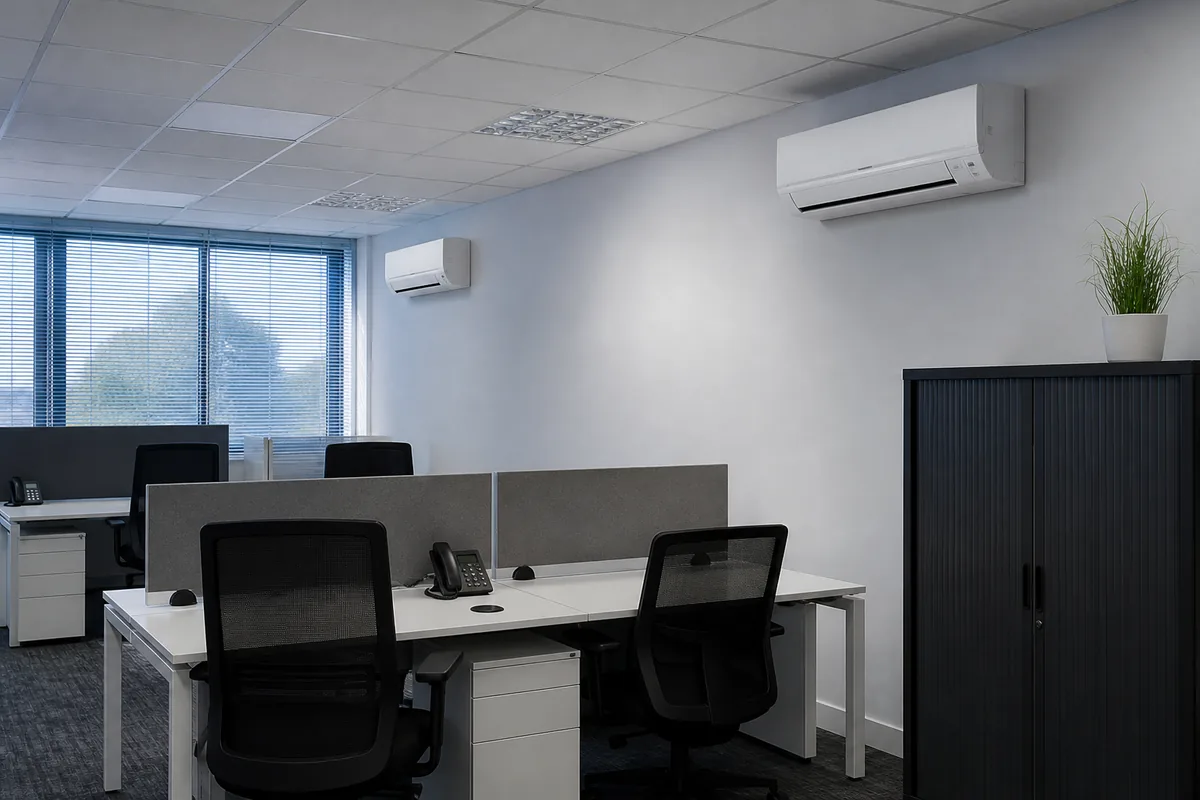
Load is people and machines, not floor tiles
Peak occupancy, class timetable, treadmills, sunlight through glazing and kitchen or juice-bar heat all belong in the calculation. Latent load from sweat matters. A system that only looks at square metres will feel sticky even if the thermostat hits the set point.
Garage gym air conditioner searches often mean an insulated garden studio or garage conversion used by one or two people. That can be a domestic-scale split. A high-street gym with changing rooms is a commercial design.
- State peak occupancy and class length.
- List major cardio and HVAC already in the space.
- Do not block outdoor airflow with extract or kitchen discharge.
- Plan condensate for continuous peak-season running.
Ventilation is not optional because you added AC
Air conditioning recirculates and cools. Occupied gyms still need outdoor air and extract for odour, humidity and building regulations. Treating AC as a complete indoor-environment system is how changing rooms smell and windows stream.
Ask how the cooling proposal sits with existing MVHR, extract fans or rooftop AHUs. Fighting a large extract with an undersized cassette is a classic failed fit-out.
Indoor unit choice: cassette, ducted or wall
Cassettes keep walls free for mirrors and kit. Ducted can be discreet in a new ceiling. Wall units are cheaper and easier to service in a garage gym. In a commercial studio, wall heads on the training wall get hit by balls and block layouts.
Outdoor units need airflow, acoustic control and landlord consent. Gyms often run early and late, so neighbour noise is a planning and lease issue, not an afterthought.
Budget and resilience
A garage gym may land near domestic installed bands if the building work is simple. A multi-cassette or VRF gym is a commercial quote, often into five figures, especially with evening working and roof plant. Use the commercial cost calculator, then survey.
Ask what happens if one indoor unit fails during a peak class. Continuity is not data-centre N+1, but a single cassette serving the only studio is still a business risk on a heatwave Saturday.
Frequently asked questions
Can I use a domestic split in a gym?
For a lightly used garage gym, sometimes, after a survey. For a commercial studio with classes, you usually need a load-based commercial design, suitable indoor format and a maintenance plan.
How much does gym air conditioning cost in the UK?
Garage gyms can resemble domestic split prices. Commercial gyms are typically several thousand to tens of thousands of pounds installed depending on zone count, ceiling work and plant access. There is no gym tariff.
Do gyms need VRF?
Only if zone count, pipe runs or outdoor-space limits justify it. Many small studios work with one or two splits or a small multi-split. Do not buy VRF for the acronym.
Core buying guides
Start with these high-intent guides, then dig into the rest of the library.
Related guides
Sources and further reading
How this guide was prepared
This guide was written by the Local AC Installers Editorial Team. We compare official guidance, legislation and established consumer information, separate general information from project-specific advice, and show publication dates and sources. We do not accept installer accreditation claims at face value.