
For the first week, pick a comfortable setpoint and leave it there. Do not set 16C and expect faster cooling. The unit can only deliver its kilowatts. A lower number mostly keeps it running harder and can ice the coil. Use fan speed if you want the room to feel different. Shut the internal doors of the room you are cooling, and keep the windows closed while it runs. Judge the install after it has held that pattern, not after an hour with the sash open.
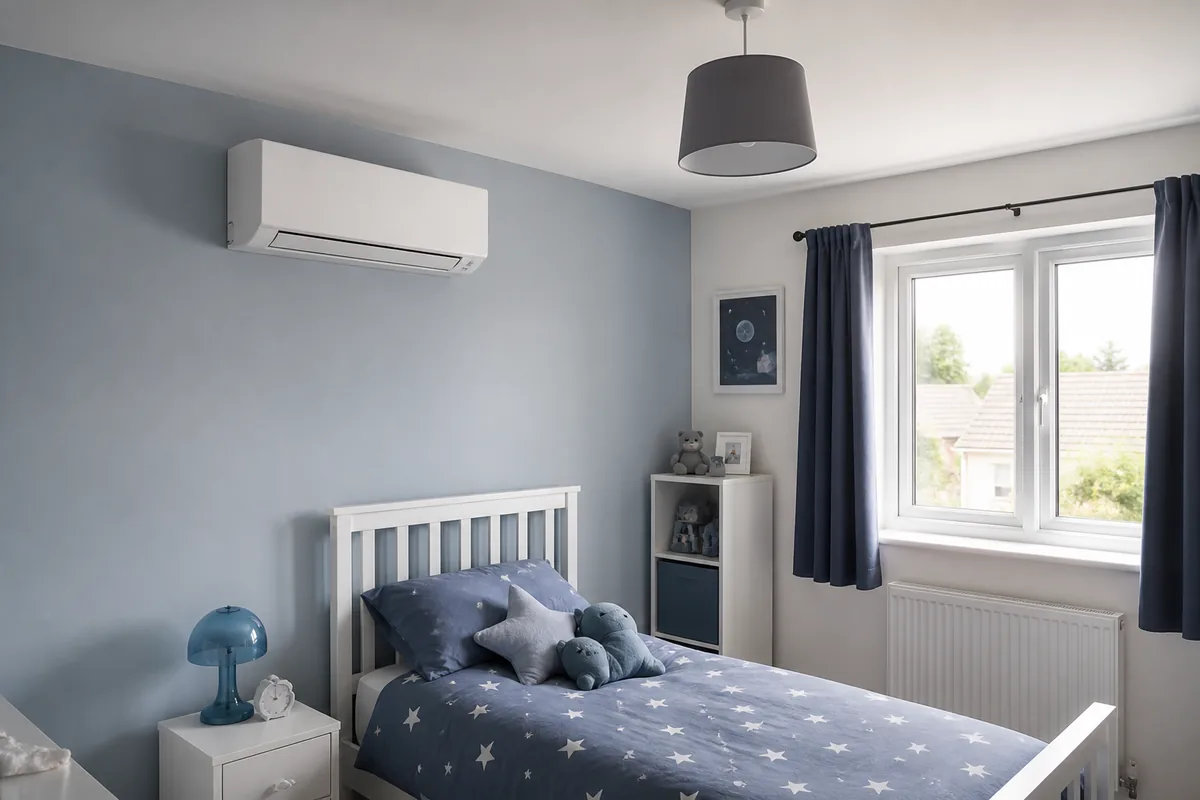
The sash cracked on the first hot afternoon
A cracked window while cooling dumps the treated air outside and pulls warm air in. Ventilate before you switch on, or afterwards, not during. Night airing when the unit is off is a different habit. The first week is for learning the closed-room pattern the survey assumed. Judge the install after it has held that pattern, not after an hour with the sash open.
A livable number, then leave it
Set something you would actually live with, often the low or mid 20s for cooling in a UK heatwave, and give it time. The remote's lowest number is not a boost button. Capacity is on the data plate in kilowatts. Once the room approaches the setpoint, a healthy unit eases off. If it never eases off and the room stays hot, then you have a fault, a sizing issue, or a window you left cracked. Heating mode, if you try it on a cool evening, has its own curve. A reverse-cycle unit can feel slow to start and it will defrost in cold damp weather. Energy Saving Trust explains air-to-air heat pumps in those terms. Neither mode rewards slamming the setpoint to the end of the scale.
- Choose a livable setpoint and leave it.
- Do not use 16C as a faster cool.
- Change fan speed if you want more or less throw.
- Keep windows closed and the room's doors shut.
The landing door and the room you actually sized
An open internal door asks one indoor unit to cool the landing and the next room. It will try, and the room you care about will lag. Shut the doors. If you wanted those other rooms cool, they needed their own indoors or an open-plan design that was sized for that volume. For the first week, keep the bedroom door shut so you learn what that indoor actually does. You can open it later, and the unit will then be asked to treat the landing too.
Water, gurgling and warm dust
A little water at the outdoor unit, or in the drain, is condensate and it should be leaving by the route they showed you. Gurgling from a pump, if you have one, should match what they demonstrated. Filters should stay as they were fitted, arrows with the airflow. Do not take them out for a wash on day two unless they showed you how. Smells of warm dust on the first heat can fade.
Stop treating a puddle or a burning smell as running in
A puddle on the indoor floor is not a running-in phase. Photograph it and call them. Smells of burning plastic should stop the unit at the isolator and start a phone call. If the windows, the doors and the mode are right and the room never catches a normal setpoint, ask the installer back with the model numbers.
Frequently asked questions
Should I run it flat out for the first day to test it?
No. Set a normal temperature, close the windows and the room doors, and see if it holds. Flat out at 16C does not prove a larger capacity than the unit has.
The room is still warm after two hours. Is that a fault?
Check the windows, the doors and the mode first. A heatwave with a cracked sash will not settle. If those are right and it never catches the setpoint, ask the installer back with the model numbers.
Core buying guides
Start with these high-intent guides, then dig into the rest of the library.
Related guides
Sources and further reading
How this guide was prepared
This guide was written by the Local AC Installers Editorial Team. We compare official guidance, legislation and established consumer information, separate general information from project-specific advice, and show publication dates and sources. We do not accept installer accreditation claims at face value.