
Auto mode on a UK reverse-cycle split compares the room temperature with your setpoint and then picks cooling, heating or fan. It does not mean the unit has measured the best possible comfort, and it is not the same thing as an inverter ramping compressor speed. In a British spring day that swings from sun to a cool evening, auto can heat, stop, and cool in the same afternoon. You can leave auto for a stable room, but choose cool in a heatwave and heat in a cold snap. If auto never settles, or the outdoor unit short cycles, an F-gas engineer should check sensors and sizing. Do not open the gas circuit to make auto behave.
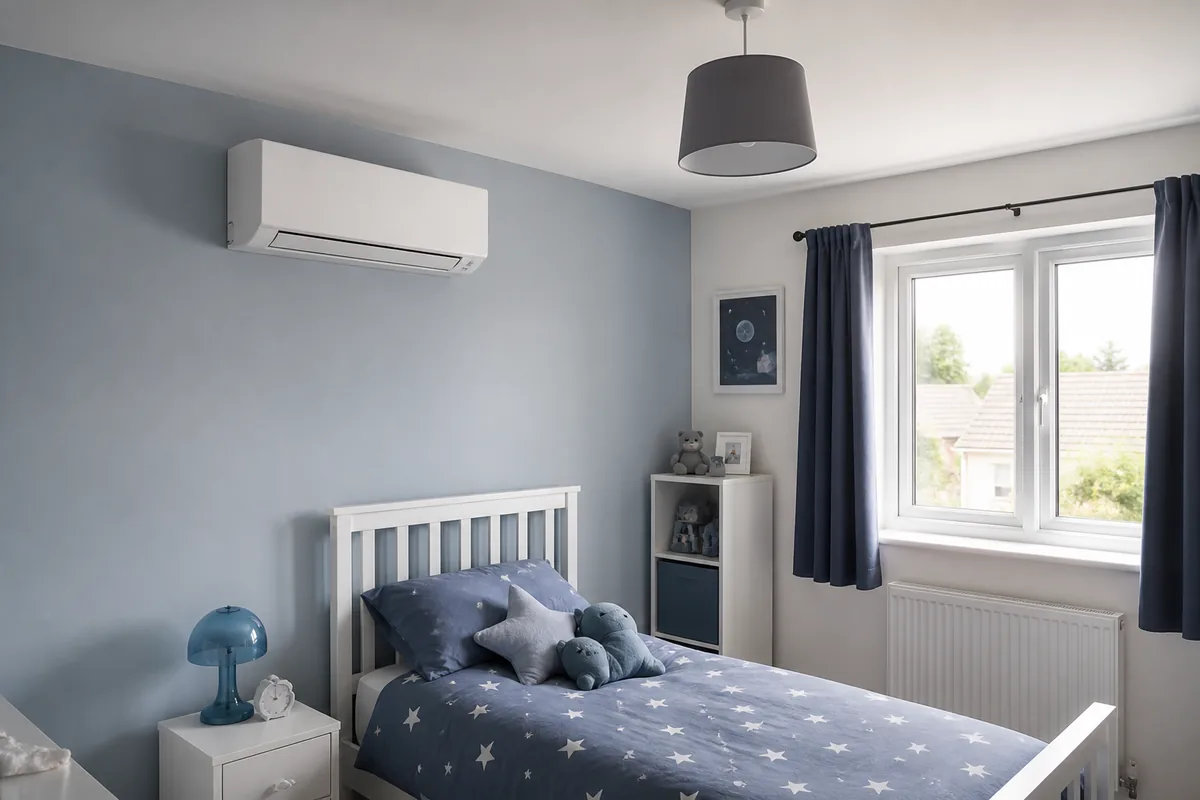
A target, a return-air sensor, and a dead band
You set a target. The indoor sensor reads return air, which may be warmer near the ceiling than the air at the sofa. If the room is above the target, auto tends to cool. If it is below, auto tends to heat. Close to the target, many units sit in fan. The dead band differs by brand. The manual states it. A forum post for a different model does not. Energy Saving Trust's air-to-air explanation is about moving heat, not about this button. The button is a control strategy on top of that heat pump.
Inverter speed is a different feature
Inverter control is separate. Once the unit has chosen cool, an inverter can run the compressor gently. People hear auto and inverter used as if they were one feature. You can be in cool mode on an inverter. You can be in auto on a simpler fixed-speed unit. Ask the engineer which you have if the quote never said. On many remotes, auto mode picks heat or cool, while fan speed has its own auto. They are different lines on the display. Check both before you assume one button does everything.
What to pick when the weather will not sit still
Explicit cool or heat with a moderate setpoint is easier to understand than a setpoint at the end of the scale. Auto is not a rule for the most efficient setting. It can heat and cool in the same day in UK weather.
- Leave auto for a stable room you rarely touch.
- Choose cool in a heatwave, including overnight if cooling is all you want.
- Choose heat in a cold snap rather than hoping auto will.
A south-facing room at 3pm and again at 7pm
A south-facing room can be hot at 3pm and below setpoint by 7pm with the window open. Auto follows. You get a warm blow, then later a cool blow, and it feels indecisive. That can be the mode doing what it was told, with a setpoint in the middle and a room that will not sit still. For sleep, auto is a poor choice if you only wanted cooling. It may heat at 5am.
Explicit cool that still fails is not an auto problem
If you set cool explicitly and still get no cold air, the problem is not auto. Check the isolator, the demand and the outdoor unit. If auto short cycles all day in a small room, the unit may be oversized or the sensor may be in a sun patch. Clean filters and keep heat sources off the indoor unit. HSE temperature guidance is workplace law, not a reason to leave a hunting auto mode as your only control.
When changing the icon is the wrong response
Book an F-gas engineer if the mode chatters the reversing valve, if ice forms, or if the room never reaches a sensible target in explicit cool or heat. GOV.UK certification sits with that company. Do not open the outdoor unit to change a dip switch from a screenshot. Sensor and board work stays with them, and refrigerant stays inside the pipes. If cool mode also heats when you only asked for cooling, that is a fault. Say whether auto heats at night, never settles, or fails in the same way as explicit cool.
Frequently asked questions
Why does auto blow warm in the morning when I wanted cooling overnight?
The room drifted below setpoint and auto called for heat. Use cool mode overnight if cooling is all you want. If cool mode also heats, that is a fault for an F-gas engineer.
Core buying guides
Start with these high-intent guides, then dig into the rest of the library.
Related guides
Sources and further reading
How this guide was prepared
This guide was written by the Local AC Installers Editorial Team. We compare official guidance, legislation and established consumer information, separate general information from project-specific advice, and show publication dates and sources. We do not accept installer accreditation claims at face value.