
Cool a box room with a small unit after a survey, not with a living-room kilowatt that was left on the van. The decision is fit and throw: the bed already fills the floor, so the air must miss the pillow and the casing must not steal the only wardrobe wall. A short pipe to a lawful outdoor spot matters more than a feature fascia. An F-gas certified company installs it. Do not add this room to a multi-split if the pipe length or height does not work.
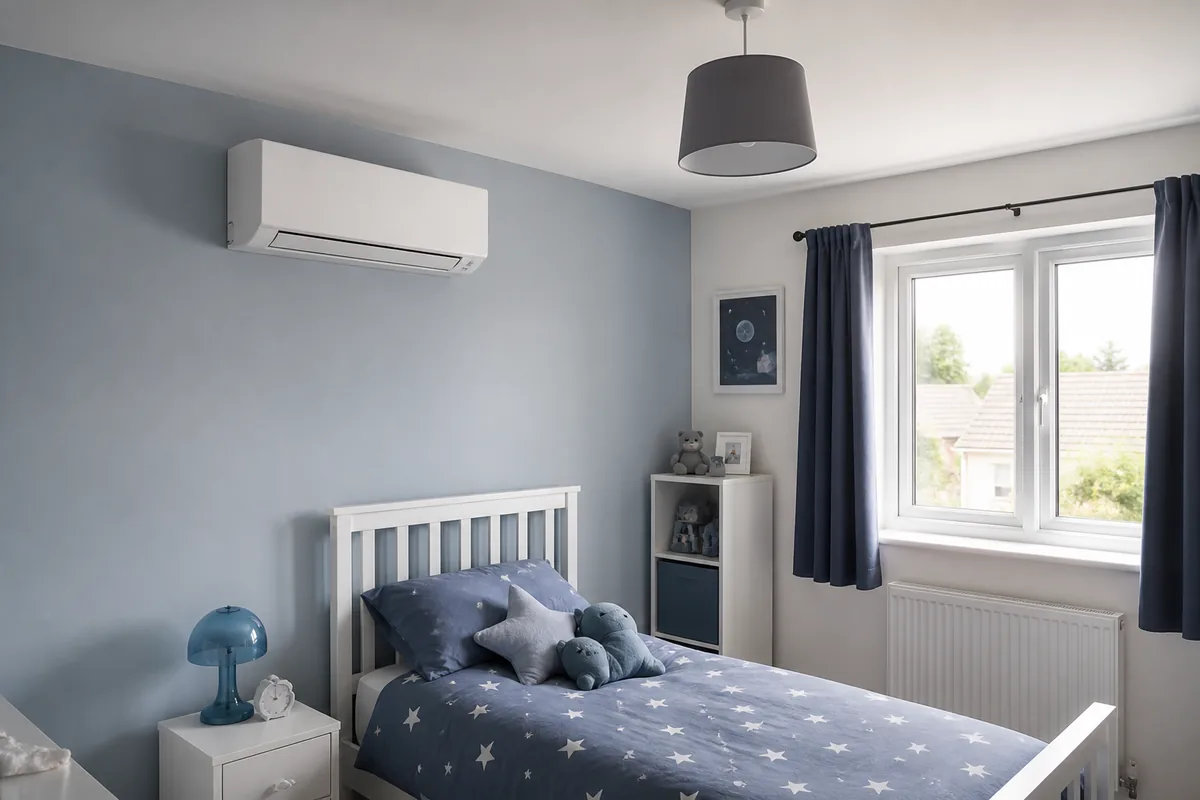
A small duty in a room the bed already fills
A box room is often 2 to 3 metres across, with one window and a door that stays shut. The cooling duty is frequently in the smallest domestic class, sometimes around 1.5 to 2.5 kW, and only the survey of that window and the floor below a hot roof can say. The indoor sound figure matters because you are always close to it. Compare low-fan noise on the model code. A reverse-cycle unit still makes sense if the room is a spare bedroom or a study that is cold in January. Energy Saving Trust treats those machines as air-to-air heat pumps. Say it is a box room. A photo that shows the bed, the window pier and the door swing, plus the outdoor elevation and the consumer unit, and the rough width if you know it, is enough to start. Ask for a small duty after survey, the model codes, and confirmation the casing fits the pier. Leave a wall you can still open the door against. Aim the air along the ceiling, off the bed.
The pier beside the only window
Box rooms have one outside wall and it is mostly window. An internal wall can work if the pipe run and a condensate pump are real, and if you are not drilling a chimney the house shares with next door. Measure the pier before you fall in love with a catalogue photo. In a terrace, the rear or side of a semi is the aim, under Planning Portal conditions in England. Survey the real floor area and the glass, and keep the duty in the small class unless the survey says otherwise. As a 2026 illustration, a straightforward box-room split is often at the lower end of a single-room install, still in the low thousands including VAT once electrics and the drain are included. A pump and a long internal run are what push it up. A new indoor unit on an old outdoor unit elsewhere in the house is usually not a mix-and-match. Only a listed combination on the same refrigerant is a maybe, and a tiny room still has to be on that list.
Frequently asked questions
Is a portable better because the room is small?
A portable is loud in a small room and needs a hose in the only window. A small fixed split is the better fit when an outdoor spot exists.
Will a big unit cool a box room faster?
It will overshoot and switch off. The survey should keep the duty matched to the volume so the room stays steady on a low fan. A 5 kW unit will short-cycle, overshoot and feel draughtier in a space you cannot step away from.
Can the box room share the main bedroom outdoor unit?
Only if the manufacturer lists that second indoor unit and the pipe length and height work. Otherwise give it a separate single or leave it out.
What if the pier beside the window is too narrow for the bracket?
The pier beside the window may be too narrow for the bracket. An internal wall can work if the pipe run and a condensate pump are real. If the casing will not fit, that catalogue photo is not your wall.
What if the condenser would sit in the only window?
The outdoor unit should not sit on the other side of that single window if the room is slept in, unless the mount is quiet enough on a survey. There is no value in a whisper-quiet indoor unit if the condenser is in the window reveal.
Should a box room at the far end of a terrace join the house multi-split?
That is the indoor unit that breaks a multi-split: the pipe is long, the height may be wrong, and the room did not need the big outdoor unit in the first place. Give it a small single pair if the outdoor spot exists, or leave it off the system. Ask them to reject the room from any multi-split that cannot meet the pipe and height limits.
Core buying guides
Start with these high-intent guides, then dig into the rest of the library.
Related guides
Sources and further reading
How this guide was prepared
This guide was written by the Local AC Installers Editorial Team. We compare official guidance, legislation and established consumer information, separate general information from project-specific advice, and show publication dates and sources. We do not accept installer accreditation claims at face value.