
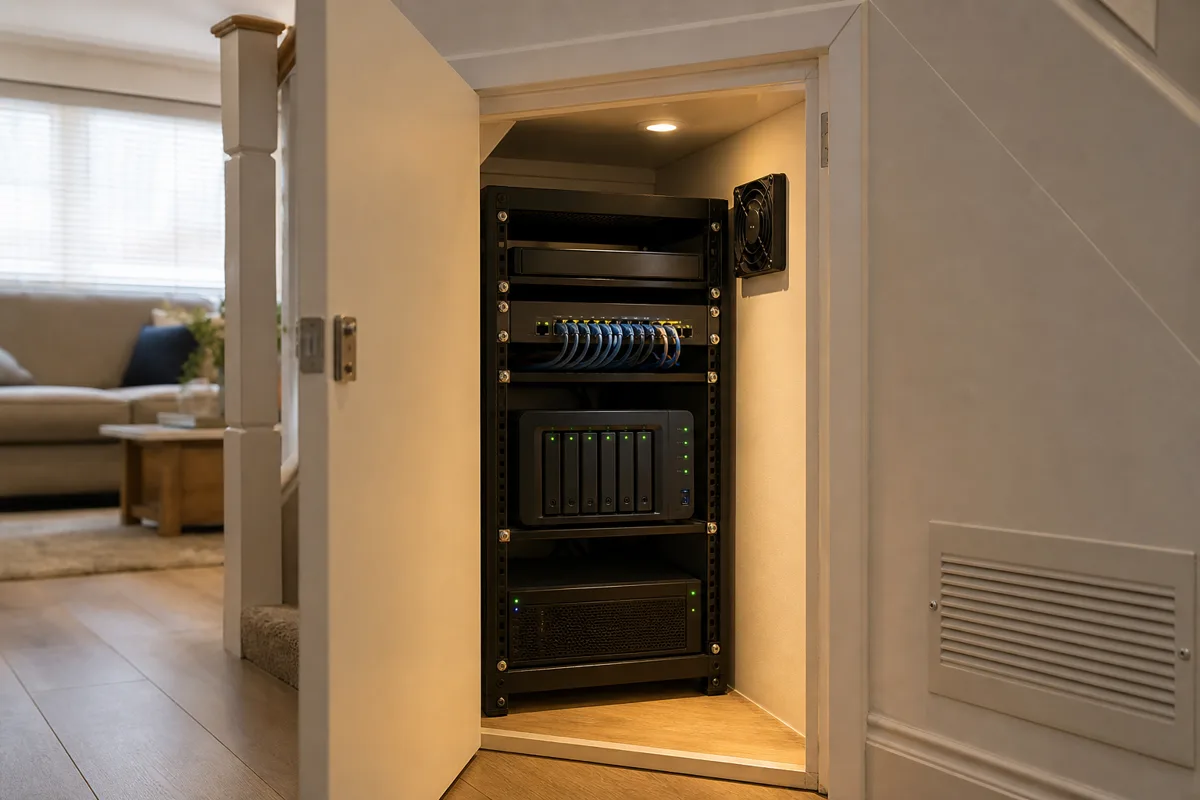
Most home servers do not need air conditioning; they need honest airflow and a location that is not a sealed cupboard. A NAS and a switch drawing under 150 watts can live in a ventilated cupboard with passive vents. A homelab drawing 500 watts to a kilowatt in an enclosed space will creep past safe temperatures in summer, and that is the point where forced extract, relocation, or a small dedicated split becomes worth pricing. Size from the wall-socket draw, fix airflow before buying refrigeration, and remember the loft is the hottest room in the house in July.
Know your actual load
Measure at the plug with a power meter rather than adding up nameplate ratings. A typical NAS idles at tens of watts; a used enterprise server can idle at 100 watts and spike far higher. Whatever the sockets show is the heat entering the space every hour.
Under about 150 watts in a cupboard with high and low vents, natural convection usually copes. From a few hundred watts upward in an enclosed space, temperature rises until something actively moves the heat out.
- Measure watts at the socket; that number is your heat load.
- High and low passive vents beat one big hole for cupboard convection.
- A quiet extract fan on a thermostat solves most sub-500 watt cases.
- Lofts overheat in summer; a loft lab needs a summer plan, not hope.
- Dust filters on intakes save the hardware the fan pulls air across.
The escalation ladder
First, relocate: a garage, hallway or north-facing room may fix the problem free. Second, ventilate: a thermostatically controlled extract fan ducted to another room or outside handles hundreds of watts for pennies. Third, refrigerate: a small split holds a set point regardless of the weather.
The network closet cooling guide covers the business version of the same ladder, and the ventilation versus air conditioning guide explains why fans stop working in heatwaves.
When a small split is the right call
Sustained loads near a kilowatt in an enclosed room, hardware you care about, and a household that will not accept server fans screaming through the summer. A small wall split rated for it holds 24 degrees silently and doubles as heating for the room in winter.
As a 2026 illustration, small single splits installed commonly sit in the low thousands of pounds. Against years of thermal throttling and drive failures, homelab owners with serious kit often decide it is cheap. Continuous duty rating matters if the load runs day and night.
Noise, family politics and quotes
The quietest solution is heat that never enters the living space: garage walls, ducted extracts and sensible hardware choices beat any fan curve tuning. Check outdoor unit siting rules if a split is going on a wall near a neighbour.
Use the quote form with the measured load and a photo of the space. Installers who handle comms rooms will treat a homelab seriously.
Frequently asked questions
Do I need air conditioning for a home server?
Usually not below a few hundred watts of load if the space has real airflow. Measure consumption at the socket, add ventilation first, and consider a small split only for sustained high loads in enclosed rooms or where summer temperatures already push hardware past safe intake limits.
What temperature is too hot for a home server?
Keep intake air below roughly 27 degrees for comfortable margins on modern hardware, and watch drive temperatures rather than CPU alone. If the room sits above 30 degrees for summer weeks, plan proper cooling before the hardware makes the decision for you.
Can I put my homelab in the loft?
Winter yes, summer no without a plan. UK lofts regularly exceed 40 degrees under summer sun, which is beyond safe intake for most equipment. Insulated, ventilated loft rooms differ from raw lofts; measure before committing racks up there.
Core buying guides
Start with these high-intent guides, then dig into the rest of the library.
Related guides
Sources and further reading
How this guide was prepared
This guide was written by the Local AC Installers Editorial Team. We compare official guidance, legislation and established consumer information, separate general information from project-specific advice, and show publication dates and sources. We do not accept installer accreditation claims at face value.