
Short cycling means the compressor starts and stops in short bursts instead of settling into a steady run. On a UK split that can be an oversized unit in a small bedroom, a sensor reading sun or a nearby lamp, a filthy filter, or a protection stop that needs an engineer. Inverter units are allowed to tick over gently. They are not supposed to clank on and off every couple of minutes all afternoon. Note the on and off times, clean the filters, and keep the remote out of direct sun. If the bursts continue, stop. Do not add refrigerant and do not open the gas circuit.
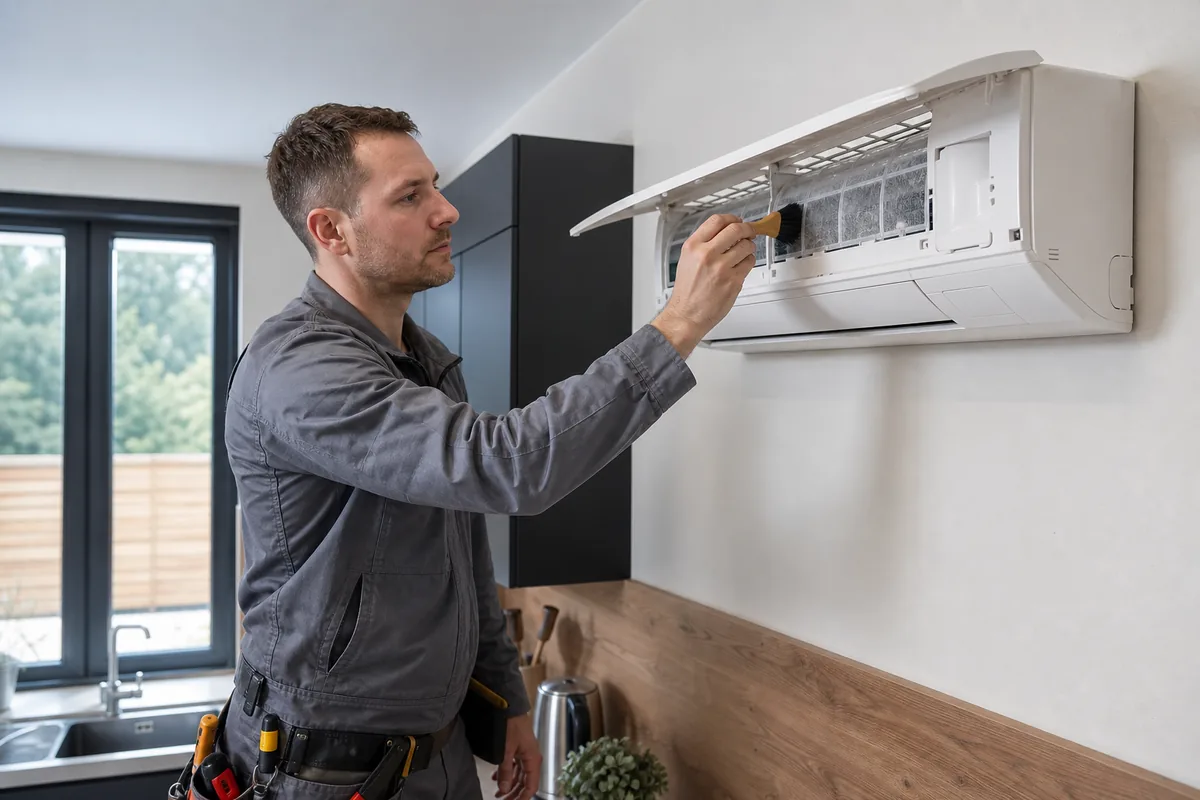
Two minutes on, two minutes off, all afternoon
Time it. A compressor that runs for two minutes, stops for two minutes, and repeats all day is short cycling. A unit that runs for twenty minutes and rests because the room has reached setpoint is doing its job. Inverter models vary compressor speed and can sound as if they surge. That surge is not the same as a hard stop and a fresh start with the usual delay.
Small UK bedrooms with a large nominal capacity reach setpoint almost at once, especially with the door shut and the curtains closed. The kit is then too big for the heat left in the room.
Filters, mode, setpoint, and the stops that are not housekeeping
Wash and dry the filters. Set an explicit cool or heat mode rather than auto on a mild day, because auto can hunt around a British spring temperature. Put the setpoint at a sensible cooling figure, not 16 degrees. Forcing 16 degrees usually makes an oversized unit run longer and can ice a dirty coil. It does not fix oversizing.
Make sure a supply grille or a louvre is not closed. Starved airflow can trip a protection stop that looks like short cycling and can end in ice. Do not change dip switches inside the indoor unit. Do not unplug sensors. Write down how long it runs. That note is the diagnosis.
If it still short cycles after filters, mode and a sane setpoint, book an F-gas engineer. Low charge, a faulty thermistor, or a board fault are instrument jobs. HSE F-gas rules sit behind that limit, and GOV.UK certification is what the company needs. Oversizing is a design fact: the engineer may confirm the unit is simply too big, which is not fixed by gas. Energy Saving Trust describes these air-to-air machines as moving heat, not as something you enlarge by adding refrigerant.
Stop and leave it off if the cycling comes with ice, a burning smell, a tripping breaker, or rapid clicking from the outdoor unit. Do not keep it running to see if it settles. Do not ask for a top-up as the opening move. A survey of airflow, sensor position and the original room load comes before any refrigerant work. Do not open the pipes while you wait.
Day one points at size, a later change points at a fault
Say whether this started on day one or after years of normal running. Day one points at size and sensors. A new pattern after years points at a fault. Note the on and off times and whether the room ever gets comfortable.
Frequently asked questions
Is an inverter unit faulty if the outdoor noise rises and falls?
Not by itself. Inverters change speed. Faulty short cycling is a full stop and a restart in short, repeated bursts. Note the pattern before you assume the compressor is failing.
Will a lower setpoint stop the cycling?
Forcing 16 degrees usually makes an oversized unit run longer and can ice a dirty coil. It does not fix oversizing. Use a normal setpoint and let an engineer judge the capacity.
Could short cycling mean the gas is low?
It can, among other causes. Only an F-gas engineer should test that. Adding refrigerant because the unit stops and starts will not correct a sensor or a unit that is too big for the room.
Why does the room sensor disagree with the handset?
On many splits the indoor unit measures the return air. A sensor that sees a sun patch, a lamp, or heat from a TV can satisfy and stop while the rest of the room is still warm. The handset's temperature is not always the sensor that matters. Keep the remote, if it has its own sensor, off the windowsill.
Core buying guides
Start with these high-intent guides, then dig into the rest of the library.
Related guides
Sources and further reading
How this guide was prepared
This guide was written by the Local AC Installers Editorial Team. We compare official guidance, legislation and established consumer information, separate general information from project-specific advice, and show publication dates and sources. We do not accept installer accreditation claims at face value.