
Inverter air conditioning changes compressor speed to follow the room, instead of running flat out and then stopping. Nearly every mainstream UK wall split quoted for a house now works this way. You get a steadier temperature, lower electricity use at part load, and usually a quieter indoor fan once the room is near the setpoint. Inverter control does not replace a survey. Too little capacity still fails on a hot afternoon, and a wild oversize can still hunt if the room and the controls are a poor match.
Full speed or a changing speed
A fixed-speed compressor is either delivering its full output or it is off. The room warms, the machine starts, the room overshoots, the machine stops. An inverter compressor speeds up and slows down. When the room is close to the setpoint it ticks over. When you come home to a hot house, or when the evening sun hits the glass, it climbs toward full output. That behaviour is already baked into SEER and SCOP, because seasonal tests spend a lot of time away from full load. The badge and the inverter are related. They are not the same decision as choosing 2.5 kW or 5 kW. Energy Saving Trust's air-to-air guidance is the plain account of equipment that moves heat this way.
Bedrooms, patio doors and outdoor noise
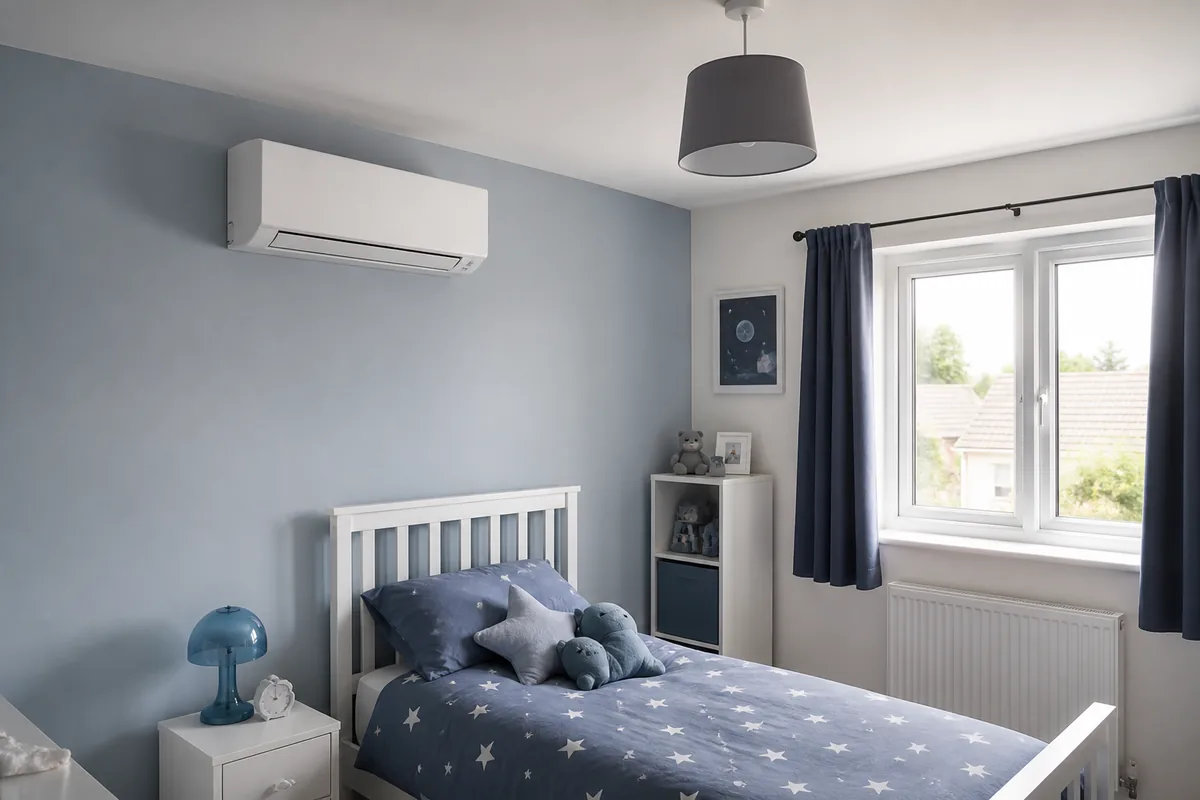
In a bedroom the useful result is fewer blasts of cold air and a fan that can stay on a low speed overnight. In a living room with patio doors the useful result is the ability to push harder for an hour and then settle. Heating mode in a damp winter uses the same idea: the unit modulates, and it will still pause now and then to clear frost from the outdoor coil. Noise follows fan speed and compressor speed, plus how the outdoor unit is mounted. An inverter indoor quoted at a very low decibel figure can still disappoint if the outdoor unit is bolted to a bedroom wall with no isolation. Read the sound data for both ends.
The minimum, the maximum and the survey
An inverter has a minimum and a maximum. Below the minimum it may cycle anyway. Above the maximum it simply cannot hold the room, however clever the drive is. Glass, roof lights, cooking, people and the floor above a hot flat all sit outside the slogan on the box. The survey should state cooling capacity and heating capacity at a stated outdoor temperature, not only the inverter badge. Two inverter quotes for the same lounge can still be a 3.5 kW machine and a 5 kW machine. Compare those figures before you compare fascia colours.
Frequently asked questions
Are all new UK splits inverter models?
Most domestic and light-commercial splits quoted now are inverter machines. Treat it as the normal specification and still read the model code. A leftover fixed-speed unit is a different product.
Does inverter mean I can buy a smaller unit?
No. Modulation helps at part load. Peak load on the hottest afternoon still has to sit inside the unit's maximum output. Undersize shows up in a heatwave, not on a mild June evening.
Will an inverter heat a UK house in January?
Many reverse-cycle inverter splits will heat well in typical British winters, with output falling as the outdoor air gets colder and with pauses for defrost. Ask for heating capacity at a low outdoor temperature, and keep a plan for the coldest nights if the house has no other heat.
Who commissions the refrigerant side?
Ask who commissions the system. Refrigerant work belongs to a firm with F-gas certification. GOV.UK publishes the certification rules for companies working on equipment that contains F-gas. The inverter label does not change that.
Does the inverter label settle outdoor permission?
No. Outdoor siting still needs a planning check. The Planning Portal explains permission for air source heat pumps used as heating plant. A cooling condenser on a flat, a listed house or a tight terrace is a site-specific question, and the inverter label does not answer it. Ask for the operating range as well: the lowest outdoor temperature for heating and the highest for cooling.
Core buying guides
Start with these high-intent guides, then dig into the rest of the library.
Related guides
Sources and further reading
How this guide was prepared
This guide was written by the Local AC Installers Editorial Team. We compare official guidance, legislation and established consumer information, separate general information from project-specific advice, and show publication dates and sources. We do not accept installer accreditation claims at face value.