
Office air conditioning should be designed around people, solar gain, equipment and changing occupancy rather than a single thermostat target. Employers must provide a reasonable indoor temperature and assess heat as a workplace risk, but UK law does not set a maximum workplace temperature. Good results combine heat-gain reduction, adequate fresh air, sensible zoning, clear controls and a maintenance plan.
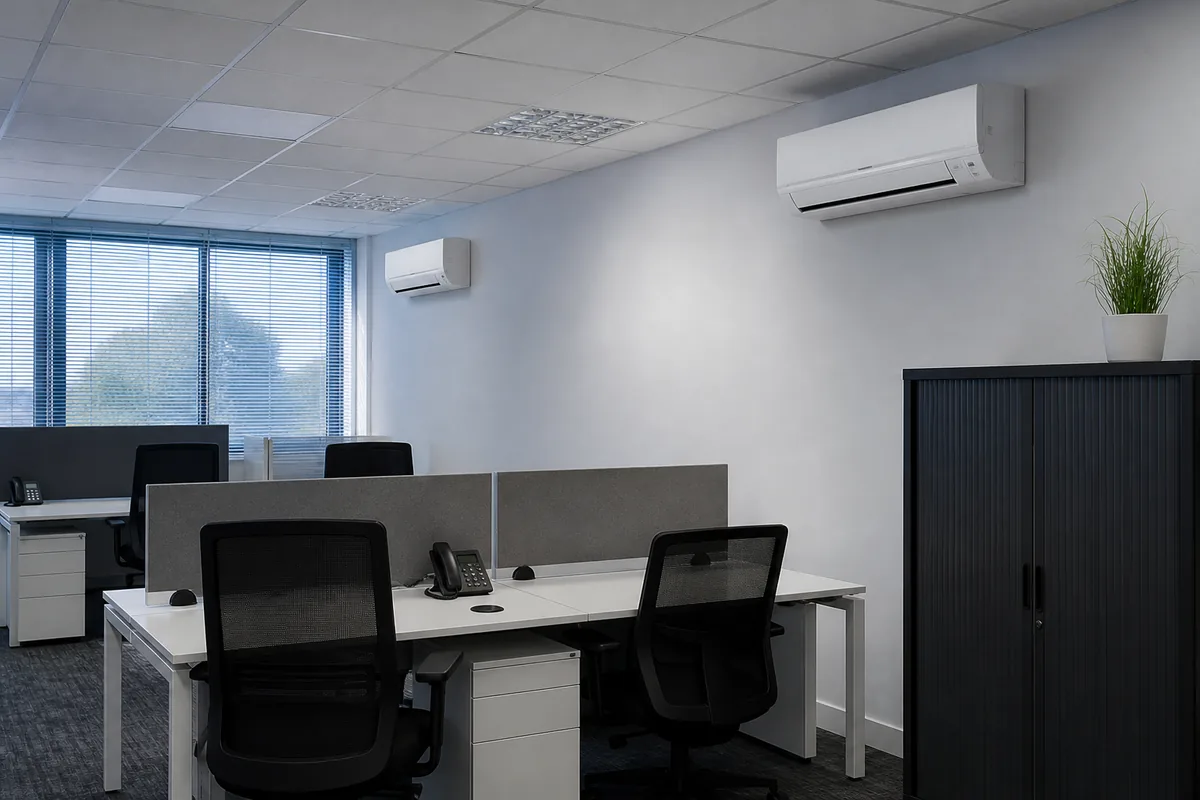
Treat temperature as a workplace risk
The Health and Safety Executive states that employers must provide a reasonable indoor temperature and assess risks from heat. There is no statutory maximum workplace temperature because suitable conditions depend on the work, clothing, humidity, radiant heat, air movement and individual needs. A temperature reading alone therefore does not settle whether conditions are reasonable.
Consult staff and examine patterns of discomfort. Persistent afternoon overheating beside west-facing glazing may need shading and zoning, while complaints in one meeting room may relate to occupancy and poor air distribution. Controls can include blinds, drinking water, altered working patterns and local measures as well as mechanical cooling.
Separate cooling from fresh-air ventilation
Split and variable refrigerant systems commonly recirculate room air. They can lower temperature but do not necessarily introduce outdoor air or remove pollutants at the rate an occupied office requires. Existing natural or mechanical ventilation should be assessed as part of the design, particularly in densely used meeting rooms.
Opening windows may help in some buildings, but external noise, air quality, security and high outdoor temperatures can limit its value. A competent designer should explain the proposed ventilation strategy, how it interacts with cooling, and whether controls could accidentally make the systems work against each other.
- Map normal desk occupancy and peak meeting-room occupancy.
- Check outdoor-air provision independently of cooling capacity.
- Locate sensors away from direct sun, draughts and heat-producing equipment.
- Avoid placing supply air where it creates persistent cold draughts.
Zone for hybrid and varied use
Hybrid working makes broad, inflexible zones wasteful. Reception, meeting rooms, server cupboards and open-plan areas often need different schedules and set points. Controls should allow authorised local adjustment within sensible limits while preventing simultaneous heating and cooling.
Specify timers, occupancy scheduling, holiday modes and central visibility where these suit the organisation. Simple user guidance matters: unexplained icons and unrestricted set points often lead to windows being opened while cooling runs, or systems being left on overnight.
Commission, monitor and maintain
Commissioning should test temperatures, airflow, controls, condensate drainage and operation under representative conditions. Record the agreed settings and revisit them after staff have occupied the space. Seasonal fine-tuning can resolve complaints without replacing equipment.
Filters and heat exchangers need routine attention to preserve airflow and efficiency. Keep faults, refrigerant work and energy use under review. Where one person controls multiple air conditioning units in a building, those units are treated as components of one system for the regulations. Establish whether that system's effective rated output exceeds 12 kW and who must arrange the applicable inspection.
Frequently asked questions
Is there a legal maximum office temperature in the UK?
No. HSE says there is no maximum workplace temperature in law, but employers must provide a reasonable indoor temperature, assess heat risks and act on findings.
What thermostat setting should every office use?
There is no single setting suitable for every office. Activity, clothing, humidity, air movement and building conditions affect comfort. Stable, agreed settings and limited local adjustment are generally more useful than frequent large changes.
Can air conditioning solve a stuffy meeting room?
Cooling may reduce temperature, but stuffiness can indicate insufficient outdoor-air ventilation. Ask for ventilation and occupancy to be checked separately.
How should an office handle hot-weather complaints?
Record where and when problems occur, consult workers, assess vulnerable individuals and apply proportionate controls. HSE guidance provides a framework, but a competent occupational health or building-services adviser may be needed for complex cases.
Core buying guides
Start with these high-intent guides, then dig into the rest of the library.
Related guides
Sources and further reading
How this guide was prepared
This guide was written by the Local AC Installers Editorial Team. We compare official guidance, legislation and established consumer information, separate general information from project-specific advice, and show publication dates and sources. We do not accept installer accreditation claims at face value.