
An air conditioning contractor is the company that takes responsibility for the job: survey, equipment, refrigerant pipework, commissioning, servicing, repairs and safe recovery of the refrigerant when a system comes out. In Great Britain the company must hold an F-gas company certificate from an approved body (Refcom, the F-Gas Register run by Quidos, or Bureau Veritas) and each engineer who handles refrigerant needs a personal F-gas certificate. You can check the company on the certification body's register in a few minutes, and for building regulations work in England and Wales, look for a competent person scheme such as BESCA, NICEIC or NAPIT.
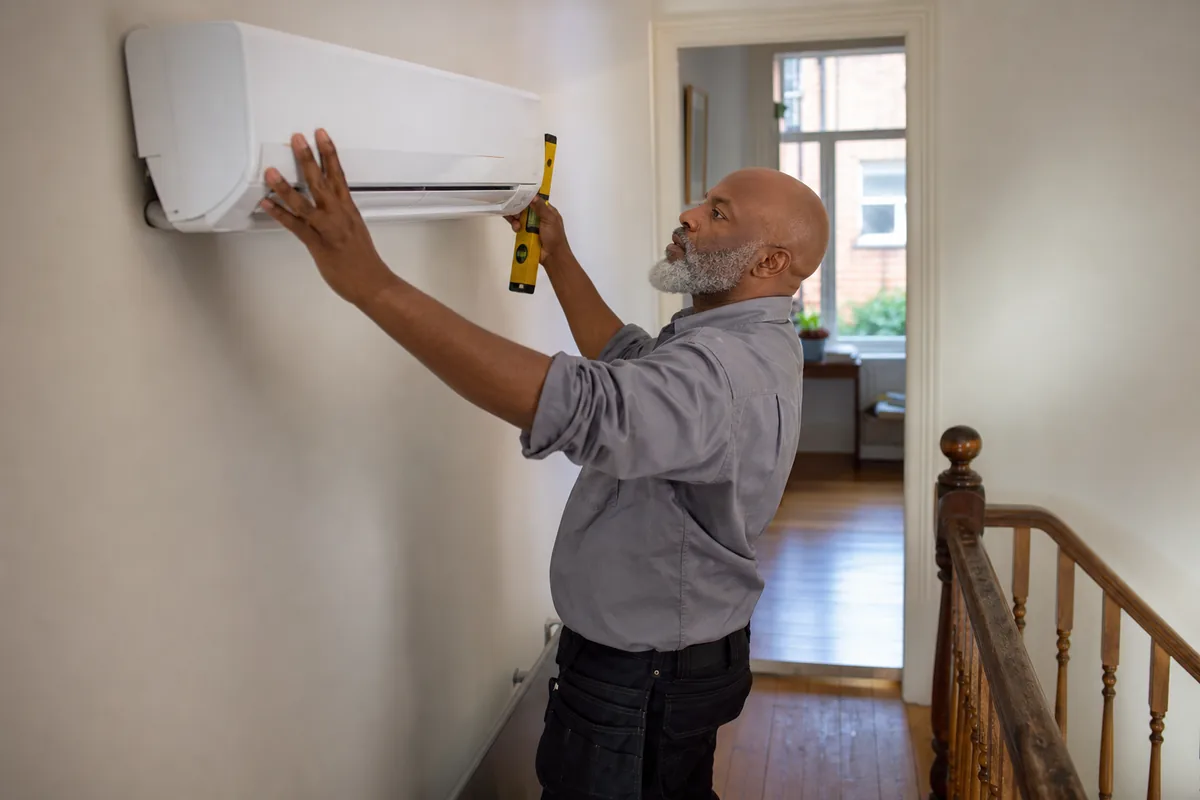
What an air conditioning contractor does
Search pages mix contractor, installer, fitter and engineer. The contractor is the firm you sign with and the one responsible for the work. The engineer is the person on the tools, who may be an employee or a subcontractor. On a bedroom split they are often the same small company. On a shop, office or server room the contractor may bring in an electrician and a builder and still own the refrigerant circuit.
The trade that installs air conditioning is refrigeration and air conditioning, often written RACHP (refrigeration, air conditioning and heat pumps). The government apprenticeship for it, the Refrigeration Air Conditioning and Heat Pump Engineering Technician standard on Skills England, describes the job as installing components, routine maintenance, reactive service, commissioning and decommissioning, with typical job titles including air conditioning engineer, commissioning engineer and service engineer. A general plumber or electrician is not the same trade, though an electrician often supplies the circuit.
In practice a full-service contractor covers five jobs: install (survey, mounting, pipework, drain, electrics or the electrician who does them), commission (pressure test, vacuum, refrigerant charge, a working check), service (filters, coils, drains and the leak checks larger systems need), repair (faults, leaks, parts), and recovery (taking refrigerant out safely when a unit is moved or scrapped). Ask which of these a firm does itself. Some only install and pass servicing to someone else.
| Type | Usual work | Ask for |
|---|---|---|
| Domestic installer | Wall splits, multi-splits in homes | F-gas company certificate, written quote with model codes |
| Commercial contractor | Offices, shops, VRF, cassettes | F-gas certificate, leak-check and TM44 plan, insurance |
| Service contractor | Maintenance, repairs, leak checks | Who keeps the F-gas records, call-out terms |
| Electrician only | Supply circuit and isolator | Competent person scheme, electrical certificate |
The legal checks: F-gas company and personal certificates
GOV.UK guidance on certification for companies working on equipment containing F gas says your company, including a sole trader, must be certified by an approved body to install, repair, maintain or decommission stationary equipment containing F gas that other people operate, and air conditioning is named. A firm that only services its own equipment does not need it. The approved bodies listed for stationary refrigeration, air conditioning and heat pumps are Refcom Certification Ltd, the F-Gas Register (Quidos) and Bureau Veritas UK Ltd. The rules sit in the Fluorinated Greenhouse Gases Regulations 2015 on legislation.gov.uk.
The company certificate is not enough on its own. GOV.UK's qualifications page says anyone working on equipment containing F gas needs their own qualification, even if they work for someone else. For stationary air conditioning, category 1 covers all activities, category 2 covers installing and servicing smaller systems (under 3kg of F gas, or under 6kg if hermetically sealed), and categories 3 and 4 cover recovery and leak checks only. The F-gas certification guide covers this in full.
Ask for both: the company certificate number and the engineer's personal certificate. If a category 4 holder turns up to install, that is the wrong person for the job. GOV.UK says work without the right certification is against the law and can lead to a civil penalty, and gives f-gas-support@environment-agency.gov.uk for reporting it.
Building regulations: electrics and competent person schemes
GOV.UK's page on when you need building regulations approval lists putting in a fixed air-conditioning system, and some electrical work, among jobs that may need approval. It also says you do not need to get approval yourself if you use someone registered with a competent person scheme. In England that means electrical work in a home (the Part P rules) is either done by a scheme member who self-certifies it, or notified to building control.
GOV.UK's list of current competent person schemes (last updated 17 September 2026) names BESCA, Blue Flame Certification, Certsure (trading as NICEIC) and NAPIT for air conditioning and mechanical ventilation, and BESCA, Blue Flame Certification, Certsure, NAPIT and OFTEC for fixed low or extra-low voltage electrical installations in homes. Wales keeps its own list on GOV.WALES, which names BESCA, NAPIT, Blue Flame Certification, Certsure and Stroma for ventilation and air conditioning. Scotland and Northern Ireland run different building control systems, so ask the contractor and the council there.
Many air conditioning firms are not electrical scheme members and bring in an electrician for the supply. That is fine. What matters is that someone named on the quote provides the electrical certificate at the end, and that the person doing the electrics is registered or the work is notified.
How to look a contractor up on each register
Refcom register (refcom.org.uk/refcom-register): choose one search, either the company name or a postcode with a radius of 5, 10, 25 or 50 miles, and press Search. Results list the company, postcode, distance, town and whether it holds Refcom F-Gas and Refcom Elite, with a View details link for the address, phone and email. If nothing shows, the page says to try changing the search criteria. Search the exact limited company name from the quote, not the trading name on the van.
F-Gas Register (Quidos): its website, fgasregister.com, links to a company directory. That directory would not load for us when we checked on 27 November 2026, so if it fails for you, ask the contractor for the certificate number and phone the F-Gas Register to confirm it. Bureau Veritas certificates are checked the same way, through the contact details GOV.UK gives. A firm that will not give a certificate number has told you something.
Competent person schemes in England and Wales: the Front Door search at labcfrontdoor.co.uk/find-a-competent-person (the old competentperson.co.uk address now redirects there) takes a full postcode, an optional business name and a trade from a drop-down, which includes VentilationAirCon and Electrics, then Find a Competent Person. Electricians are also on the Electrical Competent Person Register that GOV.UK links to. BESCA has its own Find a BESCA Member directory on besca.org.uk.
The site's installer checks page sets out the same checks as a list you can work through with any firm, including the ones we introduce. If a quote request through this site puts you in touch with a contractor, the register search is still yours to run.
| Check | Where | Search by | Proves |
|---|---|---|---|
| F-gas company | Refcom register | Name, or postcode and radius | Refcom F-Gas or Elite listed |
| F-gas company | F-Gas Register, Bureau Veritas | Certificate number, by phone | Certificate held with that body |
| F-gas personal | Engineer's card | Category on the card | Can handle refrigerant on that system |
| Building regs | LABC Front Door | Postcode, name, trade | Can self-certify notifiable work |
| Trade body | BESA member search | Company name or letter | BESA member, audited under CAS |
Trade bodies: what FETA and BESA membership does and does not mean
BESA, the Building Engineering Services Association, is the trade association for building engineering services contractors. Its Competence Assessment Standard is described on BESA's site as a mandatory audit of members' technical competence and commercial capability, made up of a business management review and a technical audit, done when a firm joins, again at the end of the first year and then every three years. Its Find a BESA Member search works by company name or by first letter. BESA's group also runs Refcom and the BESCA competent person scheme, which are separate certificates.
FETA, the Federation of Environmental Trade Associations, says it represents over 400 manufacturers, suppliers, installers and contractors through associations such as the British Refrigeration Association, HEVAC and the Heat Pump Association. Many FETA members are makers and distributors rather than installers. FETA's home page links to a members directory but does not describe membership standards, so treat FETA membership as a sign of an engaged business, not as a check on the person drilling your wall.
Refcom Elite is a voluntary scheme above the mandatory Refcom F-gas certificate. BESA describes it as a best practice registration for refrigerant management and a mark of distinction, unlike mandatory F-gas certification. It is a plus point. Neither trade body membership nor Elite replaces the legal F-gas company certificate, and none of them guarantees your particular job. Citizens Advice says to check that a trader really is a member of any scheme or association they claim, using the scheme's own website.
Commercial air conditioning contractors vs domestic installers: what changes
For a home, the contractor's job is mostly the install, the electrics, the drain, planning and noise checks, and the warranty registration. Flats add a freeholder or managing agent. Planning Portal guidance in England is the starting point for outdoor units, and the contractor can advise but the consent sits with you and the council where it applies.
For a business, the owner or operator carries duties of its own. GOV.UK guidance on checking F gas equipment for leaks says the duty to prevent leaks is shared between the equipment user and the service technicians, and the user needs checks at least every 12 months for systems from 5 to under 50 tonnes of CO2 equivalent, at least every 6 months from 50 to under 500 tonnes, with intervals doubled where automatic leak detection is fitted. A commercial contractor should tell you which band each system sits in and who keeps the records.
Larger systems also need a TM44 energy inspection. GOV.UK's guide to air conditioning inspections says systems with an effective rated output above 12kW must be inspected by an accredited energy assessor at least every 5 years, with a £300 penalty charge for not having a report. Ask whether the contractor arranges this or whether it is a separate appointment. When people search for commercial air conditioning companies, this paperwork is what separates a contractor from a fitter.
Red flags
Most warning signs come from Citizens Advice's guidance on getting building work done, with the F-gas ones added from GOV.UK. Any one of them is a reason to slow down and ask.
- No F-gas company certificate number, or a name that does not match the register
- The engineer cannot show a personal F-gas certificate, or holds only category 4 for an install
- Nothing in writing, a verbal price only, or a price far below the others
- Cash only, or full payment up front (Citizens Advice says keep any deposit low and no more than 25%)
- Only a mobile number, and no full contact details you can ring to check
- No electrical certificate offered, and no named electrician or scheme
- A claim to belong to a scheme or trade body that the body's own search does not show
What a good quote lists
Citizens Advice says a quote is a fixed price, so you know what you are getting, while an estimate is a rough guess. It says to get written quotes from at least three traders and that a quote should give a fixed total, a breakdown of work and materials, how long the price is valid, whether VAT is included and when the price could change. For air conditioning, add the items below. The quote-lines guide on this site is the longer checklist, and the quote checker tool runs the same checks on a quote you already have.
Programme matters as much as kit. Write the survey date and the install window into the acceptance. Payment should track the work: Citizens Advice suggests staged payments, paying by card where you can, and getting a receipt for any deposit. The balance belongs after commissioning, when you have felt the unit run and received the warranty and electrical paperwork. If you are comparing two contractors, level the scopes before the totals; the compare-quotes guide is that exercise.
- Company name that matches the F-gas register, and the certificate number
- Indoor and outdoor model codes, cooling and heating capacity
- Pipe length included, and the rate for extra
- Electrical supply and isolator: who does it and who certifies it
- Condensate by gravity or pump, and making good around the core hole
- Commissioning record and who registers the manufacturer warranty
- Servicing and call-out terms after the first year
After the invoice
A contractor earns the word by coming back. Filters, a noisy fan in year three, a drain that weeps in pollen season: the firm that fitted it is the first call, and the contract should say how that call is charged once the snagging period ends. The servicing cost guide is the national picture.
Keep the commissioning sheet, the model codes, the F-gas certificate number and the electrical certificate together. A future buyer, a warranty desk and the next engineer all ask for the same bundle. The company that emails it without being chased is the company you wanted on day one.
Frequently asked questions
Which trade installs air conditioning?
A refrigeration and air conditioning engineer, often called an RACHP or air conditioning engineer, working for an F-gas certified company. An electrician may supply the circuit. A general plumber is not the same trade.
Is a contractor the same as an installer?
On a small domestic job, often yes: one company surveys and fits. On larger work the contractor may coordinate other trades and still own the refrigerant circuit. Ask which legal entity invoices you and which one is F-gas certified.
How do I check an air conditioning contractor is F-gas certified?
Ask for the company certificate number and which body issued it. For Refcom, search the Refcom register by company name or postcode. For the F-Gas Register (Quidos), use its directory if it loads, or phone the body with the certificate number. For Bureau Veritas, use the contact details GOV.UK lists.
Does BESA or FETA membership mean a contractor is qualified?
BESA says its contractor members pass a Competence Assessment Standard audit every three years after the first. FETA is a federation of trade associations, many of them manufacturers. Neither replaces the legal F-gas company certificate.
Who should I phone when it stops cooling?
The contractor who commissioned it, first. They know the model, the pipe run and the warranty.
Can I supply the unit and hire a contractor only for labour?
Some firms will. Many will not warranty a unit they did not supply. If you buy the unit yourself, get the labour, the registration and the warranty position in writing before the hole is drilled.
Do you send the contractor?
We introduce local installers for the postcode and the job. The contract is between you and the company you appoint. Check certification, insurance and the written scope yourself.
Core buying guides
Start with these high-intent guides, then dig into the rest of the library.
Related guides
More installation guides
Sources and further reading
- GOV.UK: Certification for companies working on equipment containing F gas (checked 27 Nov 2026)
- GOV.UK: Qualifications required to work on equipment containing F gas (checked 27 Nov 2026)
- legislation.gov.uk: The Fluorinated Greenhouse Gases Regulations 2015 (checked 27 Nov 2026)
- GOV.UK: Checking F gas equipment for leaks (checked 27 Nov 2026)
- GOV.UK: A guide to air conditioning inspections for buildings (checked 27 Nov 2026)
- GOV.UK: Competent person schemes, current schemes (checked 27 Nov 2026)
- GOV.UK: Building regulations approval, when you need approval (checked 27 Nov 2026)
- GOV.WALES: Building work competent person schemes (checked 27 Nov 2026)
- Refcom register (checked 27 Nov 2026)
- The F-Gas Register (checked 27 Nov 2026)
- LABC Front Door: Find a competent person (checked 27 Nov 2026)
- BESCA (checked 27 Nov 2026)
- BESA: Find a BESA member (checked 27 Nov 2026)
- BESA: The Competence Assessment Standard (checked 27 Nov 2026)
- BESA: Taking your business from compliance to excellence with REFCOM Elite (checked 27 Nov 2026)
- FETA: Federation of Environmental Trade Associations (checked 27 Nov 2026)
- Skills England: Refrigeration air conditioning and heat pump engineering technician (checked 27 Nov 2026)
- Citizens Advice: Before you get building work done (checked 27 Nov 2026)
- Planning Portal: air source heat pumps (checked 27 Nov 2026)
How this guide was prepared
This guide was written by the Local AC Installers Editorial Team. We compare official guidance, legislation and established consumer information, separate general information from project-specific advice, and show publication dates and sources. We do not accept installer accreditation claims at face value.