
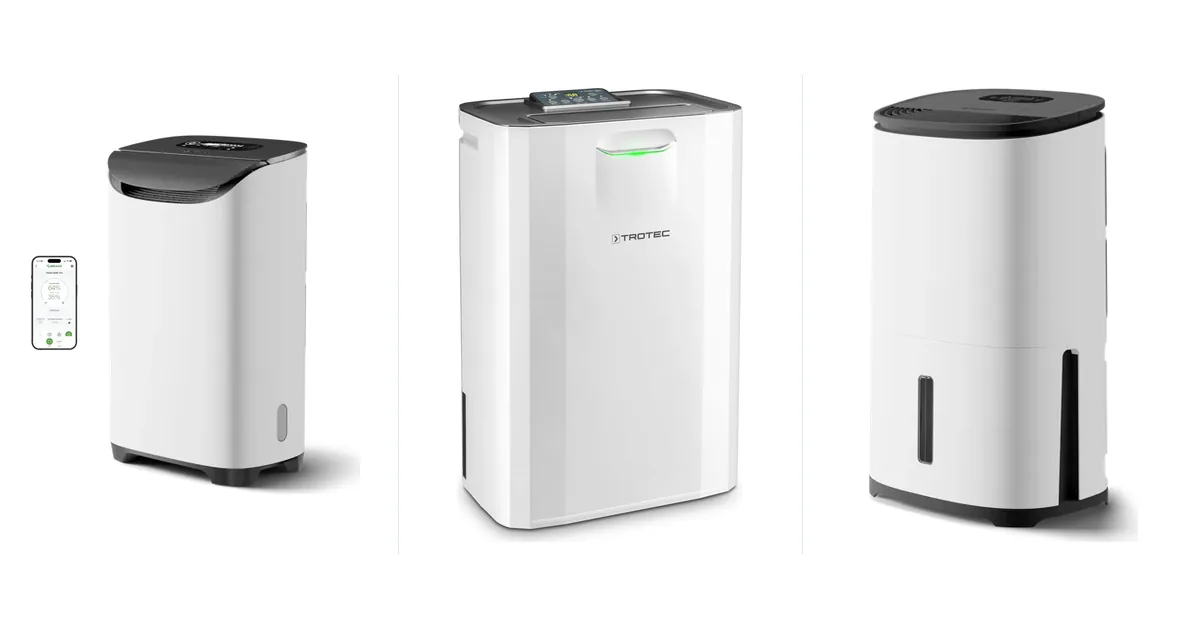
A dehumidifier is the right fix for a cellar or basement whose damp comes from the air: condensation, a musty smell, or slow drying of old brick or stone walls. It is the wrong fix when water is coming in, as puddles, running walls or a tide mark after rain, because that water has to be stopped with drainage repairs or a waterproofing system designed to BS 8102. Most cellars stay cold all year, so choose by temperature: Trotec's guidance is a desiccant model where the average is below 8°C, and at 10°C Meaco rates its desiccant DD8L Pro at 6.89 litres a day against 3.4 litres for its "20 litre" compressor Arete One. Plan a hose drain or pump from the start, because the tank fills while nobody is down there. The sections below cover where cellar damp comes from, what the BS 8102 grades mean as published guides describe them, how to size and drain a machine, and three picks on makers' figures.
Where the water in a cellar comes from
A cellar sits below the ground around it, so its walls and floor are in contact with wet soil all year. In the Building Conservation Directory, surveyor Geoff Maybank lists the usual sources: a fluctuating water table, leaking land drains, sewers or nearby streams, leaks from services inside the house, and condensation from the air inside. He also says an old cellar that was never damp-proofed will always be slightly damp compared with a modern tanked one, and that expecting a modern standard of dryness from an 18th-century cellar misses the point.
For choosing a fix, those sources fall into two groups. Water that comes in as liquid, from the ground or a leak, has to be stopped or drained at the source. Water that is already in the air, from condensation, evaporation off damp masonry, washing hung to dry or a tumble dryer, is what a dehumidifier removes.
- Likely a dehumidifier job: musty smell, condensation on cold pipes or walls, damp patches that come and go with the weather and the season, stored things going mouldy.
- Likely not: standing water, water running down a wall, wet patches that grow after rain, tide marks, a floor that is wet rather than damp, or a sump that fills.
Why airing a cellar in summer can make it wetter
Cellars are often coldest relative to the outside air in summer, and opening their windows on a warm, humid day brings water in. Using the Magnus formula published by the National Physical Laboratory, outdoor air at 20°C and 70% humidity holds about 12.1 g of water per cubic metre and has a dew point of about 14.4°C. Cool that air to 13°C in the cellar and it is saturated: air at 13°C can hold only about 11.3 g per cubic metre, so the rest condenses. Any wall or pipe at 11°C, below the dew point, gets wet.
The temperatures are our illustration, not measurements, but the effect is why cellars often feel wettest in summer. On warm humid days keep cellar windows shut and let a dehumidifier do the drying; ventilate on cool, dry days instead.
| Air temperature | Humidity the same air reaches | Water it can hold at 100%, g/m³ |
|---|---|---|
| 20°C | 70% | 17.2 |
| 17°C | 84% | 14.4 |
| 15°C | 96% | 12.8 |
| 13°C | 100% | 11.3 |
| 11°C | 100% | 10.0 |
When the answer is waterproofing, not a dehumidifier
BS 8102 is the British Standard code of practice for protecting below-ground structures against water from the ground. The standard itself is sold by BSI, so this section describes it from published summaries by waterproofing firms and industry bodies, not from the text.
It grades a basement by how dry the finished space has to be. Heidelberg Materials UK's summary of the 2009 edition describes Grade 1 (basic utility, such as car parks and plant rooms) as some seepage and damp areas tolerable depending on use; Grade 2 (better utility, such as storage and workshops) as no water penetration, with ventilation possibly required; and Grade 3 (habitable rooms, offices, restaurants) as no water penetration and a totally dry environment. Writing in PBC Today on the 2022 edition, Peter Cox's national waterproofing manager says Grade 1 is now split into 1A, where seepage and damp areas are tolerable, and 1B, where seepage is not tolerated but damp areas are, with further definitions added to Grades 2 and 3.
The Property Care Association, writing to BSI in 2019 when the revision was being prepared, quoted the Grade 3 wording as no water penetration acceptable, with ventilation, dehumidification or air conditioning appropriate for use. So a dehumidifier has a place even in a fully waterproofed habitable basement, but as the way the air is kept dry, not as the way water is kept out.
The same summaries describe three types of protection. Type A is a barrier applied to the walls and floor, often called tanking. Type B is a structure that is itself watertight, such as concrete with waterproofing additives. Type C is a cavity drain membrane: a dimpled sheet that lets water in behind it and leads it to a sump and pump or a land drain. Maybank's article warns that internal tanking leaves the damp in the wall and only stops it affecting the room, and that older buildings may need listed building consent.
- Water coming in: get a survey from a specialist in structural waterproofing before buying anything. A cellar used only for storage may need much less than one being turned into a bedroom.
- A Type C system already has a sump pump. Ask the installer whether a dehumidifier's drain hose can run into the sump, which saves a second pump.
Sizing a cellar dehumidifier by volume and temperature
Start with the volume. A cellar of 4 m by 5 m with a 2.2 m ceiling is 20 m² and about 44 cubic metres. Trotec rates the TTR 57 E for rooms up to 20 m² or 50 m³, so that example sits at the top of its range. Trotec also advises checking a maker's room-size claim against the machine's air flow and power, because a small fan cannot move a large room's air through the machine often enough.
Then the temperature. The air itself holds little water: at 10°C and 80% humidity our example cellar's air holds about 330 g, and at 60% about 248 g, a difference of about 83 g, which the DD8L Pro's 10°C rate of 6.89 litres a day would remove in about 17 minutes. The litres come from the walls, floor and anything stored down there, which can keep releasing moisture long after the air itself is dry. What matters is how much the machine removes at cellar temperature, and that is far below the box figure. At 10°C, Meaco rates the Meaco DD8L Pro at 6.89 litres a day, its compressor MeacoDry Arete One 20L at 3.4 litres, and Dimplex rates its EverDri20EL at 2.8 litres. Our garage dehumidifier guide has the full 10°C table with running costs.
Then pick the type by the cellar's winter temperature. Trotec recommends a desiccant model where the average is below 8°C, says a compressor model can work from 8°C but needs hot gas defrost below 15°C, and says a desiccant model stops making economic sense above about 12°C. Measure with a thermometer-hygrometer for a week or two of cold weather before you choose.
- Unheated cellar used for storage, below 8°C in winter: desiccant.
- Cellar that sits between 8°C and 15°C: a compressor model with hot gas defrost, or a desiccant model if it often drops lower.
- Converted or heated basement at 15°C or more: a compressor model, which uses less electricity per litre.
Draining it: the tank, a hose or a pump
In a cellar the tank fills quickly and nobody notices. At 10°C the Meaco DD8L Pro on top speed fills its 2 litre tank in about 7 hours, and the MeacoDry Arete One 20L fills its 4.8 litre tank in about 34 hours. Then the machine stops: Dimplex's manual, for example, says the compressor stops when the tank is full.
A continuous drain hose solves that only if the water can run downhill. Dimplex's manual says the open end of the drain hose must be lower than the machine's drain outlet so the water drains freely. In many cellars the nearest drain is at ground level or above, higher than the machine, so the options are:
- A floor gully or sump in the cellar itself, lower than the outlet: a plain hose works. Stand the machine on a sturdy base to gain height if needed.
- A Type C waterproofing sump: ask the installer whether the hose can run into it.
- No drain below the machine: a condensate pump that lifts the water to a drain above, or emptying the tank by hand. Check the pump suits the litres a day the dehumidifier will produce.
- Hose through an outside wall: keep it from freezing. Dimplex's manual says to protect the drain hose in very cold weather.
Running costs and setting it
At the Ofgem price cap of 26.32p per kWh, the Meaco DD8L Pro costs about 17p an hour on top speed and the MeacoDry Arete One 20L about 5p an hour at 10°C. The cap rises to 32.69p per kWh from 1 January 2027. Set the humidistat rather than running it flat out: once the cellar is dry, the machine runs only as often as moisture comes back. Trotec gives 80% humidity as the level at which metal corrodes; a storage cellar kept well below that protects tools, bikes and boxes without drying it harder than it needs.
Our dehumidifier running cost guide has the same sums for every model we hold figures for. If you need a cellar dried once, after a leak or a flood, our dehumidifier hire guide compares hire rates for the larger dryers that drying and restoration firms use.
If a dehumidifier is the right fix: three to consider
These are the same models as our garage dehumidifier picks, because a cellar is cold for the same reasons. Picked on what the makers say each removes in cold air and the lowest temperature it is rated for, read on 29 November 2026. We have not tested them.
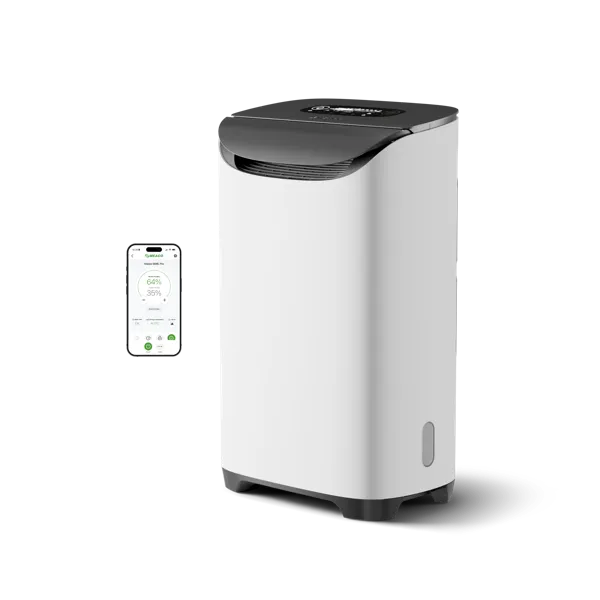
Cold cellar, the best published 10°C figure
Meaco DD8L Pro
6.89 litres a day at 10°C and 60% on top speed, 630 W, rated from 1°C
About 17p an hour on top speed. Its 2 litre tank fills in about 7 hours at that rate, so set up the hose drain.
Check price on AmazonPhoto: Meaco
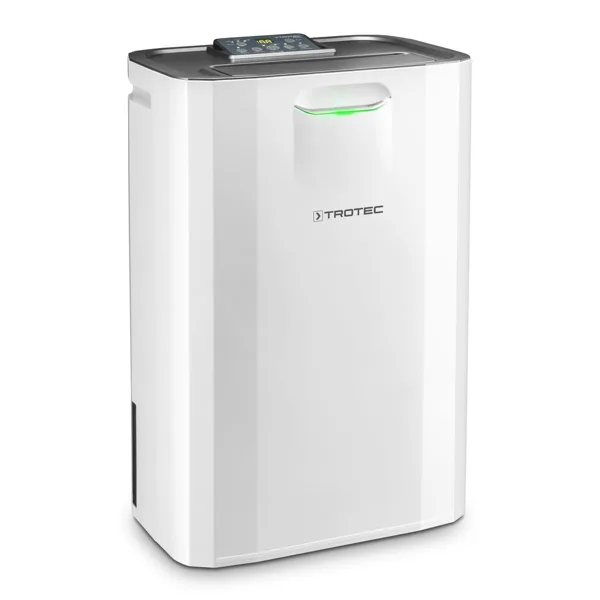
Cold cellar up to 50 m³
Trotec TTR 57 E
8.5 litres a day at 30°C and 80% humidity, 730 W, rated from 1°C, 5 litre tank
About 19p an hour while running. Trotec rates it for rooms up to 20 m² or 50 m³ and lists a hose connection (11 mm hose recommended). Trotec publishes no cold-air extraction figure.
Check price at TrotecPhoto: Trotec
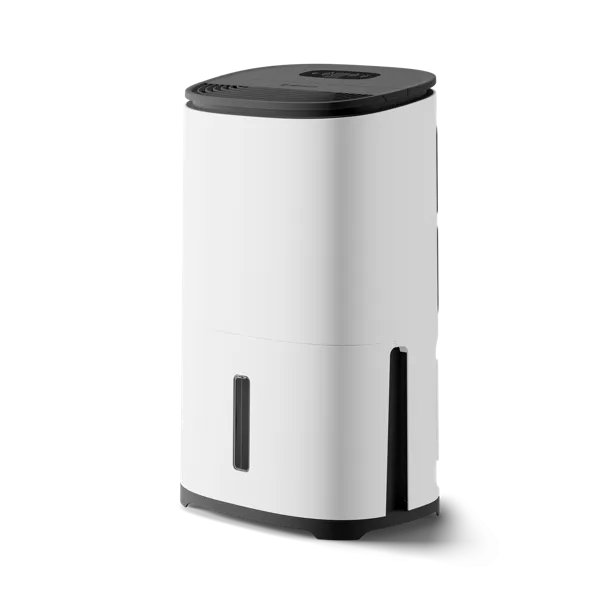
Converted or heated cellar at 15°C or more
MeacoDry Arete One 20L
3.4 litres a day at 10°C and 60%, 180 W, rated from 5°C
About 5p an hour. Uses less electricity per litre than the desiccant models at 10°C, so it suits a cellar that is lived in and kept warm.
Check price on AmazonPhoto: Meaco
If water runs down the walls, pools on the floor or leaves tide marks, fix that first. No dehumidifier keeps up with water coming in from the ground.
Frequently asked questions
Does a dehumidifier work in a cellar?
Yes, for damp that comes from the air: condensation, a musty smell or old masonry drying out. It cannot stop water coming in from the ground. In a cold cellar choose by temperature: at 10°C Meaco rates its desiccant DD8L Pro at 6.89 litres a day and its compressor Arete One 20L at 3.4.
What is the best dehumidifier for a cold basement?
A desiccant model, if the basement averages below about 8°C in winter, which is Trotec's own guidance. The Meaco DD8L Pro and Trotec TTR 57 E are both rated from 1°C. In a converted basement kept at 15°C or more, a compressor model uses less electricity per litre.
What size dehumidifier do I need for a cellar?
Check the room volume against the maker's rating, then the litres it removes at cellar temperature. Trotec rates the TTR 57 E for up to 50 m³. At 10°C, "20 litre" compressor models remove about 2.8 to 3.4 litres a day on Meaco's and Dimplex's figures, so buy on the cold figure, not the name.
Should I open the cellar windows to dry it out?
Not on warm, humid days. Outdoor air at 20°C and 70% has a dew point of about 14.4°C, so it condenses on cellar walls colder than that, by NPL's Magnus formula. Ventilate on cool, dry days and keep the windows shut while a dehumidifier runs.
Is a dehumidifier enough for a basement conversion?
Not on its own. A habitable basement needs waterproofing to stop water coming in; published summaries of BS 8102 describe the habitable grade as no water penetration, with ventilation, dehumidification or air conditioning suited to the use. A dehumidifier or air conditioning then keeps the air dry. Get a structural waterproofing survey first.
Core buying guides
Start with these high-intent guides, then dig into the rest of the library.
Related guides
- Basement Air Conditioning in the UK
- Compressor vs Desiccant Dehumidifier: Which One for Which Room
- Garage Dehumidifier UK: What Still Works at 10°C, on Makers' Figures
- How Much Does a Dehumidifier Cost to Run? UK Cost per Hour, Day and Month
- Dehumidifier Hire UK: Rates From 9 Hire Firms, Per Day and Per Week
Sources and further reading
- Heidelberg Materials UK: waterproofing concept and considerations, BS 8102 grades 1 to 3 and Types A, B and C (checked 29 Nov 2026)
- PBC Today: a summary of changes to BS 8102:2022, Michael Jones, Peter Cox, 21 December 2022 (checked 29 Nov 2026)
- Property Care Association: letter to BSI on BS 8102, 20 February 2019, Grade 3 wording (checked 29 Nov 2026)
- Sika UK: basement waterproofing concept, Types A, B and C (checked 29 Nov 2026)
- Building Conservation Directory: Damp below Ground, Geoff Maybank, 2008 (checked 29 Nov 2026)
- Trotec UK: practical knowledge concerning dehumidifiers, temperature ranges, defrosting and room size (checked 29 Nov 2026)
- Trotec UK: TTR 57 E technical data, 20 m² or 50 m³, 1 to 32°C, 5 l tank, hose drain (checked 29 Nov 2026)
- Meaco: DD8L Pro water removal table at 10°C and 20°C (checked 29 Nov 2026)
- Meaco: MeacoDry Arete One 20L water removal table at 10°C and 20°C (checked 29 Nov 2026)
- Dimplex: EverDri 20E/20EL instruction manual, 2.8 L a day at 10°C and 59%, drain hose lower than the outlet, frost (checked 29 Nov 2026)
- National Physical Laboratory: dew point and relative humidity, Magnus formula over water (checked 29 Nov 2026)
- Ofgem: energy price cap, 1 October to 31 December 2026 (checked 29 Nov 2026)
- Ofgem: energy price cap, 1 January to 31 March 2027 (checked 29 Nov 2026)
How this guide was prepared
This guide was written by the Local AC Installers Editorial Team. We compare official guidance, legislation and established consumer information, separate general information from project-specific advice, and show publication dates and sources. We do not accept installer accreditation claims at face value.