
CRAC or close-control units and split air conditioners can both cool IT spaces, but they are not interchangeable. Close-control plant is typically designed for continuous process loads, tighter environmental control and data-hall airflow patterns. Split systems can suit smaller, lower-density rooms when correctly selected for year-round cooling, drainage and alarms. Choose based on heat density, required precision, resilience, maintenance model and room geometry rather than brand familiarity alone.
Clarify what each system is for
Computer room air conditioning, often called CRAC, and wider close-control equipment are generally engineered for continuous IT heat removal, with controls and sensors aimed at process spaces. Many comfort-oriented split systems are designed primarily for occupied rooms with intermittent use.
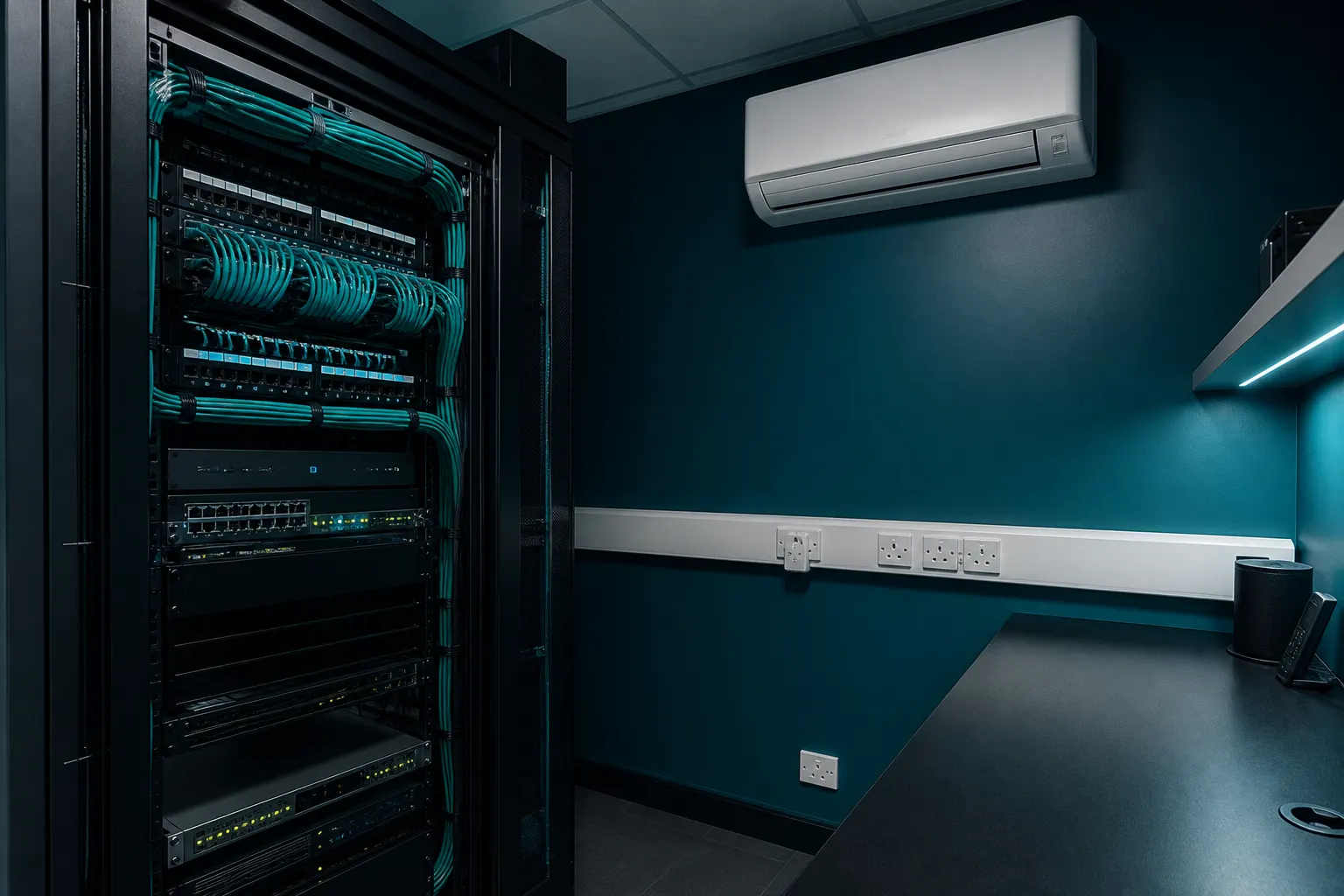
A modern split can still serve a small server room if the designer confirms continuous duty, low-ambient cooling, condensate reliability and independent controls. The risk arises when a comfort product is installed with office assumptions and no resilience plan.
Compare control of temperature, humidity and airflow
Close-control units commonly offer finer staged control, stronger airflow volumes for raised-floor or ducted layouts, and options for humidity management suited to denser rooms. Split wall or cassette units usually deliver localised cooling and may provide less structured air distribution in a racked room.
For either approach, inlet conditions at IT equipment remain the design target. A high-capacity CRAC poorly arranged with open rack voids can still create hot spots, while a modest split with good blanking and sensor placement can be stable in a small cupboard.
- Ask how supply air reaches rack inlets.
- Check whether humidity is actively managed or only incidental.
- Confirm sensor locations and alarm outputs.
- Review part-load behaviour and compressor cycling at night.
Weigh resilience, service and room constraints
CRAC installations in larger rooms often sit within designs that anticipate multiple units, floor grilles and defined return paths. Split systems may be easier to locate in constrained UK fit-outs, but outdoor-unit positions, pipe lengths and noise limits can dominate the design.
Service access differs. Close-control plant may need clearances and specialist maintenance. Splits need filter access and outdoor-unit space without blocking escapes or creating nuisance. F-gas competence and leak-checking duties apply to relevant refrigerant systems in either case.
Select by duty, not by labels alone
Use measured and forecast IT load, acceptable inlet envelope, required redundancy and building constraints to shortlist options. For many small UK server rooms, a dedicated split or small close-control package with monitoring is proportionate. For higher density or critical halls, CRAC or equivalent process cooling with engineered airflow is usually more appropriate.
Request a written comparison of capital cost, energy use assumptions, maintenance, expected life and failure modes. Avoid treating either technology as automatically compliant with Uptime Institute Tier concepts unless the whole power and cooling topology has been assessed against the intended outcome.
Frequently asked questions
Is a comfort split automatically unsuitable for servers?
Not automatically, but it must be assessed as continuous process cooling with suitable controls, drainage, alarms and operating limits. Many office splits are a poor fit without those checks.
Does CRAC always control humidity better?
Close-control plant often has stronger humidity options, but performance still depends on design, sensors and commissioning. Ask for the intended humidity or dew-point strategy in writing.
Which option is cheaper?
Small split installations often have lower capital cost in simple rooms, while CRAC or close-control solutions may cost more but suit denser or more critical loads. Compare whole-life risk and energy, not only equipment price.
Can I mix CRAC and splits in one room?
Mixed plant can create control conflicts if not carefully designed. Prefer a coordinated strategy with clear lead, lag and alarm behaviour.
Core buying guides
Start with these high-intent guides, then dig into the rest of the library.
Related guides
Sources and further reading
How this guide was prepared
This guide was written by the Local AC Installers Editorial Team. We compare official guidance, legislation and established consumer information, separate general information from project-specific advice, and show publication dates and sources. We do not accept installer accreditation claims at face value.