
Treat a home cinema as a small shut room that runs warm in the dark. The decision is a quiet indoor unit whose air travels along the ceiling, not across the seats or straight at the screen, sized for the people plus the projector and amplifier. Blackout means you cannot rely on the window. Survey the heat from the kit and the wall you can actually use. An F-gas certified company installs the pair. This is one room, not a whole-house system.
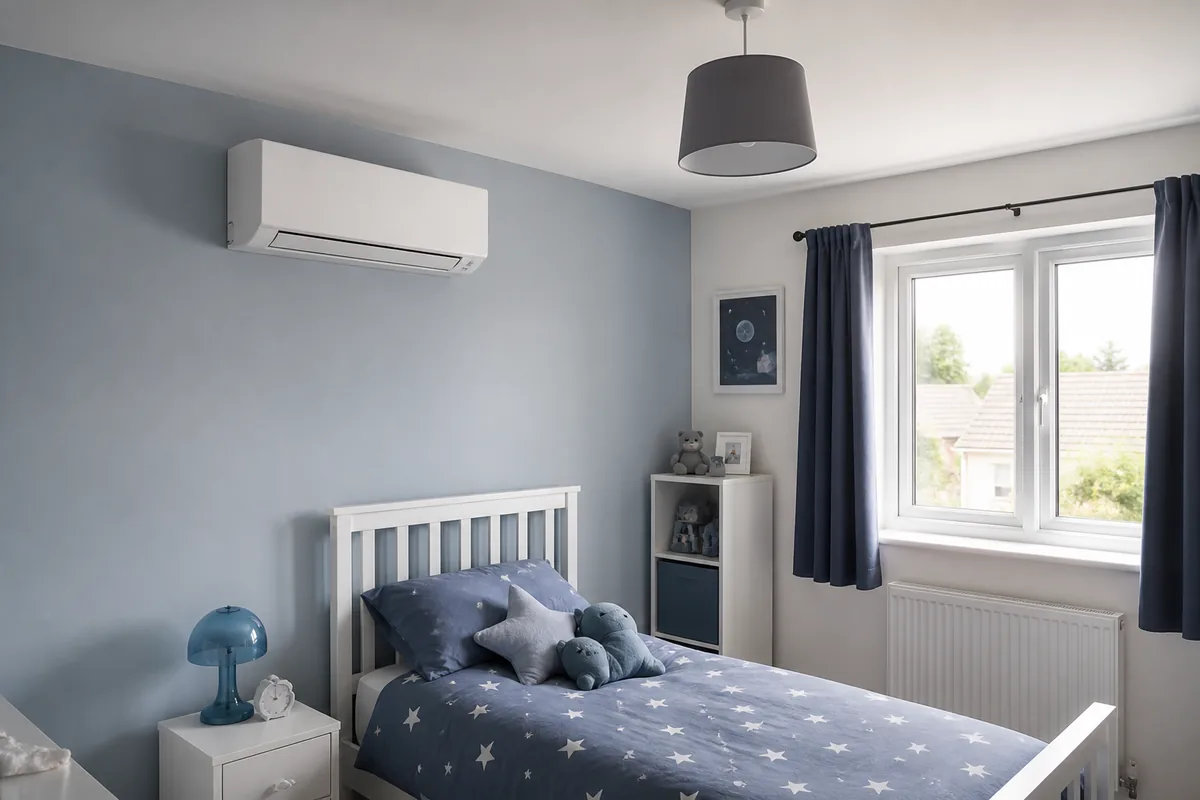
A dark room, a projector and four people
A projector, an amplifier and four people in a sealed, dark room are the load. The survey should see the equipment, not a bare floor area. A modest domestic duty is usual for a single-row room. A commercial cassette copied from a public cinema is the wrong machine and the wrong noise. The room is often internal, with no outside wall. That means a longer pipe and usually a condensate pump back to a drain. Those runs still have to stay inside the manufacturer's length and height limits. If the only lawful outdoor spot cannot reach this internal room, the cinema does not get a head on someone else's multi-split. A cinema can share the living room outdoor unit only if the pipe length, the height and a listed combination all work. An internal cinema at the far end of the plan often fails that test and needs its own look. Include projector and amplifier heat in the survey, prefer a low-fan sound figure on the model code, and treat an internal room as needing a real drain route. Say this is a home cinema. A photo of the seating, the screen wall, the projector location and any outside wall, a note that the room is blacked out, the main heat sources if you know them, and the outdoor elevation, are the survey set.
Throw above the seats, and a drain from an internal room
Cold air dumped on the back of necks, or a fan that ramps up in a quiet scene, ruins the room faster than a degree of temperature. Specify the low-fan noise and a steady setpoint. Mount the unit so the throw crosses above the seating. Keep the vane off faces and off the screen. The survey should stand in the seats and trace that path before the bracket is fixed. Ask for model codes with the low-fan sound figure, the pipe length, and how condensate leaves an internal room. Ask them to confirm the throw misses the seats and the screen. The outdoor unit wants to be off the party wall of this room if the room is used late. In England, Planning Portal conditions still apply. A cinema in a terrace is a noise question at 11pm even when the indoor fan is well behaved.
It does not ventilate a sealed box. If the room has no fresh air at all, that is a separate building question. The split recirculates and cools. It also does not silence the projector. Pick a quiet projector if silence is the goal. Do not oversize the split to drown fan noise with airflow. Fresh air, if the room has none, is a separate question for whoever designed the room. A new indoor unit on an old outdoor unit elsewhere is usually not a mix-and-match. Only a listed combination on the same refrigerant is worth pricing, and only inside the pipe limit. As a 2026 illustration, a straightforward cinema-room split is often in the low thousands including VAT. A long pump run from an internal room is the extra.
Core buying guides
Start with these high-intent guides, then dig into the rest of the library.
Related guides
Sources and further reading
How this guide was prepared
This guide was written by the Local AC Installers Editorial Team. We compare official guidance, legislation and established consumer information, separate general information from project-specific advice, and show publication dates and sources. We do not accept installer accreditation claims at face value.