
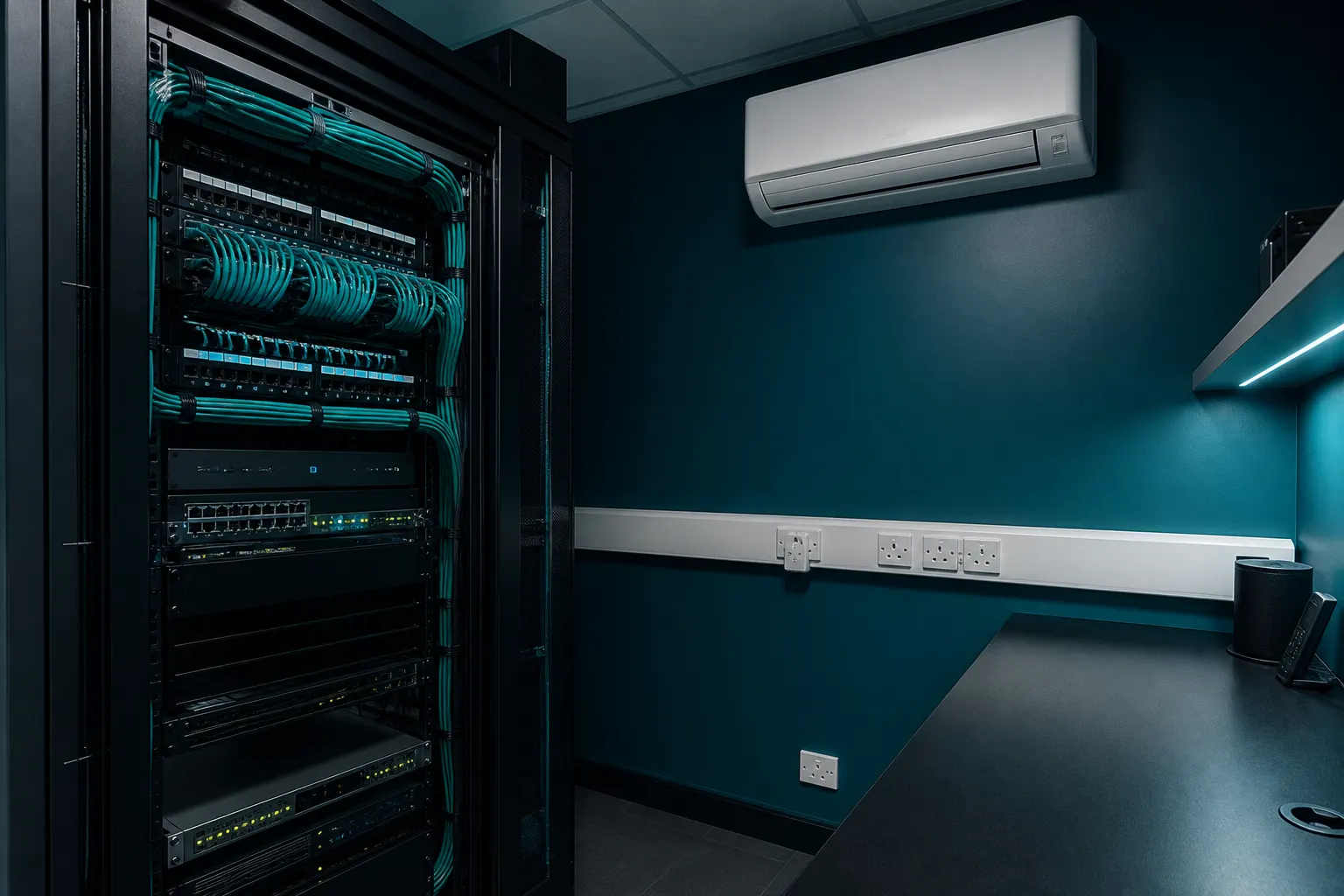
Office server rooms and data centres both reject continuous IT heat, but they differ in scale, redundancy, airflow architecture and operating discipline. A small office room often uses split or compact dedicated cooling with local monitoring, while a data centre is planned around engineered airflow, concurrent maintainability and formal availability targets.
Same physics, different scale and risk
Both environments convert electrical energy into heat that must be removed continuously. The difference is density, diversity of load, acceptable downtime and the cost of failure. An office cupboard supporting a few business systems is not designed like a multi-megawatt facility, but it still needs process cooling rather than comfort-only thinking.
Uptime Institute materials and ASHRAE datacom guidance are widely used reference points for professional data centre practice. Smaller rooms can borrow the principles of inlet monitoring, airflow management and resilience without copying every data centre feature.
Airflow architecture
Data centres commonly use hot-aisle or cold-aisle arrangements, containment and engineered supply paths. Office server rooms more often rely on one or two wall or ceiling units, so short-circuiting and hot spots are frequent unless blanking and unit placement are carefully considered.
Raised floors, in-row cooling and sophisticated containment are rarely justified for a single low-density room. The practical goal is still the same: deliver cool air to intakes and take hot exhaust away without uncontrolled mixing.
- Office rooms: prioritise dedicated plant, inlet sensors and simple airflow fixes.
- Data centres: design for zones, containment and maintainable capacity.
- Both: treat IT moves as cooling-change events.
- Both: distinguish comfort set points from equipment inlet limits.
Resilience and operations
Data centre cooling is typically specified against defined failure scenarios and concurrent maintenance. Office rooms may accept lower resilience if systems can be restored quickly or workloads can fail over to cloud or another site.
Be explicit about the business decision. Installing two comfort splits that share one outdoor location, one power board and one condensate pump is not equivalent to a maintainable N+1 data centre design.
When an office room needs a different approach
Rising rack density, 24/7 trading systems, strict recovery objectives or regulatory evidence requirements can push an office room beyond ad hoc cooling. At that point, organisations often improve the room, relocate kit, or migrate services rather than endlessly adding comfort capacity.
Energy and inspection duties still apply in commercial buildings. Efficient operation, competent maintenance and, where relevant, air conditioning inspection compliance remain part of responsible ownership.
Frequently asked questions
Can an office server room use data centre temperature guidelines?
Recognised datacom environmental guidance is a useful reference for equipment inlet conditions, but the cooling architecture and resilience of a small room will usually be simpler than a purpose-built facility.
Is a data centre always more reliable than an office room?
Purpose-built facilities are designed for higher availability, but actual reliability depends on design, operations and the specific service. A poorly operated data centre hall can still fail.
When should IT leave the office server room?
Consider relocation or migration when density, resilience, noise, power, fire strategy or cooling constraints make continued on-premise operation disproportionate to the business need.
Does comfort office AC count as data centre-grade cooling?
No. Comfort systems are generally intended for occupied spaces and intermittent use, not as a complete substitute for continuous process cooling design.
Core buying guides
Start with these high-intent guides, then dig into the rest of the library.
Related guides
Sources and further reading
How this guide was prepared
This guide was written by the Local AC Installers Editorial Team. We compare official guidance, legislation and established consumer information, separate general information from project-specific advice, and show publication dates and sources. We do not accept installer accreditation claims at face value.