
Cooling redundancy means the IT environment can remain within agreed limits when a cooling component is offline for maintenance or fault. N+1 usually means enough capacity to serve the design load with one unit or module spare. Buying two indoor units is not enough if they share one power supply, one controller, one drain or one outdoor constraint. Define the failures you must tolerate, then design and test the whole cooling chain against that requirement.
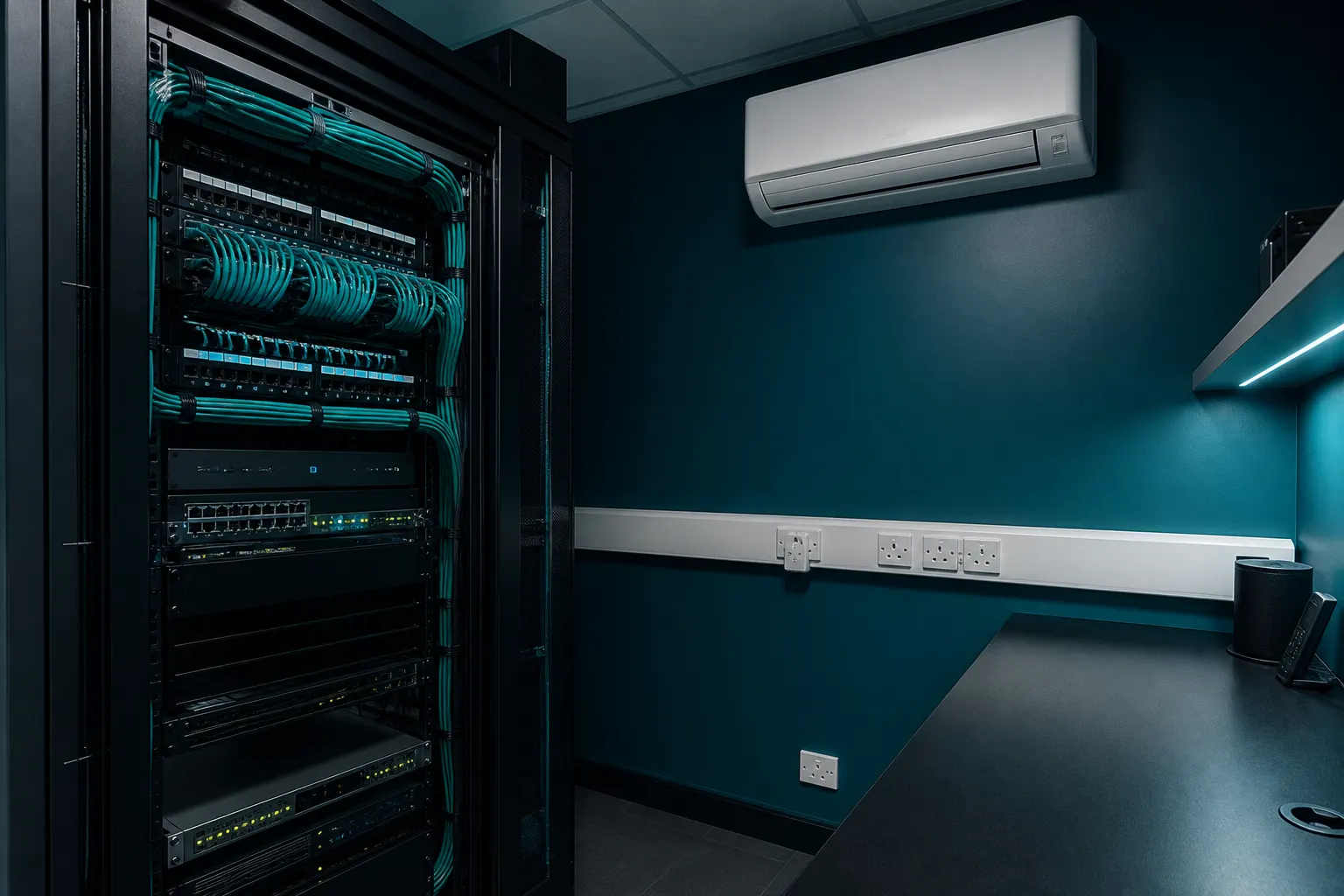
Define the resilience outcome before counting units
Start with business impact: how long the room can ride through degraded cooling, which IT loads can be shed, and whether maintenance must occur without shutting servers down. Those answers drive whether N capacity, N+1 capacity or a more fault-tolerant topology is justified.
Uptime Institute Tier concepts are performance-based outcomes for site infrastructure, not a simple checklist of two air conditioners. Even outside formal Tier certification, the same discipline helps: redundant components still fail together if distribution paths and controls are common.
- State the design IT load and any growth allowance.
- Decide whether one cooling unit may be isolated for service.
- List power, control, water and outdoor single points of failure.
- Agree alarm ownership for day and night response.
Understand what N+1 does and does not provide
In common mechanical shorthand, N is the capacity needed for the load and +1 is one additional equivalent module. If two 10 kW units serve a 10 kW room, the room may have N+1 at that load, but not if the real peak is already 18 kW or if one unit cannot carry the load alone under design outdoor conditions.
N+1 does not automatically equal concurrent maintainability of every related component. A shared refrigerant circuit, a single condensate pump system, or one network switch carrying all alarms can still stop effective cooling or stop you knowing that cooling has failed.
Design diversity into power, controls and heat rejection
Feed redundant cooling units from diverse electrical sources where the resilience case requires it, and verify that a board or breaker trip cannot disable every unit at once. Controls should support automatic changeover or clear lead-lag behaviour without manual attendance.
Outdoor heat rejection needs the same scrutiny: adjacent condensers that both overheat when airflow is blocked, or both depend on one inaccessible roof area, weaken the indoor redundancy story. Maintenance isolation should leave the required capacity online.
Commission, test and keep the design honest
Test failover: switch off one unit during a controlled window and confirm inlet temperatures remain acceptable. Repeat after IT growth. Duty rotation can reduce uneven wear but must not hide a failed standby unit.
Change control is part of redundancy. Adding dense racks without revisiting cooling capacity converts an N+1 design into an overloaded N design. Keep as-built drawings, set points and test records with the facilities and IT teams.
Frequently asked questions
Do two air conditioning units equal full redundancy?
Not by themselves. Shared electrics, drains, controls or insufficient spare capacity during peak load can leave single points of failure.
Is N+1 the same as an Uptime Institute Tier level?
No. Tier classification assesses broader topology and performance outcomes. Extra cooling modules alone do not determine a Tier rating.
How often should failover be tested?
At commissioning and then at intervals agreed in the maintenance plan, and after significant IT or plant changes. Untested standby plant is a common weakness.
What is a practical minimum for a small critical cupboard?
At least remote inlet-temperature alarms, a documented response plan and either a second cooling path or verified temporary cooling with power and drainage. Exact needs follow business risk.
Core buying guides
Start with these high-intent guides, then dig into the rest of the library.
Related guides
Sources and further reading
How this guide was prepared
This guide was written by the Local AC Installers Editorial Team. We compare official guidance, legislation and established consumer information, separate general information from project-specific advice, and show publication dates and sources. We do not accept installer accreditation claims at face value.