
If your lease needed the freeholder's permission and the air conditioning was fitted without it, the flat is likely to be in breach of the lease, and that is true even if a previous owner did the work. The Leasehold Advisory Service says unauthorised alterations can make a property harder to sell, remortgage or insure. The usual way to put it right is to apply for retrospective consent: tell the freeholder what is there, show that it was fitted properly and offer the same undertakings you would have offered beforehand. Do it before a buyer's solicitor asks, because a sale is the worst time to find out.
First, check whether consent was needed
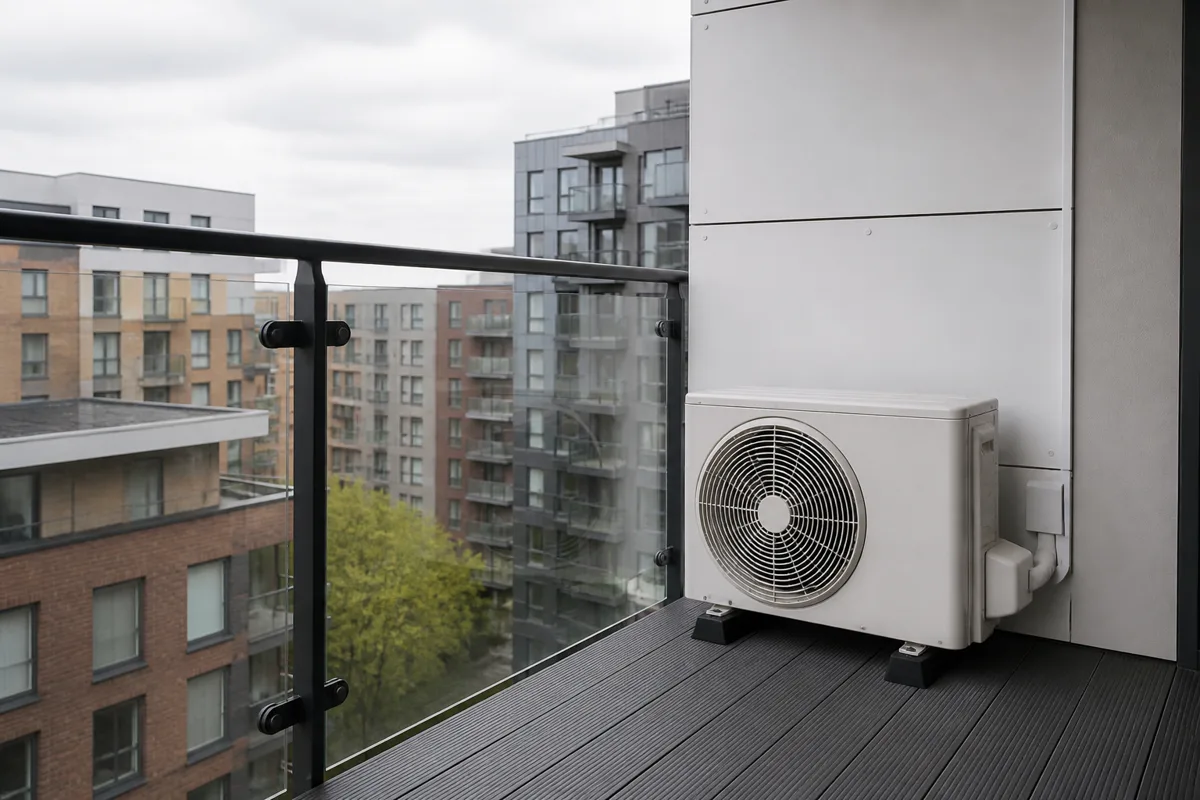
Not every installation is a breach. Read two things in the lease. The plan and description show what you own, and the alterations clause says what needs permission. An outdoor unit fixed to an external wall, or pipes through it, almost always involves the freeholder's property. A portable unit with a window hose alters nothing.
Then look for paperwork. A letter of consent or a licence to alter may be with the lease, with the solicitor who acted on the purchase, or in the managing agent's file. Ask the agent before assuming there is nothing.
| Situation | Position | What to do |
|---|---|---|
| You fitted it without asking | Likely breach of the alterations clause | Apply for retrospective consent now, in writing |
| A previous owner fitted it | The breach passes to you with the lease | Ask the agent for any record, then apply for retrospective consent |
| You are buying a flat with a unit and no consent | The problem becomes yours on completion | Ask your solicitor to have the seller obtain consent, or take advice on the risk |
| Consent exists but the unit differs from what was approved | The consent may not cover what is there | Send the freeholder the as-built details and ask them to confirm |
Why a previous owner's unit is your problem
The Leasehold Advisory Service is direct about this: if permission was needed and an alteration was made without it, you could be in breach of your lease even if the alteration was made by a previous owner. Restrictions in a lease run with the land, so each owner takes on the duty to see they are observed.
It also notes that in some circumstances there can be a 12-year time limit for a landlord to take action for a breach, under the Limitation Act 1980, but that the limit may not apply if the landlord can show the breach is continuing, which depends on the exact wording of the lease. Do not rely on time having passed without taking advice.
How to apply for retrospective consent
Write to the freeholder or managing agent, say plainly that the system is already installed, and ask for retrospective consent under the alterations clause. A frank letter with complete information is much easier to approve than one that has to be investigated.
The enclosures are the same as for a new application, written in the past tense, with evidence that the system is safe and maintained.
- What is fitted: make, model, capacity, and where each indoor and outdoor unit sits.
- Photographs of the outdoor unit, the pipe route, the wall penetration and the condensate drain.
- When it was installed and by whom, if you know, with the installer's F-gas certificate if you have it.
- A recent service report from an F-gas certified business.
- The manufacturer's sound data, and a sound calculation at the nearest neighbouring window if one can be produced.
- The planning position for the unit.
- Undertakings on servicing, noise, making good, and removal and reinstatement if required.
What the freeholder may ask for
Expect a surveyor's inspection, conditions and costs. If the lease allows, the landlord can recover the legal or other expenses of dealing with the request. Those are administration charges, which have to be payable under the lease and reasonable, and which a tribunal can rule on. Ask for the figure in writing first.
The freeholder may also ask for changes: a different position, an acoustic enclosure, a tidier pipe route or better fire stopping where pipes pass through the wall. Agreeing to reasonable changes is usually cheaper than a dispute. If they ask for removal, ask for the reasons in writing and whether a different position or a system with no outdoor unit would be acceptable.
Check planning as well
The freeholder's consent and planning are separate. In England, a reversible unit on a block of flats can be permitted development if it meets the conditions in force since 29 May 2025, which include only one unit on the whole block and an outdoor unit of no more than 0.6 cubic metres. A unit fitted before that date, a cooling-only unit, or a second unit on the block may have needed planning permission. In Wales the right covers houses only. If you are not sure, ask the council about a lawful development certificate before you tell the freeholder that planning is in order.
Selling or remortgaging
A buyer's solicitor will ask whether alterations were made and whether consent was obtained, and a visible outdoor unit invites the question. Start the retrospective application before the flat goes on the market, so that the answer is a document and not a delay. Keep the consent with the lease once you have it.
What not to do
Do not ignore it and hope the sale goes through, and do not give a buyer or lender an answer you cannot support. The Leasehold Advisory Service's advice is to get professional help with resolving unauthorised alterations, for example applying for retrospective consent and working with the landlord. If the freeholder threatens action over the breach, speak to a solicitor before replying.
Frequently asked questions
Is air conditioning without freeholder consent a breach of lease?
If your lease required permission for the work and none was given, it is likely to be. Check the alterations clause and what the lease says you own. Fixing an outdoor unit to an external wall usually involves the freeholder's property.
The previous owner installed it. Am I responsible?
Yes. The Leasehold Advisory Service says you could be in breach even if the alteration was made by a previous owner, because lease restrictions run with the land. Ask the managing agent whether consent is on file, and apply for retrospective consent if it is not.
Can I get consent after the air conditioning is installed?
You can ask. Retrospective consent is at the freeholder's discretion in the same way as consent beforehand, and it is easier to get with a full description, photographs, a service report and undertakings. It is harder than asking first.
Will an unauthorised unit stop me selling?
It can delay or complicate a sale. The Leasehold Advisory Service says unauthorised alterations can make a property harder to sell, remortgage or insure. Sorting out consent before you market the flat avoids finding out mid-sale.
Is there a time limit for the freeholder to act?
There can be a 12-year limit under the Limitation Act 1980 in some circumstances, but it may not apply where the breach is continuing, and that depends on the wording of the lease. Take advice before relying on it.
Should I just remove the unit?
Removal ends the alteration but leaves holes, fixings and making good, and refrigerant must be recovered by an F-gas certified business. Ask for retrospective consent first. Removal is the fallback if consent is refused.
Core buying guides
Start with these high-intent guides, then dig into the rest of the library.
Related guides
More planning guides
Sources and further reading
How this guide was prepared
This guide was written by the Local AC Installers Editorial Team. We compare official guidance, legislation and established consumer information, separate general information from project-specific advice, and show publication dates and sources. We do not accept installer accreditation claims at face value.