
A split fitted in Scotland is the same kind of machine as one fitted in England, and a different permissions story. English permitted-development pages, including the Planning Portal notes we link elsewhere, do not decide a Scottish building warrant or a Scottish planning application. The company still needs to be properly certified for F-gas work. The design should also admit that a Glasgow or Aberdeen winter asks more of heating mode than a southern coastal evening does. Edinburgh and Glasgow have their own installer pages. This page is the national difference.
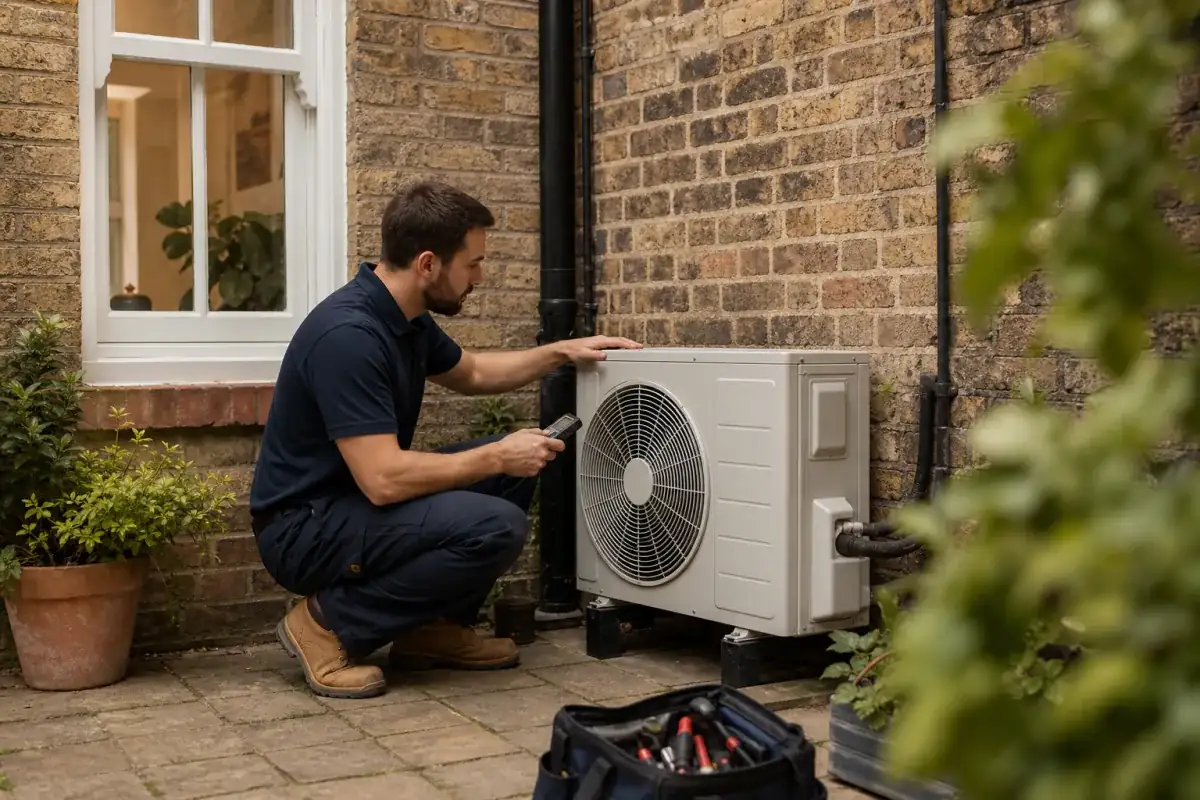
Warrant and planning, before the bracket
Scottish building standards are devolved. A building warrant is the permission to carry out certain building work, and whether your core hole, your electrical work and your plant need one is a question for the local authority verifier, not for an English forum. The Scottish Government publishes the building-standards policy. Your council publishes how to apply. Ask the installer what they will submit and what they expect you to submit.
Planning is separate again. A domestic outdoor unit can be acceptable on one elevation and contentious on another, especially in a tenement, a conservation area or a flat where the wall is common. Get the planning position and the warrant position named in writing before equipment is ordered. Reversing a drilled sandstone tenement is a miserable hobby.
Northern Ireland's F-gas note on this site is a third jurisdiction. Scotland is not covered by that page either. Match the guidance to the nation on the postcode.
Tenements, new estates and the outdoor unit
Glasgow and Edinburgh tenements give you stairs, stone, a close, and a back court that may be the only lawful place for a condenser. Factor consent, listed status and the neighbours above and below sit in the survey. A wall unit in the front room with the outdoor unit somehow on the street is usually a drawing, not a job.
Newer estates around both cities, and across the central belt, behave more like UK suburban installs: cavity wall, a board in a cupboard, a side path. They still want a Scottish verifier's view where the work needs a warrant. They do not inherit English permitted development because the brochure was printed in Hertfordshire.
Heating mode earns its keep. A reversible split is an air-to-air heat pump, in Energy Saving Trust's language, and Scottish heating days are long. Choose capacity with a winter figure, not only a cooling badge. The heating-mode guide explains what one indoor unit will and will not do for a whole flat.
The circuit and the company
F-gas certification for the business that handles refrigerant still applies. Ask to see it, and ask who registers the manufacturer warranty at the Scottish address. A company that only works in England can sell you a unit. Commissioning and the return visit need someone who will actually attend.
Electrics follow UK practice and Scottish building standards where they bite. A full consumer unit in a tenement cupboard is a normal discovery. Name the electrical scope in the quote so it is not a variation on the stair.
Condensate in a stair or a back court has to go somewhere that stays liquid in a cold snap and does not sheet the steps. Say the route. A pump that fails over a close is a neighbour issue as well as a drip.
How to brief the job
Postcode, tenement or house, listed or not, and whether a factor is involved. Photos of the proposed outdoor wall and the board. Rooms that overheat, and whether you also want heat in the same rooms.
Then ask the quotation to state the warrant assumption: included, excluded, or not required, and who confirmed that. A price that is silent on warrants is an estimate. The estimate guide is the general warning. In Scotland it is the first line to look for.
Use the Edinburgh or Glasgow location pages if that is the city, and still tell the installer the nation so nobody applies an English planning checklist to a Scottish stair.
Frequently asked questions
Can I use English permitted development in Scotland?
No. Scotland has its own building standards and planning system. Ask the local authority verifier and the planning authority, and get the installer's warranty assumption in writing.
Are the air conditioners different?
The machines are the same families sold across the UK. The selection should respect a colder heating design, and the paperwork is Scottish.
Does F-gas apply?
Yes. The company that works on the refrigerant circuit needs the proper certification. Ask for it with the quote.
Will one split heat a tenement flat?
It will heat the room it serves, if it is reversible and sized for heat. It will not replace the rest of the flat's heating or the hot water. Read the heating-mode guide before you retire anything.
Core buying guides
Start with these high-intent guides, then dig into the rest of the library.
Related guides
More planning guides
- Air Conditioning in a Thatched Cottage in the UK
- Air Conditioning Installed Without Freeholder Consent: How to Put It Right
- Air Conditioning in a House with a Looped Supply in the UK
- Air Conditioning Lead Times in a UK Heatwave
- Air Conditioning in a Converted Chapel in the UK
- Air Conditioning in Listed Buildings and Conservation Areas
Sources and further reading
How this guide was prepared
This guide was written by the Local AC Installers Editorial Team. We compare official guidance, legislation and established consumer information, separate general information from project-specific advice, and show publication dates and sources. We do not accept installer accreditation claims at face value.