
MVHR on its own does not cool a house in any real sense. Summer bypass stops the heat exchanger warming incoming air, so on a cool night you get outside air as it is. It cannot make air cooler than outside, and MVHR airflows are small, so the effect on a hot room is modest. Add-on cooling modules chill the supply air and help a little more, but an overheating bedroom usually still needs shading, purge ventilation or air conditioning.
What summer bypass actually does
In winter an MVHR unit passes warm outgoing air past cold incoming air so the heat is kept. In summer that is the opposite of what you want. Summer bypass routes incoming air around the heat exchanger so it enters the house at outdoor temperature.
That helps at night when outside air is cooler than the house. On a hot afternoon, outside air may be warmer than the rooms, and bypass then brings in warm air. Good controllers only open bypass when the outdoor temperature is below the indoor temperature and above a set minimum.
Why the cooling effect is small
MVHR is sized for fresh air, not for cooling. A typical house might run around 0.3 to 0.5 air changes an hour. Air carries very little heat at those flows, so even night-time air several degrees cooler only removes a few hundred watts from the whole house.
A south-facing bedroom in a heatwave can gain far more than that through its glass. That is why MVHR houses, which are usually airtight and well insulated, can still overheat. Approved Document O now asks new homes to limit overheating through design first, with mechanical cooling as a later option.
| Option | What it does | Limits |
|---|---|---|
| Summer bypass | Brings outdoor air in unwarmed | No cooler than outside; 150 m³/h of air 3°C below room temperature removes only about 150 W, against 2,500 W from a small split |
| Boost with windows open at night | Purge ventilation | Security, noise, pollen |
| MVHR cooling module | Chills supply air with a small heat pump or DX coil | Limited capacity, condensate drain needed |
| Split air conditioning | Cools the room directly | Outdoor unit, cost, F-gas install |
| External shading | Stops heat reaching the glass | Planning, cost, but very effective |
MVHR cooling modules
Some MVHR makers sell a post-cooler: a small refrigerant coil or compact heat pump that chills and dries the supply air before it is ducted to the rooms. It uses the existing ducts, so there are no indoor wall units.
The capacity is bounded by the MVHR airflow, so it takes the edge off rather than cooling a hot room quickly. It also produces condensate and needs a drain. Ask the supplier for the real cooling output at your airflow rather than the maximum figure.
Running MVHR and air conditioning together
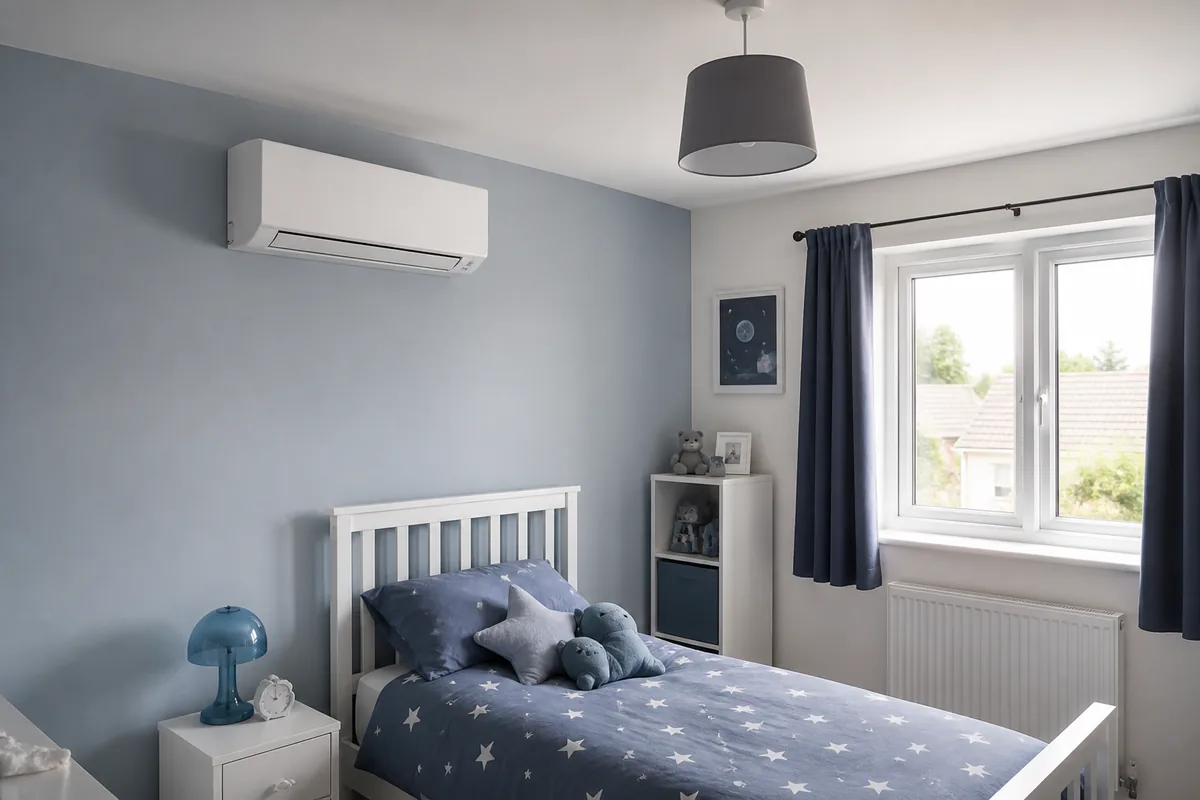
MVHR and a split air conditioner work well side by side. MVHR keeps the air fresh and the split cools the rooms that overheat. Keep bypass closed when the air conditioning is cooling on a hot day so you are not bringing warm air in.
Fit split units where they will not blow straight at MVHR extract valves, and keep the supply and extract rates as designed. If you have one overheating bedroom, a single split for that room is usually cheaper than a whole-house cooling module.
Frequently asked questions
Does MVHR cool the house in summer?
Only slightly. Summer bypass brings in outdoor air without warming it, which helps on cool nights. It cannot cool below outdoor temperature and the airflow is small.
What is an MVHR cooling module?
An add-on coil or compact heat pump that chills the supply air from the MVHR unit. It helps, but its output is limited by the MVHR airflow.
Should summer bypass be on during the day?
Only when outside air is cooler than inside. Most controllers decide this automatically using temperature sensors.
Can I add air conditioning to an MVHR house?
Yes. A split system cools the hot rooms and MVHR keeps providing fresh air. The airtight envelope means the pipe hole needs careful sealing.
Core buying guides
Start with these high-intent guides, then dig into the rest of the library.
Related guides
More technology guides
Sources and further reading
How this guide was prepared
This guide was written by the Local AC Installers Editorial Team. We compare official guidance, legislation and established consumer information, separate general information from project-specific advice, and show publication dates and sources. We do not accept installer accreditation claims at face value.