

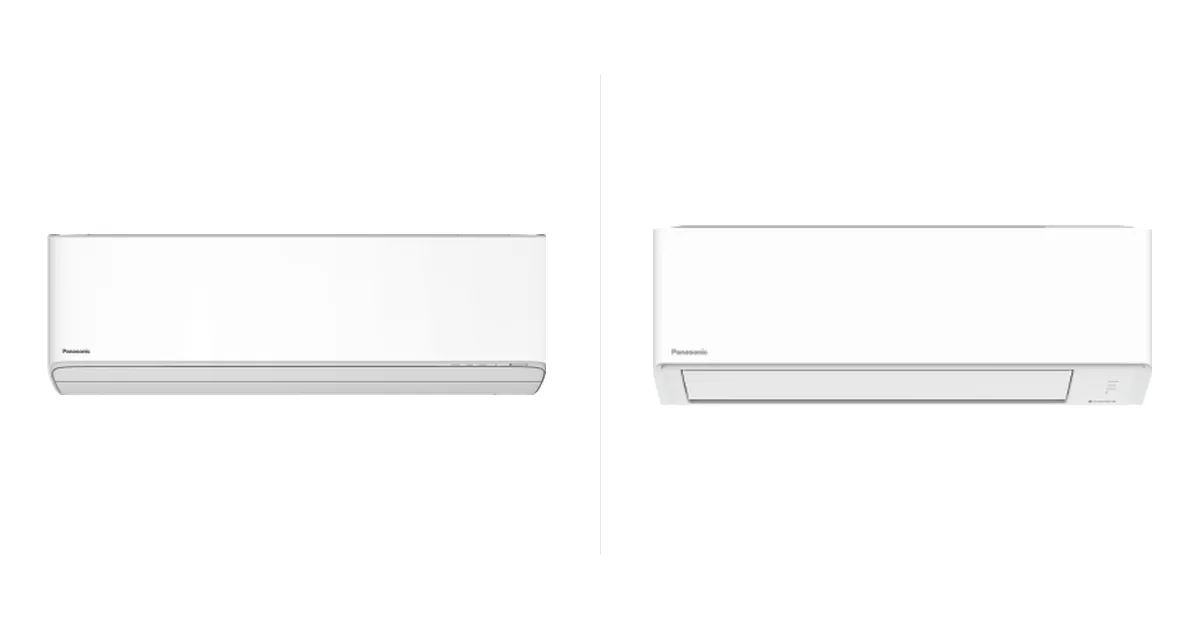
Etherea is Panasonic's flagship wall unit. TZ is its compact, lower-cost range. At 2.5 kW the Etherea publishes SEER 9.5 and SCOP 5.2, A+++ for both seasons. The TZ sits in A++ for both, with a lowest cooling step of 20 dB(A) and an indoor unit about 779 mm wide. Both have nanoe X. Choose Etherea for a room you heat and cool every day. Choose TZ for a spare room, a small office or a wall too narrow for a full-size unit.
Flagship against compact
Etherea is the Panasonic most people mean when they ask for a good Panasonic wall unit. It has the higher label, finishes beyond white, and nanoe X air treatment.
TZ is the super-compact range. It is narrower, cheaper and also has nanoe X. It is not a cut-down Etherea. It is a smaller unit for rooms where width and price matter more than the last point of efficiency.
Both are R32 reverse-cycle splits. Both need an outdoor unit, a pipe route and a drain, so the install labour is the same.
Published figures at 2.5 kW
Etherea figures are for the CS-Z25ZKE with the CU-Z25ZKE outdoor unit. TZ figures are from Panasonic's UK page for KIT-TZ25-ZKE. Published TZ tables vary slightly by region, so read the label in your quote.
| Etherea CS-Z25ZKE | TZ CS-TZ25ZKE | |
|---|---|---|
| SEER / cooling class | 9.5 / A+++ | About 7.1 to 7.3 / A++ |
| SCOP / heating class (average climate) | 5.2 / A+++ | About 4.6 / A++ |
| Quietest indoor step, cooling | The quiet step on the Etherea sheet | 20 dB(A) |
| Indoor unit width | Full-size wall unit | About 779 mm |
| Air treatment | nanoe X | nanoe X |
| Refrigerant | R32 | R32 |
| Usually bought for | Main rooms used daily | Spare rooms, small offices, narrow walls |
When the label gap matters
SCOP 5.2 against about 4.6 means Etherea gives roughly 13 percent more heat per unit of electricity over a season. If the split heats a lounge or a home office all winter, that gap is worth paying for.
If the room is a guest bedroom used a few weeks a year, it is not. The TZ's lower price will take years to lose to its running cost, if it ever does.
Cooling is closer than the numbers suggest. Both are efficient in a UK summer. Heating is where Etherea earns its premium.
Fitting the wall
The TZ's narrow body is a real reason to choose it. Alcoves, chimney breasts and walls broken by windows often leave too little width for a full-size unit with the clearances the installer needs.
Measure the wall with the installer's clearances, not just the unit's width. Air needs space to leave the unit, and the engineer needs space to service it.
If you are comparing Etherea with Daikin, read the Etherea versus Perfera guide. If you want to know what nanoe X does, read the nanoe X guide.
Frequently asked questions
Is the Panasonic TZ a good air conditioner?
Yes, for the right room. It is A++ for cooling and heating at 2.5 kW, quiet at 20 dB(A) on its lowest cooling step, and narrow. It suits spare rooms, small offices and tight walls.
Does the TZ have nanoe X?
Yes. Both the TZ and the Etherea include Panasonic's nanoe X air treatment.
Is Etherea worth the extra money?
If the unit will heat a room you use every day, usually yes. Its SCOP of 5.2 against about 4.6 for the TZ adds up over winters. For an occasional room, the TZ is the better value.
Can both go on a multi-split?
Panasonic offers multi-split indoor versions of its ranges. Ask the installer which indoor units your chosen outdoor unit lists before you plan a second room.
Core buying guides
Start with these high-intent guides, then dig into the rest of the library.
Related guides
More homes guides
Sources and further reading
How this guide was prepared
This guide was written by the Local AC Installers Editorial Team. We compare official guidance, legislation and established consumer information, separate general information from project-specific advice, and show publication dates and sources. We do not accept installer accreditation claims at face value.