
Usually the wall socket is better, but a single 13A extension lead can carry a portable air conditioner if you do it properly. Of the 27 models in our dataset, the highest published running power is 1,760 W, about 7.7 A at 230 V, against roughly 3,000 W for a 13A lead. The risk is not the headline number. It is an air conditioner running for hours on a lead that is coiled, shared, daisy-chained or old. Use one lead, fully unwound, with nothing else on it, and check the plug and lead for warmth.
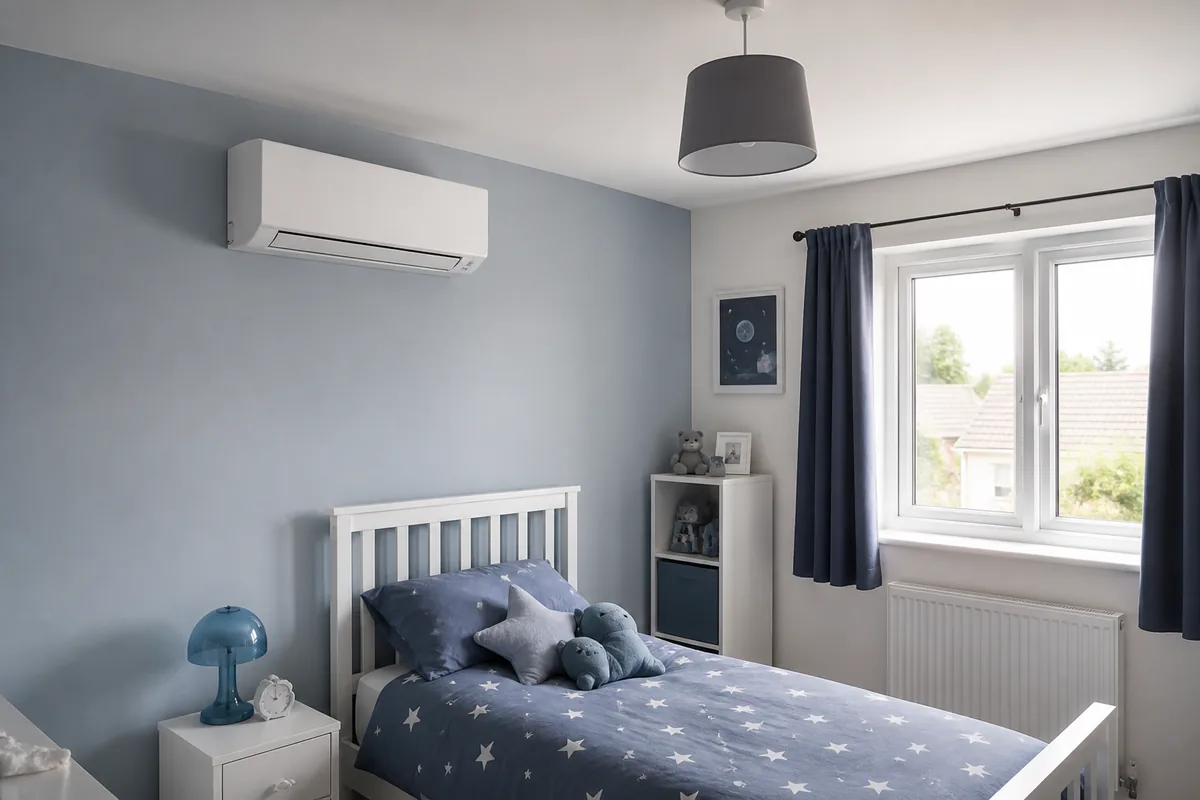
How many amps a portable air conditioner draws
The table turns each maker's published power draw into amps at 230 V, which is the figure that matters for a lead. It is our own arithmetic (watts divided by 230), using the running power the makers publish, read on 21 November 2026. Where a maker gives no wattage, the figure was worked out from its published efficiency. We have not measured any of these machines.
A 13A lead or socket is rated for 13 amps, which at 230 V is about 2,990 W. No portable in the dataset comes close to that on its own. A compressor can draw more for a moment when it starts than it does when running, and makers do not publish that figure, so treat the table as the running load and keep some margin.
| Model | Published power draw | Amps at 230 V | Share of a 13A lead |
|---|---|---|---|
| electriQ P16HPW 16000 BTU with heat pump | 1,760 W | 7.7 A | 59% |
| Meaco Cirro+ 16000 Inverter | 1,750 W | 7.6 A | 59% |
| Meaco Cirro+ 16000 Inverter with heater | 1,750 W | 7.6 A | 59% |
| Meaco Cirro+ 14000 Inverter | 1,550 W | 6.7 A | 52% |
| Meaco Cirro+ 14000 Inverter with heater | 1,550 W | 6.7 A | 52% |
| Meaco Cirro 12000 | 1,350 W | 5.9 A | 45% |
| Meaco Cirro 12000 with heater | 1,350 W | 5.9 A | 45% |
| Pro Breeze 12,000 BTU 3-in-1 Smart | 1,350 W | 5.9 A | 45% |
| Pro Breeze 12,000 BTU 4-in-1 Smart with heater | 1,350 W | 5.9 A | 45% |
| electriQ EcoPlus 12000 BTU with heat pump | 1,129 W | 4.9 A | 38% |
| MeacoCool MC Series Pro 10000 CH | 1,120 W | 4.9 A | 37% |
| De'Longhi Pinguino PAC EL110 Wi-Fi | 1,115 W | 4.8 A | 37% |
| De'Longhi Pinguino 120 Silent PAC EX120 | 1,050 W | 4.6 A | 35% |
| De'Longhi Pinguino GentleJet Inverter PAC AP130I | 1,035 W | 4.5 A | 35% |
| MeacoCool MC Series Pro 9000 CH | 1,005 W | 4.4 A | 34% |
| De'Longhi Pinguino PAC EM82 | 1,000 W | 4.3 A | 33% |
| De'Longhi Pinguino PAC EM90 Silent | 1,000 W | 4.3 A | 33% |
| De'Longhi Pinguino PAC EM93 Silent | 1,000 W | 4.3 A | 33% |
| Pro Breeze 9000 BTU 3-in-1 Smart | 1,000 W | 4.3 A | 33% |
| Olimpia Splendid Dolceclima Brezza 9 | 962 W (from its EER) | 4.2 A | 32% |
| De'Longhi Pinguino GentleJet PAC AP98 | 875 W | 3.8 A | 29% |
| De'Longhi Pinguino Extreme PAC EX93 | 810 W | 3.5 A | 27% |
| De'Longhi Pinguino Compact PAC ES72 | 808 W | 3.5 A | 27% |
| Pro Breeze 7000 BTU 3-in-1 | 778 W | 3.4 A | 26% |
| De'Longhi Pinguino 100 Silent PAC EX100 | 700 W | 3.0 A | 23% |
| Olimpia Splendid Dolceclima Air Pro A++ | 667 W (from its EER) | 2.9 A | 22% |
| Pro Breeze 5000 BTU Smart | 563 W | 2.4 A | 19% |
Why the lead still matters
A fan heater is on for twenty minutes. A portable air conditioner can run for eight hours on a hot night. Heat builds in plugs, sockets and cables under a steady load, which is why the electrical safety advice on leads is about how you use them, not only the rating.
Electrical Safety First says extension leads are rated at 13A, apart from some older ones rated at 10A. It also says cable reels are rated by the size of cable fitted and must be unwound to reach their rating, and that running a reel while it is wound can make it overheat and catch fire. A reel should have a thermal cut-out, and if it is not clearly marked, or has none, it should not be used.
Its advice is to use only one extension device per socket, and never to plug one extension lead into another, which it calls daisy chaining. It also advises against overloading a lead with appliances that together exceed its rating.
The sensible order of choices
Work down this list and stop at the first one that suits the room.
- Plug straight into a wall socket. The hose is short, so move the machine nearer the socket, or the window kit to the other side of the room, before reaching for a lead.
- If the socket is out of reach, use one short 13A lead with a fuse and a standard UK three-pin plug, bought from a reputable retailer, with only the air conditioner on it.
- Never use a block adaptor, a second lead, or a reel that is still wound.
- If you keep needing a lead for this machine every summer, ask an electrician for a new socket near the window. Electrical Safety First recommends more wall sockets over relying on extension leads.
- If you are renting, ask the landlord before anyone drills or adds a socket.
Signs the lead or socket is struggling
Electrical Safety First lists danger signs worth checking for every time you set the machine up. Switch off, unplug and stop using the lead if you see any of them.
- A smell of hot plastic near the plug, lead or socket.
- Scorch marks or blackening around the plug or socket.
- A plug or lead that is hot to touch after the machine has been running.
- Buzzing or crackling, or sparks or smoke.
- A fuse that blows or a breaker that trips for no obvious reason.
What about the heating mode and other portables
Where a maker publishes a heating draw, it is no higher than that model's cooling draw in our dataset, so the same advice applies in winter. The highest published heating draw is 1,400 W.
The same logic covers dehumidifiers. The highest published draw among the 54 dehumidifiers in our dataset is 1,730 W, about 7.5 A, so they sit in the same range as a portable air conditioner.
When to stop improvising
Running a portable air conditioner for most of the summer is a regular load, and a fitted split on its own circuit removes the question. The related guides cover the real running costs, the window kit and what a fitted unit involves.
If the breaker trips whenever the machine starts, do not keep resetting it. Stop, unplug it, and have an electrician look at the circuit.
If you buy a portable, buy on power draw and noise
Two numbers decide what a portable is like to live with. The power draw sets the running cost: at 26.32p per kWh, a 1,000 W machine costs about 26p an hour. The noise figure sets whether you can sleep next to it. These four are picked on their makers' published figures, checked 21 November 2026. Noise figures are each maker's own and are not comparable between brands.
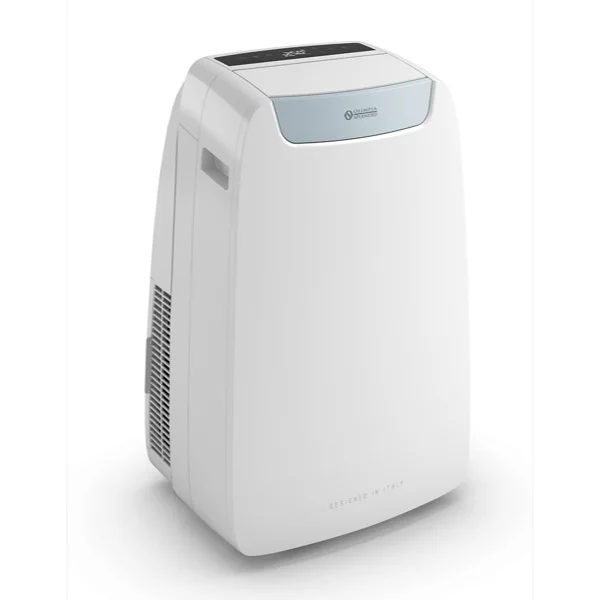
The efficient one
Olimpia Splendid Dolceclima Air Pro A++
2.4 kW, 667 W from its EER, class A++, 63 dB(A)
About 18p an hour at full power. Class A++ with an EER of 3.6, the highest we found.
Check price on AmazonPhoto: Olimpia Splendid
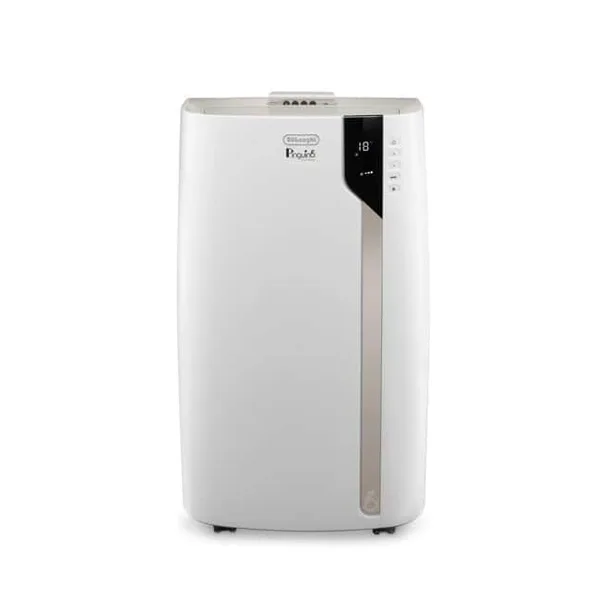
Low draw and quiet
De'Longhi Pinguino Extreme PAC EX93
8,900 BTU (2.5 kW), 810 W, class A+, 42 to 46 dB(A)
About 21p an hour at full power. The lowest published power draw of the models we compared that are quoted under 45 dB.
Check price on AmazonPhoto: De'Longhi
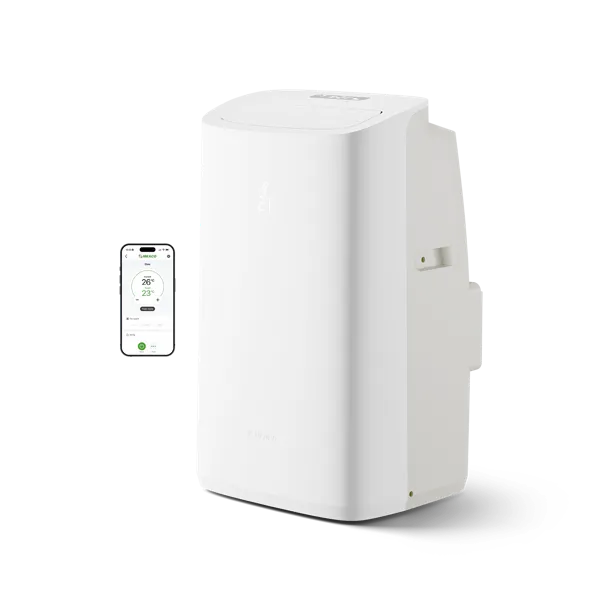
For a living room
Meaco Cirro 12000
12,000 BTU, 1,350 W, class A, from 45 dB
About 36p an hour at full power. Rated for 20 to 30 m², with two window kits included.
Check price on AmazonPhoto: Meaco
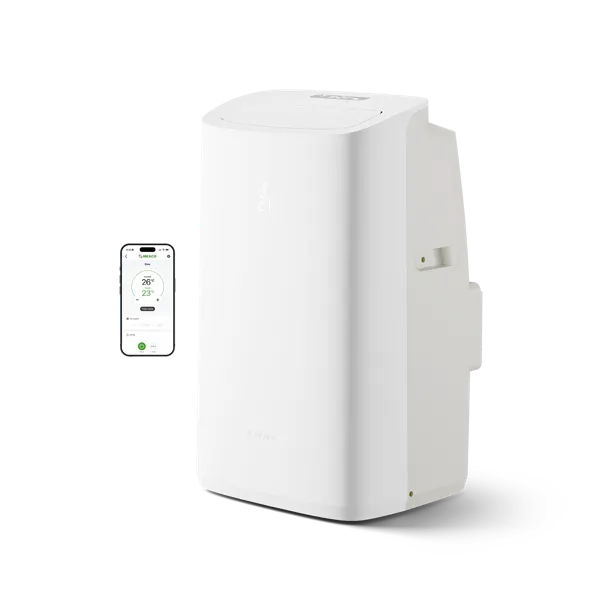
For a large room
Meaco Cirro+ 14000 Inverter
14,000 BTU, 1,550 W, class A, from 42 dB
About 41p an hour at full power. An inverter machine rated for 25 to 35 m².
Check price on AmazonPhoto: Meaco
Comparing another brand? Look for the lowest wattage for the BTU you need, and a published noise figure. Every portable needs its hose sealed into a window, so check which window kit is in the box.
Frequently asked questions
Can I plug a portable air conditioner into an extension lead?
You can use a single 13A extension lead that is in good condition, fully unwound if it is a reel, with nothing else on it. A wall socket is better. Do not daisy chain leads or use a block adaptor.
How many amps does a portable air conditioner use?
Between 2.4 A and 7.7 A at 230 V on the published running power of the 27 models in our dataset. Your machine's rating plate is the figure to trust.
Is a cable reel safe for an air conditioner?
Only if it is fully unwound and has a thermal cut-out. Electrical Safety First warns that running a reel while wound can make it overheat and catch fire.
Why does my breaker trip when the air conditioner starts?
Do not keep resetting it. It can mean an overloaded circuit or a fault. Unplug the machine and ask an electrician to check the circuit.
Is an older 10A extension lead enough?
Electrical Safety First says some older leads are rated at 10A, about 2,300 W at 230 V. The largest published running power in our dataset is about 7.7 A, so it would fit on paper, but with little margin on a long run. Replace an old lead rather than rely on it.
Core buying guides
Start with these high-intent guides, then dig into the rest of the library.
Related guides
More planning guides
- Overheating Assessment London: Part O, TM59 and Air Conditioning
- Quiet air conditioning and outdoor-unit noise
- Northern Ireland F-Gas Rules Are Not the GB Pages
- A Restrictive Covenant Can Block an Outdoor Unit
- What refrigerant should a new UK split use in 2026?
- Salford Air Conditioning Noise Assessment Guide
Sources and further reading
- Electrical Safety First: extension leads, cable reels and block adaptors
- Electrical Safety First: overloading sockets
- Meaco: portable air conditioner specifications
- De'Longhi UK: Pinguino portable air conditioner specifications
- Pro Breeze: product specifications
- electriQ: product specifications
- Olimpia Splendid 2025 retail catalogue
How this guide was prepared
This guide was written by the Local AC Installers Editorial Team. We compare official guidance, legislation and established consumer information, separate general information from project-specific advice, and show publication dates and sources. We do not accept installer accreditation claims at face value.