
When a portable air conditioner runs but does not cool, check the set-up before assuming a fault: the mode, a full water tank, a loose or kinked exhaust hose, gaps around the window kit and a dirty filter. Then check whether the room is bigger or hotter than the machine is rated for. Makers also build in a compressor delay of about 3 minutes after starting or a power loss, so give it that long first.
Why portables fail to cool in ways a fitted split does not
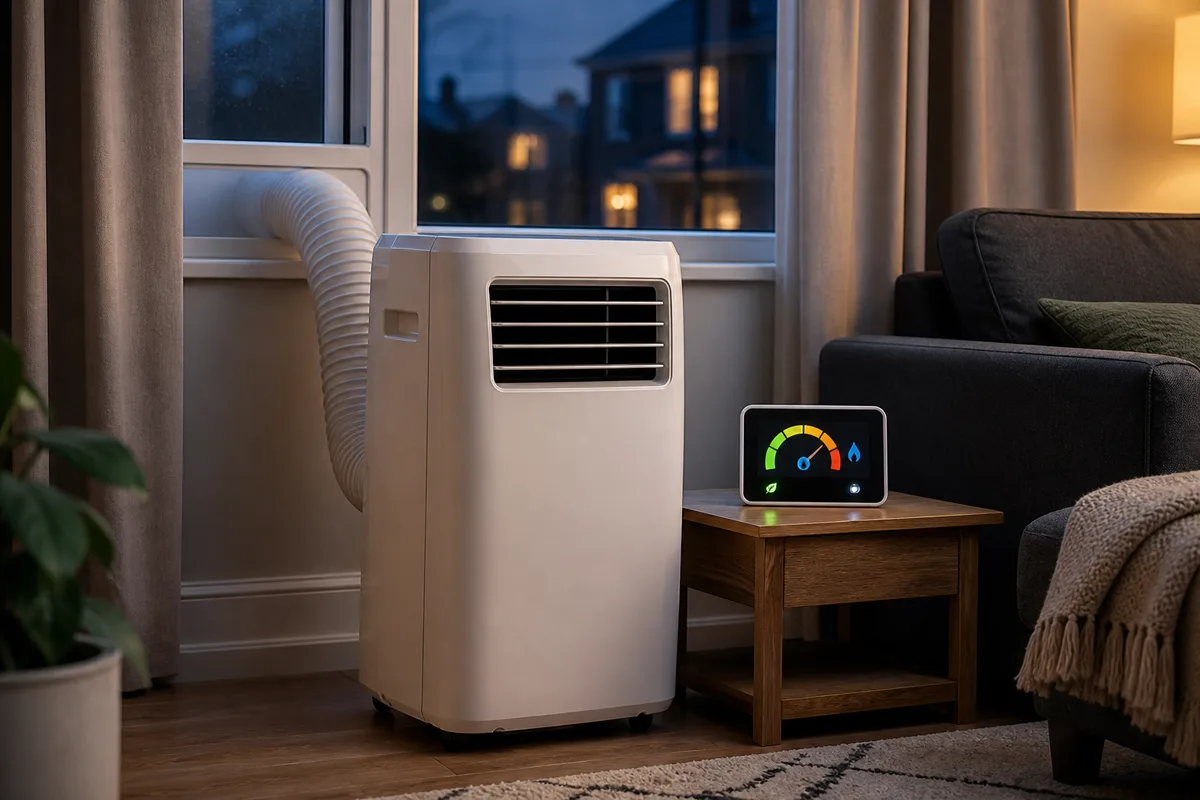
A portable sits in the room it is cooling and has to push the heat it removes out through an exhaust hose. Pro Breeze's manual says the hose must lead the hot air outside through a door or window, or it recirculates in the room. So portable problems centre on that hose, the window seal and the water the machine collects, which is why our general guide to air conditioning not cooling, written mainly for fixed splits, is not the right checklist here.
GE Appliances, a US maker, explains that a single-hose unit pushes room air outside, so replacement air is drawn in through gaps under doors and around windows, and on a hot day that air is warm. A dual-hose unit draws the air it uses to cool itself from outdoors instead. That is US guidance, but it describes how any single-hose unit works.
The fault-finding order
Start at the top: the early checks take seconds, the later ones decide whether the machine can cope with the room at all. Each fix comes from the makers' manuals or support pages listed at the end. We have not tested any of these machines.
| Check | How to check in two minutes | What fixes it |
|---|---|---|
| Mode and set temperature | Is it on cool, not fan or dry? Is the set temperature below the room temperature? | Select cool and set a temperature below the room reading. |
| Compressor delay | Did you just switch it on or have a power cut? | Wait 3 minutes. De'Longhi and Pro Breeze both list this delay. |
| Full water tank | Look for a tank symbol or a code such as Ft. | Drain it as the manual shows, then restart. |
| Exhaust hose | Is it clipped in at both ends, or kinked, stretched or sharply bent? | Refit it, short and straight. Pro Breeze says no bend over 45 degrees. |
| Window kit gaps | Run a hand round the seal. Warm air or daylight? | Close the gaps with the supplied kit. |
| Doors and windows | Are other windows or the room door open? | Close them while it runs. |
| Air filter | Slide the filter out. Is it grey with dust? | Clean it as the manual says. Meaco suggests every other week in season. |
| Blocked air path | Is the unit against a wall or curtain, or not level? | Move it clear, onto a level floor. |
| Sun and heat sources | Sun on the window, or an oven or heater on? | Draw curtains and remove the heat source. |
| Room size | Compare floor area with the maker's rating. | Cool a smaller space, or accept it is undersized. |
| Room too hot | Read the room temperature. | Check your manual's limit; Pro Breeze's 7,000 BTU unit says 32°C. |
Mode, delay and water: the quick wins
Meaco's Cirro page describes three modes: cooling lowers the room temperature, drying removes moisture, and fan-only circulates air when active cooling is not needed. So a unit left on dry or fan will blow air without doing the job you want. De'Longhi's page on a compressor that keeps stopping also asks you to check that the room is warmer than the set temperature.
De'Longhi says a portable collects more water when the room is humid, and shuts down when the tank is full until it is drained. Pro Breeze's manual says its unit beeps 20 times, shows Ft and pauses. With a continuous drain hose, Pro Breeze says to keep it free of kinks and not to leave the end under water, which can cause an air lock.
If a new or recently moved machine will not start, De'Longhi says to keep it upright for at least 6 hours after transport before switching on, and Pro Breeze's manual says at least two hours. Follow your own manual.
Hose and window: where most cooling is lost
Meaco says the exhaust duct should be fixed tight to the unit and lead straight to the window or door, sealed with a window kit, and warns that kinks in the hose or gaps in the window reduce efficiency. Rather than stretching the hose to a far window, move the unit closer.
Meaco supplies a standard kit for sash windows and a flexible kit for all window types. Our window kit guide covers casement, tilt-and-turn and sliding windows.
- Hose clipped into the unit and the window adaptor, with no gap at either end
- Hose short and straight, with no sharp bend or sag
- Window seal closed all the way round
- Other windows and the room door shut while it runs
Is the unit simply too small for the room?
De'Longhi lists, as a reason for poor cooling, that the appliance may simply not suit the room. Compare your floor area with the maker's rating. These are the rated room sizes in our data, as each maker publishes them, read on 21 November 2026. They are not our test results.
A 9,000 BTU machine rated for up to 22 m² is working outside its maker's rating in a 30 m² open-plan room, however well it is set up. Our guide to portable BTU and room size explains how to measure and when to go up a size.
| Cooling output | Model | Maker's rated room size |
|---|---|---|
| 7,000 BTU | Pro Breeze 7000 BTU 3-in-1 | up to 16 m² |
| 9,000 BTU | MeacoCool MC Series Pro 9000 CH | 16 to 26 m² |
| 9,000 BTU | Pro Breeze 9000 BTU 3-in-1 Smart | up to 22 m² |
| 10,000 BTU | MeacoCool MC Series Pro 10000 CH | 18 to 28 m² |
| 12,000 BTU | Meaco Cirro 12000 | 20 to 30 m² |
| 12,000 BTU | electriQ EcoPlus 12000 BTU with heat pump | up to 35 m² |
| 14,000 BTU | Meaco Cirro+ 14000 Inverter | 25 to 35 m² |
| 16,000 BTU | Meaco Cirro+ 16000 Inverter | 35 to 45 m² |
| 16,000 BTU | electriQ P16HPW 16000 BTU with heat pump | up to 42 m² |
Hot weather and the limits of a portable
Pro Breeze's 7,000 BTU manual lists an operating range of 5 to 35°C but says not to run it in cooling mode if the room is above 32°C. Other models differ, so check the operating conditions in your own manual before assuming a fault on the hottest day.
Meaco suggests keeping curtains closed during the day, especially on sunny south-facing windows, and opening windows only when it is cooler outside than in. If the unit copes in the evening but not mid-afternoon, heat gain is the more likely limit than a fault.
When to stop and call the maker
If everything above checks out and the air from the front is still no cooler than the room, contact the maker or retailer. Portables contain refrigerant: Pro Breeze's model uses R290, and its manual says anyone who works on the refrigerant circuit must hold a certificate from an accredited organisation. Do not open the casing.
If the room is simply too big, our guide on whether portable air conditioners are worth it covers the alternatives.
If you buy a portable, buy on power draw and noise
Two numbers decide what a portable is like to live with. The power draw sets the running cost: at 26.32p per kWh, a 1,000 W machine costs about 26p an hour. The noise figure sets whether you can sleep next to it. These four are picked on their makers' published figures, checked 21 November 2026. Noise figures are each maker's own and are not comparable between brands.
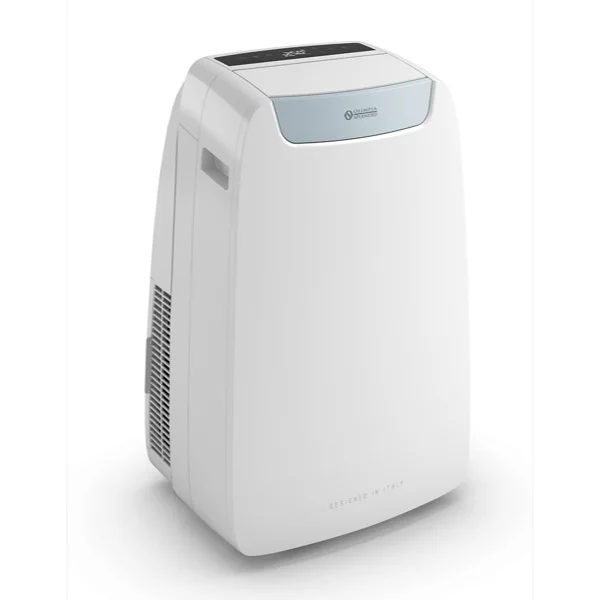
The efficient one
Olimpia Splendid Dolceclima Air Pro A++
2.4 kW, 667 W from its EER, class A++, 63 dB(A)
About 18p an hour at full power. Class A++ with an EER of 3.6, the highest we found.
Check price on AmazonPhoto: Olimpia Splendid
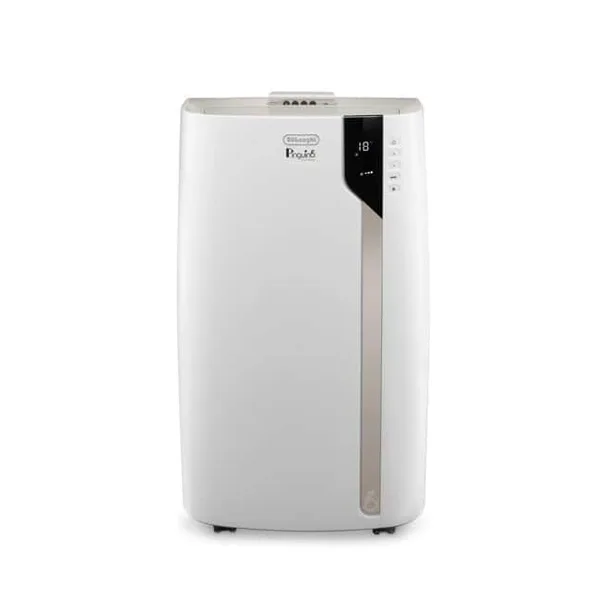
Low draw and quiet
De'Longhi Pinguino Extreme PAC EX93
8,900 BTU (2.5 kW), 810 W, class A+, 42 to 46 dB(A)
About 21p an hour at full power. The lowest published power draw of the models we compared that are quoted under 45 dB.
Check price on AmazonPhoto: De'Longhi
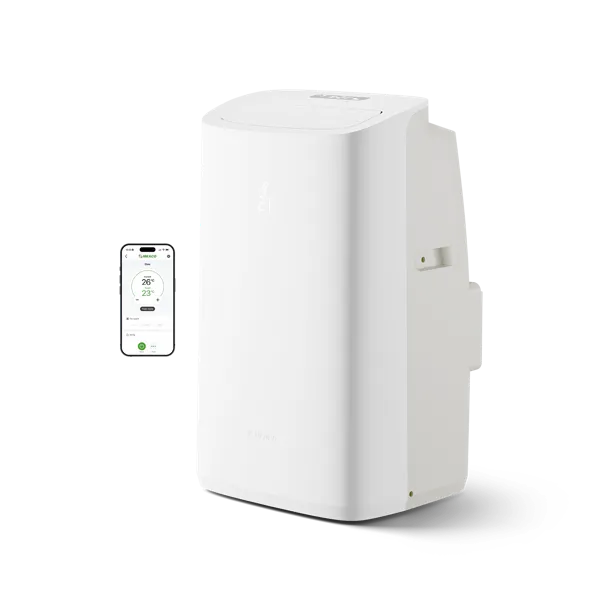
For a living room
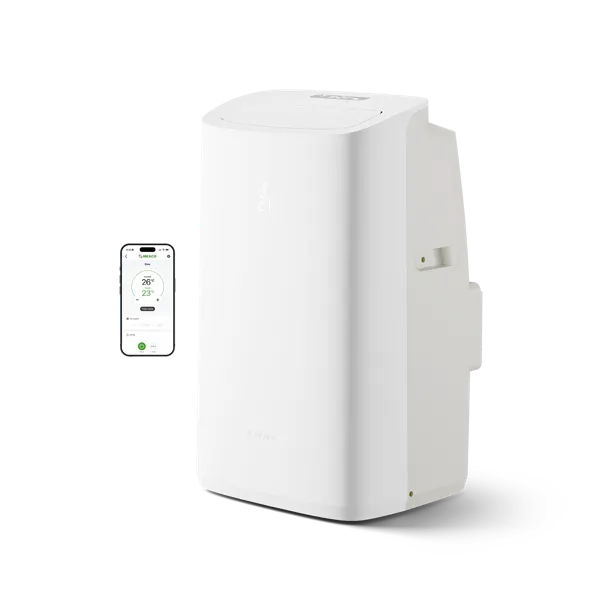
Meaco Cirro 12000
12,000 BTU, 1,350 W, class A, from 45 dB
About 36p an hour at full power. Rated for 20 to 30 m², with two window kits included.
Check price on AmazonPhoto: Meaco
For a large room
Meaco Cirro+ 14000 Inverter
14,000 BTU, 1,550 W, class A, from 42 dB
About 41p an hour at full power. An inverter machine rated for 25 to 35 m².
Check price on AmazonPhoto: Meaco
Comparing another brand? Look for the lowest wattage for the BTU you need, and a published noise figure. Every portable needs its hose sealed into a window, so check which window kit is in the box.
Frequently asked questions
Why is my portable air conditioner blowing air but not cold air?
Check it is on cool, not fan or dry, with the set temperature below the room temperature. Then wait 3 minutes for the compressor delay De'Longhi and Pro Breeze describe.
Does a full water tank stop a portable air conditioner cooling?
On many models, yes. De'Longhi says its units shut down until the tank is drained, and Pro Breeze's unit shows Ft and pauses.
Can I make the exhaust hose longer?
Pro Breeze says to keep the hose as short and straight as possible and not to overstretch it, and Meaco says it should lead straight to the window. Move the unit closer instead.
Why does my portable cool in the evening but not in the afternoon?
Afternoon sun adds heat. Close curtains on sunny windows and keep doors shut. Check your manual's limit too: Pro Breeze's 7,000 BTU model should not cool a room above 32°C.
Is a single-hose portable worse at cooling?
GE Appliances, a US maker, says a single-hose unit draws warm replacement air in through gaps, while a dual-hose unit avoids this and is more efficient in larger spaces.
How often should I clean the filter?
Meaco suggests a quick hoover every other week in the cooling season. De'Longhi lists a clogged filter as a reason a unit runs but does not cool.
Core buying guides
Start with these high-intent guides, then dig into the rest of the library.
Related guides
More installation guides
Sources and further reading
- De'Longhi UK: my Pinguino runs but does not cool the room, what can I do? (checked 25 Nov 2026)
- De'Longhi UK: my portable air conditioner keeps shutting off (compressor stops) (checked 25 Nov 2026)
- De'Longhi UK: I turned my air conditioner on but it will not start (checked 25 Nov 2026)
- De'Longhi UK: why does my portable air conditioner fill up with water so frequently? (checked 25 Nov 2026)
- Pro Breeze: 7000 BTU portable air conditioner instruction manual, PB-AC04 (checked 25 Nov 2026)
- Meaco: how to use an air conditioner, updated 22 May 2025 (checked 25 Nov 2026)
- Meaco: Cirro 12000 BTU portable air conditioner, modes and window kits (checked 25 Nov 2026)
- GE Appliances (US): portable air conditioner, single vs dual hose (checked 25 Nov 2026)
- Meaco: portable air conditioner specifications (rated room sizes, read 21 November 2026)
- Pro Breeze: product specifications (rated room sizes, read 21 November 2026)
- electriQ: electriQ EcoPlus 12000 BTU with heat pump specifications (rated room size, read 21 November 2026)
- electriQ: electriQ P16HPW 16000 BTU with heat pump specifications (rated room size, read 21 November 2026)
How this guide was prepared
This guide was written by the Local AC Installers Editorial Team. We compare official guidance, legislation and established consumer information, separate general information from project-specific advice, and show publication dates and sources. We do not accept installer accreditation claims at face value.