
Server room temperature and humidity targets should follow IT equipment requirements and recognised datacom guidance, measured at equipment inlets rather than at an arbitrary wall thermostat. ASHRAE thermal guidelines for data processing environments give recommended and allowable envelopes by equipment class, commonly cited for air-cooled classes around 18 to 27 degrees Celsius recommended dry-bulb conditions, with humidity expressed using dew point and relative humidity limits. Avoid overcooling out of habit, control moisture to reduce condensation and electrostatic risk, and set alarms on rate of change as well as absolute values.
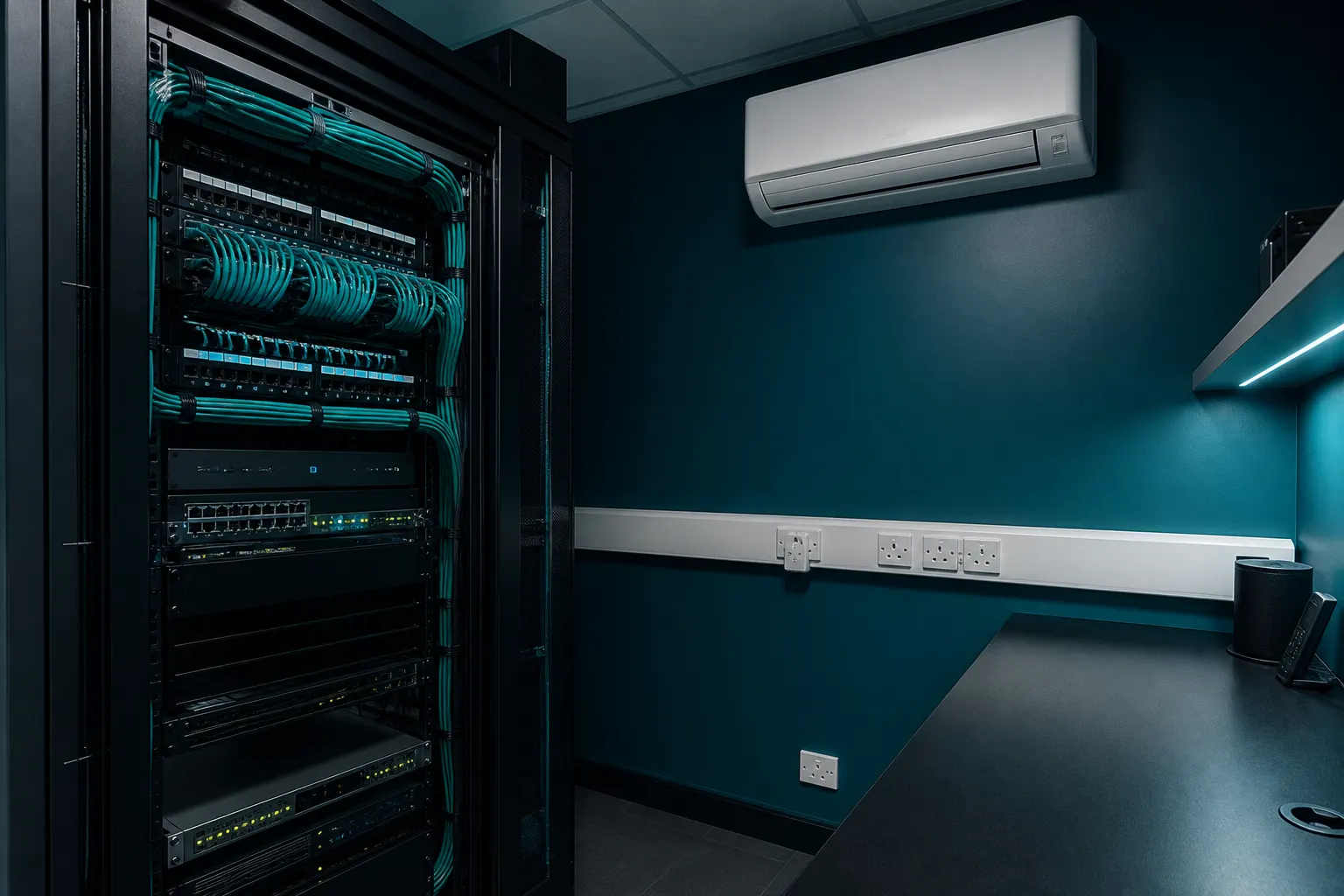
Use recommended envelopes, not folklore set points
Many older UK rooms were run colder than necessary because operators equated colder air with safer IT. Modern ASHRAE Datacom guidance distinguishes recommended operating envelopes from wider allowable limits. Recommended conditions are the practical design and operation target for most hours; allowable limits describe broader functionality bounds used by manufacturers, not a daily operating preference.
Always check the installed equipment class and vendor environmental specifications. Mixed generations of hardware may force a tighter common envelope than the newest servers alone would allow.
- Target inlet conditions at IT equipment, not corridor comfort.
- Document the equipment class and manufacturer limits used for design.
- Prefer stable recommended-range operation over frequent large set-point swings.
- Review targets after major IT refreshes.
Temperature: stability and location matter
For widely referenced air-cooled ASHRAE classes A1 to A4, the recommended dry-bulb range is commonly stated as 18 to 27 degrees Celsius at the equipment intake under the published assumptions. Operating colder wastes energy and can complicate humidity control without automatically improving reliability.
Rate of change also matters. Rapid warming after a cooling failure can be more damaging than a modest steady temperature within an agreed envelope. Place sensors at several rack heights and alarm before recovery options run out.
Humidity: dew point, condensation and ESD risk
ASHRAE guidance has moved emphasis toward dew-point based humidity control alongside relative humidity limits. Excessively moist air raises condensation risk on cold surfaces. Very dry air can increase electrostatic discharge concerns, particularly in poorly controlled small rooms.
Comfort cooling controls that only chase room dry-bulb temperature may leave humidity unmanaged. If the room has little moisture load, overcooling can still create local condensation on pipework or cabinet surfaces. Design and commissioning should show how moisture will be kept within the agreed envelope.
Monitor, trend and review
Continuous monitoring with trend history is more useful than occasional handheld readings. Correlate IT load, outdoor conditions and cooling status so operators can see whether a hot afternoon event is a capacity limit, an airflow fault or a control issue.
Agree escalation thresholds with facilities and IT teams. Include humidity or dew-point alarms where sensors exist, and test that alerts reach someone who can act outside office hours.
Frequently asked questions
Should a UK server room be kept at 18 degrees Celsius or lower?
Not by default. Many air-cooled environments can operate within a wider recommended band around 18 to 27 degrees Celsius at equipment inlets, subject to the installed kit and current ASHRAE or manufacturer guidance.
Is relative humidity the only humidity metric that matters?
No. Dew point is important for condensation risk and appears prominently in modern ASHRAE humidity guidance alongside relative humidity limits.
Where should temperature be measured?
At equipment air inlets, ideally at more than one height and in more than one rack row, rather than only on a wall far from the IT load.
Do office comfort standards apply to server rooms?
No. Server rooms are process environments. People comfort criteria are secondary to equipment inlet conditions, humidity control and resilience.
Core buying guides
Start with these high-intent guides, then dig into the rest of the library.
Related guides
Sources and further reading
How this guide was prepared
This guide was written by the Local AC Installers Editorial Team. We compare official guidance, legislation and established consumer information, separate general information from project-specific advice, and show publication dates and sources. We do not accept installer accreditation claims at face value.