
There is no single UK decibel limit for air conditioning. Instead, three sets of rules apply. Permitted development for a home outdoor unit in England relies on the MCS 020a planning standard, which caps noise at the nearest neighbouring window. Planning permission, where needed, often adds noise conditions. And at any time, a council can act against noise that is a statutory nuisance under the Environmental Protection Act 1990.
Permitted development for homes
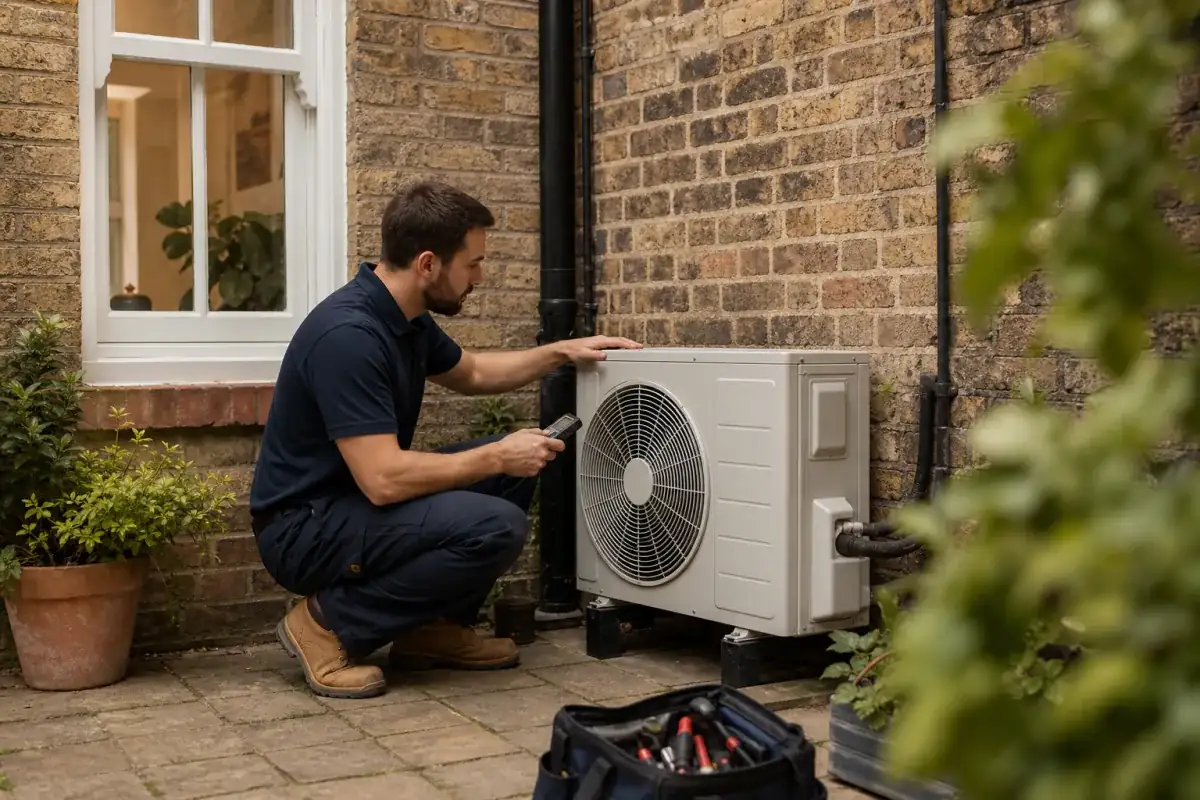
In England, an air-to-air or air-to-water heat pump outdoor unit can be permitted development under Class G, provided it meets conditions including the MCS 020a planning standard. That standard is a noise and siting calculation: it estimates the sound level at the nearest neighbouring habitable room window from the unit's sound power, distance and reflecting surfaces.
If the calculation fails, or other Class G conditions are not met, a planning application is needed. Ask the installer to show the calculation for the exact position, not a general claim that the unit is quiet.
The three rule sets compared
Each route applies at a different stage and is enforced by a different part of the council.
| Rule | When it applies | Who enforces it |
|---|---|---|
| Permitted development, MCS 020a | Before installation, for homes in England and Wales: no more than 42 dB(A) at 1 m from the nearest neighbouring habitable room window, calculated against an assumed 40 dB(A) background | Planning enforcement |
| Planning conditions | Where permission was granted with noise limits | Planning enforcement |
| Statutory nuisance, EPA 1990 | Any time noise unreasonably affects a neighbour | Environmental health |
| Commercial noise assessment | Business units, often assessed against BS 4142 | Planning and environmental health |
Statutory nuisance
Even a lawful installation can become a statutory nuisance if it unreasonably interferes with a neighbour's use of their home, for example a unit droning outside a bedroom window at night. Environmental health officers investigate complaints and can serve an abatement notice requiring the noise to be reduced.
Night-time noise, tonal hums and rattles from loose mounts attract the most complaints. Anti-vibration mounts, a better position and regular maintenance solve most problems.
Commercial units
Shops, restaurants and offices often need planning permission for condensers. Councils commonly ask for a noise assessment, often using BS 4142, which compares the unit's sound with the existing background level at the nearest homes.
For practical ways to keep a unit quiet, see our guide to quiet outdoor units, and for what to do if a neighbour complains, see our guide to neighbour noise complaints.
Frequently asked questions
Is there a legal decibel limit for air conditioning in the UK?
No single limit. Permitted development uses the MCS 020a calculation, planning permissions may set limits, and councils can act on statutory nuisance at any level that unreasonably affects a neighbour.
Can a neighbour complain about my air conditioning noise?
Yes. The council's environmental health team can investigate and serve an abatement notice if the noise is a statutory nuisance.
Do I need a noise assessment for a home unit?
For permitted development in England, the MCS 020a calculation does that job. A full acoustic report is more common for commercial units.
What is BS 4142?
A British Standard method for assessing industrial and commercial sound against background levels, often used for commercial condensers.
Core buying guides
Start with these high-intent guides, then dig into the rest of the library.
Related guides
More planning guides
Sources and further reading
- MCS 020: heat pump sound calculation for permitted development
- Institute of Acoustics: response on the air source heat pump planning standard
- Planning Portal: air source heat pumps
- UK legislation: Environmental Protection Act 1990, section 79
- GOV.UK: statutory nuisances and how councils deal with complaints
How this guide was prepared
This guide was written by the Local AC Installers Editorial Team. We compare official guidance, legislation and established consumer information, separate general information from project-specific advice, and show publication dates and sources. We do not accept installer accreditation claims at face value.