
A standard boiler thermostat such as a Nest or Hive cannot control a split air conditioner, because a split takes its commands over its own control protocol, not a simple on-off wire. The routes that work are the manufacturer's Wi-Fi app (built in or via an adapter), a manufacturer wired controller, or a universal infrared controller that mimics the remote. Built-in Wi-Fi is the most reliable choice on a new system.

Why your heating thermostat will not work
Boiler thermostats switch a relay on and off. A split air conditioner needs mode, setpoint, fan speed and louvre position, sent over the manufacturer's own communications. Wiring a heating thermostat to an indoor unit does nothing useful and can damage the board.
Ducted systems and some commercial units accept a third-party thermostat through an interface board. That is installer work and depends on the model.
The three ways to get app control
Choose by whether the system is new and how many rooms you want to control.
| Option | How it works | Best for | Watch out for |
|---|---|---|---|
| Built-in Wi-Fi | Indoor unit connects to your router; manufacturer app | New installs | 2.4 GHz Wi-Fi, app quality varies by brand |
| Manufacturer Wi-Fi adapter | Plug-in module on the indoor unit board | Recent models without built-in Wi-Fi | Adapter must match the model; installer fitting |
| Universal IR controller | Small box sends remote-control signals | Older units, rentals, mixed brands | Line of sight, no true status feedback |
| Wired controller | Wall controller from the manufacturer | Offices, shared rooms, no app needed | Cable run to the unit |
Smart home links
Most major brands' apps link with common voice assistants for simple commands such as on, off and setpoint. Deeper automations, such as running cooling when solar export is high or a room passes a temperature, are possible through home automation platforms but depend on the brand's integration.
If you have solar panels or a time-of-use tariff, schedules matter more than voice control. Pre-cool rooms during cheap or solar hours and let the unit coast through the peak.
Choosing a system with good controls
Ask installers which app the unit uses and look at its recent reviews. Check whether it supports schedules, holiday mode, energy reporting and several users. If you are fitting several rooms, keep one brand so all rooms appear in one app.
Place the Wi-Fi router or a mesh point where the indoor units can reach it. A weak signal is the most common reason app control drops out.
Adding app control to a unit that has none
If your air conditioner has an infrared remote but no Wi-Fi, a universal controller is the cheap fix. It sits in the room and sends the same signals as the remote.
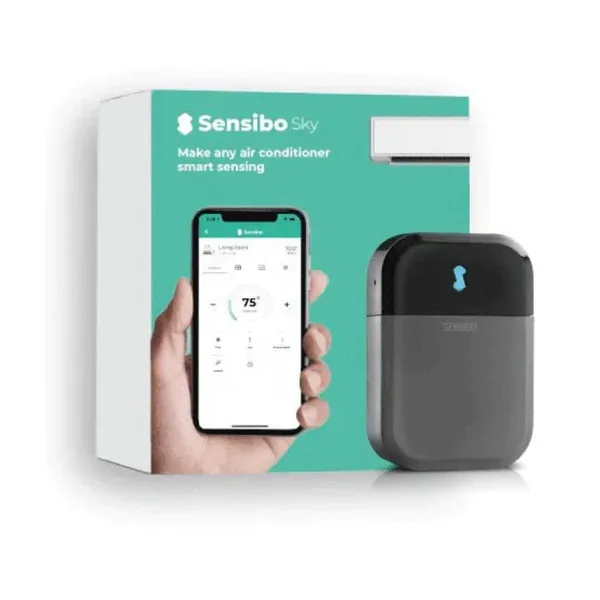
Universal controller
Sensibo Sky
Works with any air conditioner or heat pump that has a remote control, including split, window and portable units
Sensibo lists more than 10,000 supported models and links with Alexa, Google Assistant and Apple HomeKit. You need one for each indoor unit.
Check price on AmazonPhoto: Sensibo
Check your remote's model against the maker's compatibility list before you buy. A new split with built-in Wi-Fi does not need one.
Frequently asked questions
Can a Nest or Hive thermostat control air conditioning?
Not a normal split air conditioner. They switch boilers on and off and cannot send the mode and setpoint commands a split needs.
Can I add Wi-Fi to an older air conditioner?
Often, with the manufacturer's adapter if the model supports it, or with a universal infrared controller that copies the remote.
Does air conditioning Wi-Fi need 5 GHz?
Most units connect on 2.4 GHz only. Make sure your router broadcasts a 2.4 GHz network.
Is a universal IR controller reliable?
It works well for scheduling but cannot always confirm that the unit received the command, because the remote signal is one-way.
Core buying guides
Start with these high-intent guides, then dig into the rest of the library.
Related guides
More homes guides
Sources and further reading
How this guide was prepared
This guide was written by the Local AC Installers Editorial Team. We compare official guidance, legislation and established consumer information, separate general information from project-specific advice, and show publication dates and sources. We do not accept installer accreditation claims at face value.