
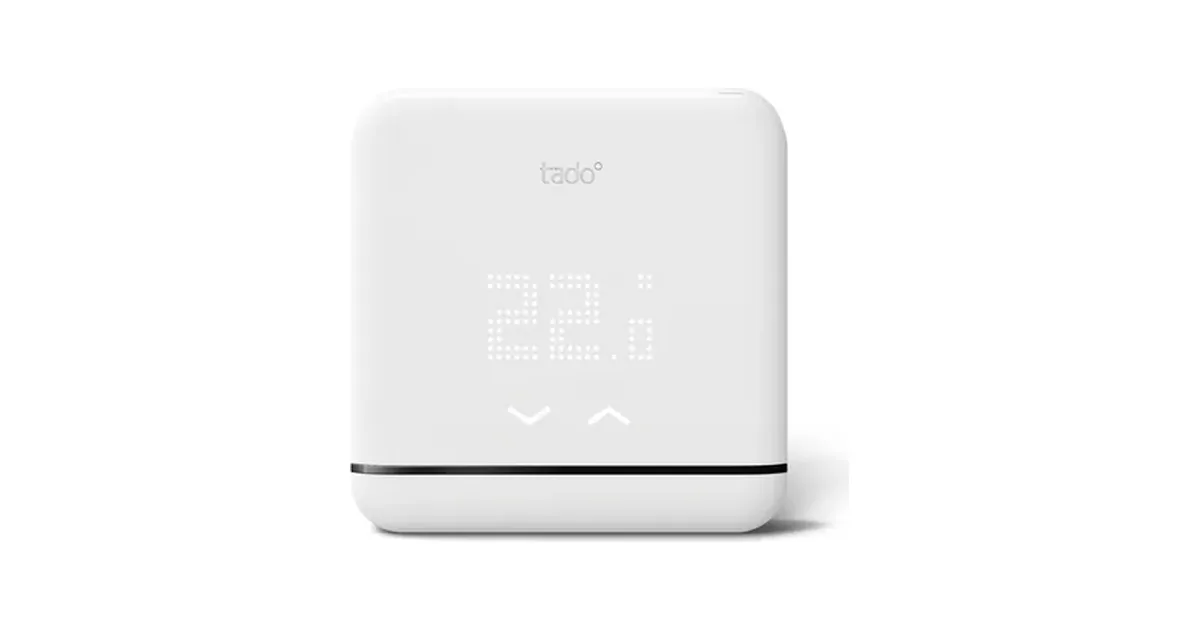
Tado's Smart AC Control replaces the infrared remote of an existing air conditioner, so you can change the mode, temperature and fan speed from your phone and set schedules. Tado says it works with air conditioners and air-to-air heat pumps whose infrared remote has a display showing the current settings, including splits, multi-splits and portables. The brand is not the test: the remote is. The device itself uses about 0.15 W, roughly 34p a year at the current price cap. What a schedule saves depends on the machine: a typical portable left running for 8 empty hours costs about £2.18, while the same hours on an efficient split cost well under 50p.
What it is and how it works
The Smart AC Control is a small square unit that you stick to a wall or stand near the indoor unit, in line of sight of it. It connects to your home Wi-Fi on 2.4 GHz, with no separate bridge, and sends the same infrared signals your remote does. Tado's UK shop lists it with a USB power adapter and a 1.85 m cable, so it needs a socket nearby.
From the Tado app you can switch the unit on and off, change the mode, temperature and fan speed, and set a daily schedule. Tado says the schedule and remote control are free. Geofencing, which notices when everyone has left, and open window detection send you a notification for free; with Tado's paid Auto-Assist they act on their own. Tado's UK product page shows Auto-Assist at €3.99 a month or €29.99 a year, in euros. It also works with Apple Home, Alexa and Google Home, according to Tado.
If the remote has a heating mode, Tado says it can control that too, so it can run an air-to-air heat pump on a heating schedule in winter.
Will it work with your air conditioner? Check the remote
Tado's support pages set one rule: the Smart AC Control V3+ works with most air conditioners whose infrared remote displays the unit's current settings, such as mode, target temperature and fan speed. Tado calls these full state display remotes. It does not support remotes without a display, or remotes whose display only shows the room temperature.
The reason is in how the remotes work. A full state remote sends every setting at once each time you press a button. A remote without a display sends only the change, such as one step up, so the controller has to keep track of the unit's settings. Tado says that synchronisation can be lost, for example when someone also uses the original remote, which is why it only supports full state remotes.
Two more limits come from Tado's own pages. Remotes that work by radio rather than infrared are not compatible, even if they have a display. And in fewer than 2% of cases Tado cannot read a remote's signal even though it passed the compatibility check, so the only sure test is to try it with your remote.
| Your remote | Works with the Smart AC Control? |
|---|---|
| Infrared, with a display showing mode, temperature and fan speed | Yes, in most cases |
| Infrared, no display, or display shows room temperature only | No |
| Radio frequency, with a display | No |
| Wired wall controller only, no handheld remote | Not covered by Tado's pages; it needs an infrared remote |
Which UK brands work with it?
Tado says the Smart AC Control works with more than 3,000 models from over 200 brands, but its UK pages do not publish a brand list, and its compatibility page now covers its heating products. So the answer is that the brand does not decide it. The remote does.
Most wall-mounted splits sold in the UK come with a handheld infrared remote with a display, including the ranges from the ten brands in our split efficiency data: Bosch, Daikin, Fujitsu, Hitachi, LG, Midea, Mitsubishi Electric, Panasonic, Samsung and Toshiba. That makes them likely candidates, but check your own remote against the table above rather than the name on the unit. Ducted and cassette systems are often run from a wired wall controller, which an infrared device cannot copy.
What it costs to run, and what a schedule saves
Tado puts the device's standby draw at about 0.15 W, or 1.31 kWh a year. At the Ofgem price cap of 26.32p per kWh that is about 34p a year. The saving comes from the air conditioner running less, and how much depends heavily on the machine.
We worked out what eight hours of running costs, the length of a working day with the house empty, from our own running-cost data. For portables we used the running power that 5 makers publish for 27 models. For splits we used the seasonal cost of each kWh of cooling for 25 ranges from 10 brands, from their published SEER figures. These are our own calculations from makers' figures at the current price cap, not measurements, and not Tado's figures.
| Machine | Basis | Cost of 8 hours |
|---|---|---|
| Portable air conditioner, lowest draw in our data | 563 W | £1.19 |
| Portable air conditioner, median of 27 | 1,035 W | £2.18 |
| Portable air conditioner, highest draw in our data | 1,760 W | £3.71 |
| Wall split, most efficient of 25 ranges | 2.5p per kWh of cooling; 10 kWh of cooling | 25p |
| Wall split, median of 25 ranges | 3.1p per kWh of cooling; 10 kWh of cooling | 31p |
| Wall split, least efficient of 25 ranges | 4.3p per kWh of cooling; 10 kWh of cooling | 43p |
| The Smart AC Control itself | 0.15 W standby | Under 0.1p |
What the numbers mean
For a portable, a schedule or geofencing is worth having. A median portable left running through eight empty hours on 30 summer days costs about £65, so stopping even a fraction of that soon covers the device. For an efficient wall split the same habit is worth much less in money, because a split delivers cooling far more cheaply. The 10 kWh of cooling in the table is our assumption, roughly a 2.5 kW unit at half its output for eight hours; your own figure will depend on the room and the weather.
Where a schedule still helps with a split is comfort: cooling a bedroom before bed, or warming a room before you get up, without running it all day. That is a convenience the maker's own app usually offers too.
Tado or the maker's own Wi-Fi?
Many splits sold now have Wi-Fi built in or offer an official adapter that plugs into the indoor unit's board. That connection is made by the manufacturer for that model. Tado works from outside the unit by infrared, the same way the remote does, and its support pages describe it keeping track of the settings it has sent rather than reading anything back from the unit.
So, as a rule of thumb: if your unit already has the maker's Wi-Fi, or an official adapter exists for your model, start there. If it does not, or you want one app for several brands, or for a portable, an infrared controller such as Tado is the practical route. Our guides to smart thermostats and app control and to retrofitting Wi-Fi on an older split cover the maker routes in more detail.
Before you buy
Tado's UK shop listed the Smart AC Control at a regular price of £89.99 on 24 November 2026, reduced to £69.99 in a sale that week. We have not tested it. The links in the picks below go to the exact listings on Amazon UK, checked on 26 November 2026, and may earn us a commission if you buy.
- Look at your remote: it needs a display showing mode, temperature and fan speed, and it must be infrared, not radio.
- Check there is a socket within reach of the 1.85 m cable, in sight of the indoor unit.
- Check your Wi-Fi works on 2.4 GHz where the unit will sit.
- Decide whether you want Auto-Assist for automatic geofencing, or are happy with notifications.
- If several people use the room, agree to use the app rather than the original remote.
Tado, and one alternative
Both sit in the room and send the same infrared signals as your remote. Check your remote against each maker's compatibility rules before you buy.
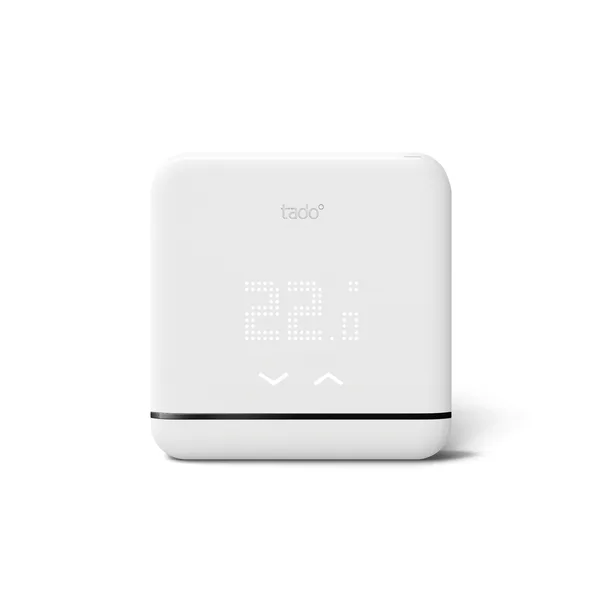
The one this guide covers
tado Smart AC Control V3+
Infrared, 2.4 GHz Wi-Fi with no bridge, about 0.15 W on standby, USB power with a 1.85 m cable
Tado supports infrared remotes with a display showing mode, temperature and fan speed. Schedules and app control are free; automatic geofencing needs its paid Auto-Assist.
Check price on AmazonPhoto: tado
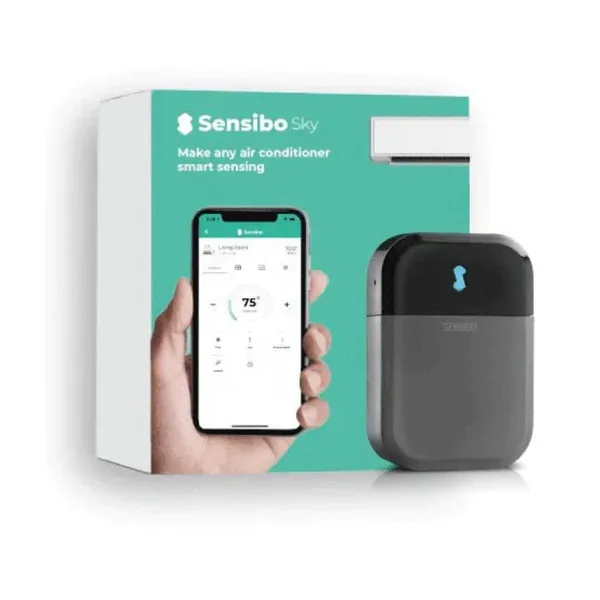
The main alternative
Sensibo Sky
Infrared, works with air conditioners and heat pumps that have a remote, by Sensibo's own list
Sensibo lists more than 10,000 supported models and links with Alexa, Google Assistant and Apple HomeKit. Check its compatibility list for your remote.
Check price on AmazonPhoto: Sensibo
If your unit has the maker's own Wi-Fi or an official adapter, start there. One controller works one indoor unit.
Frequently asked questions
Does Tado work with air conditioning?
Yes. Tado's Smart AC Control works with air conditioners and air-to-air heat pumps that have an infrared remote with a display showing the current settings, including splits, multi-splits and portables, according to Tado.
Is my air conditioner compatible with Tado?
Check the remote, not the brand. Tado supports infrared remotes that display the mode, temperature and fan speed. Remotes with no display, a display that only shows room temperature, or that use radio instead of infrared are not supported.
Does Tado Smart AC Control need a subscription?
No. Tado says app control and smart schedules are free. Its paid Auto-Assist makes geofencing and open window detection act automatically instead of sending a notification. Tado's UK page shows it at €3.99 a month or €29.99 a year.
How much electricity does the Tado Smart AC Control use?
Tado puts it at about 0.15 W on standby, or 1.31 kWh a year. At the Ofgem price cap of 26.32p per kWh that is about 34p a year.
Does Tado Smart AC Control need the Tado bridge?
No. Tado says the Smart AC Control connects directly to your Wi-Fi, with no bridge or extra hardware.
Can Tado control heating on an air conditioner?
Yes, if the remote has a heating mode. Tado says it can control heating on air conditioners and air-to-air heat pumps.
Core buying guides
Start with these high-intent guides, then dig into the rest of the library.
Related guides
More homes guides
Sources and further reading
- Tado: Smart AC Control, UK product page (checked 24 Nov 2026)
- Tado UK shop: Smart AC Control specifications and price (checked 24 Nov 2026)
- Tado support: which air conditioners are supported by the Smart AC Control
- Tado support: is tado compatible with my air conditioner
- Tado support: how much power does the Smart AC Control use
- Tado: product compatibility page (checked 24 Nov 2026)
- Ofgem: energy price cap, 1 October to 31 December 2026
- Local AC Installers: UK appliance running costs open data (portable and split figures)
How this guide was prepared
This guide was written by the Local AC Installers Editorial Team. We compare official guidance, legislation and established consumer information, separate general information from project-specific advice, and show publication dates and sources. We do not accept installer accreditation claims at face value.