
A domestic split in the UK sits under several rules at once, each with its own official page. The company that handles refrigerant needs F-gas certification. The outdoor unit may need planning permission or, in Scotland, a building warrant. Electrical work has to be safe and competent. The building regulations guide, the planning guide and the Scotland guide on this site each go deep. This page is the map, so a householder can see which question belongs where.
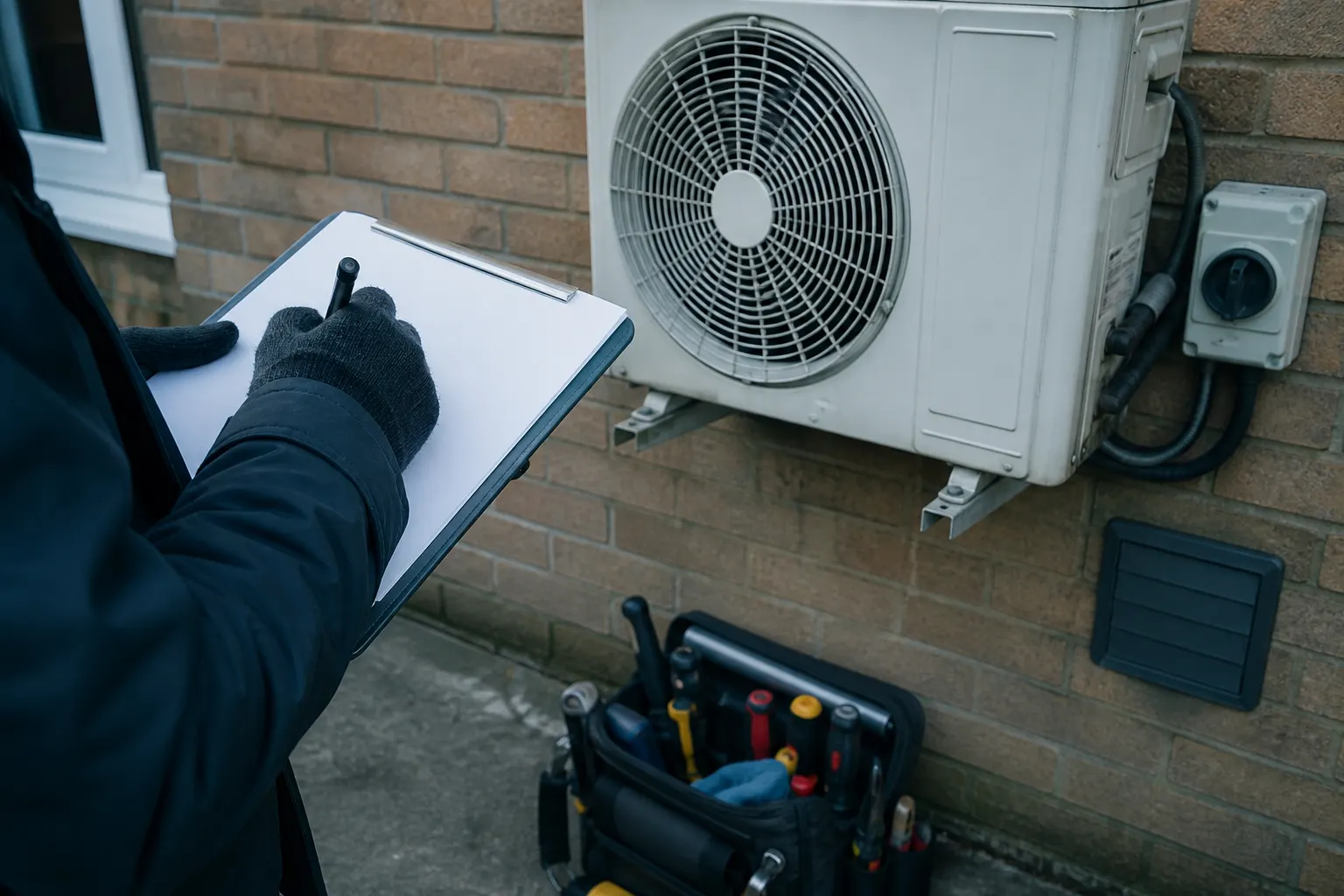
Refrigerant
If the job opens a refrigerant circuit, the business needs the right company certification. GOV.UK publishes that. It applies in a house as much as in a shop. Ask to see it before you pay a deposit. A handy friend with gauges is the wrong economy.
New equipment placed on the market also has to follow the current bans on certain F-gases. The refrigerant-rules guide explains why a 2026 domestic quote should name R32 or another fluid that passes the rule, and why an old R410A system already in the house is a different question. You do not need to memorise GWP numbers to ask 'which refrigerant, and is it allowed on a new install?'
Recovery at the end of the old unit's life is part of the same family of duties. It belongs on a replacement quote. It is not a householder job with a hacksaw.
Planning and the outdoor unit
In England, many householder outdoor units are considered under permitted development with conditions, and many are not, because of size, noise, a flat, or a conservation area. The Planning Portal publishes the heat-pump starting point. The planning guide on this site puts that into air conditioning language. Read that guide when the question is 'do I need permission?' This map only tells you that the question is real.
Flats and listed buildings add a freeholder or listed-building consent. Those are not details. They are the project. The flats guide and the listed extras guide pick up there.
Scotland uses building warrants and its own planning system. The Scotland installation guide is the one to open if the postcode is Scottish. Do not staple an English permitted-development answer onto a tenement.
Electrics and the fabric
The circuit that feeds the outdoor unit has to be suitable, protected, and installed by someone competent. Building regulations cover electrical safety in dwellings. The building-regulations guide and the consumer-unit guide are the depth. A quote should say whether a new circuit is included.
The hole through the wall, the bracket, the condensate and the fire stopping in a flat are building work. They are dull until they are wrong. A survey is how the regulations meet your actual wall rather than a diagram.
Noise is both a planning condition and a neighbour fact. A unit that ticks a guidance note and keeps a bedroom awake has still failed. The outdoor-position guide helps with placement. Regulations are the floor, not the whole design.
How to use the map
Write four lines in the enquiry: refrigerant work by a certified company, planning or warrant status, who does the electrics, and any lease or listing. Ask the quotation to answer those four. If it only shows a model and a price, it is an estimate of kit, not a compliant install.
You do not need to become the council. You do need to know which guide to open next. Permission questions go to the planning guide. Scottish warrants go to the Scotland guide. The shape of the system goes to the cost and installation guides.
Keep whatever consent you get with the invoice. The next owner and the next engineer will ask. The regulation that mattered is the one you can still find in the folder.
Frequently asked questions
Do I need planning permission?
Sometimes. England starts with the Planning Portal and the planning guide on this site. Flats, listed buildings and Scotland are more likely to need a specific yes. Get it before the unit is ordered.
Is F-gas only for big commercial systems?
No. Domestic splits contain F-gas. The company that installs or opens the circuit needs the proper certification. Ask for it.
Does building regulations approval mean I can skip planning?
No. They are different regimes. Electrics and structure can be a building-regulations question while the outdoor unit is a planning question. The quotation should not collapse them into one shrug.
Where is the detail?
Planning guide, building-regulations guide, Scotland guide, and the F-gas certification page on GOV.UK. This article only points at them so the right rule is opened first.
Core buying guides
Start with these high-intent guides, then dig into the rest of the library.
Related guides
More planning guides
- Does Air Conditioning Need MCS in the UK?
- End-Terrace Air Conditioning: Where the Outdoor Unit Goes
- EPBD and TM44 Compliance for Commercial Air Conditioning in the UK
- When a Developer Did Not Allow an Outdoor Unit in the UK
- Air Conditioning in an Ex-Local-Authority House in the UK
- Fire-Stopping Air Conditioning Pipes in a Flat
Sources and further reading
How this guide was prepared
This guide was written by the Local AC Installers Editorial Team. We compare official guidance, legislation and established consumer information, separate general information from project-specific advice, and show publication dates and sources. We do not accept installer accreditation claims at face value.