
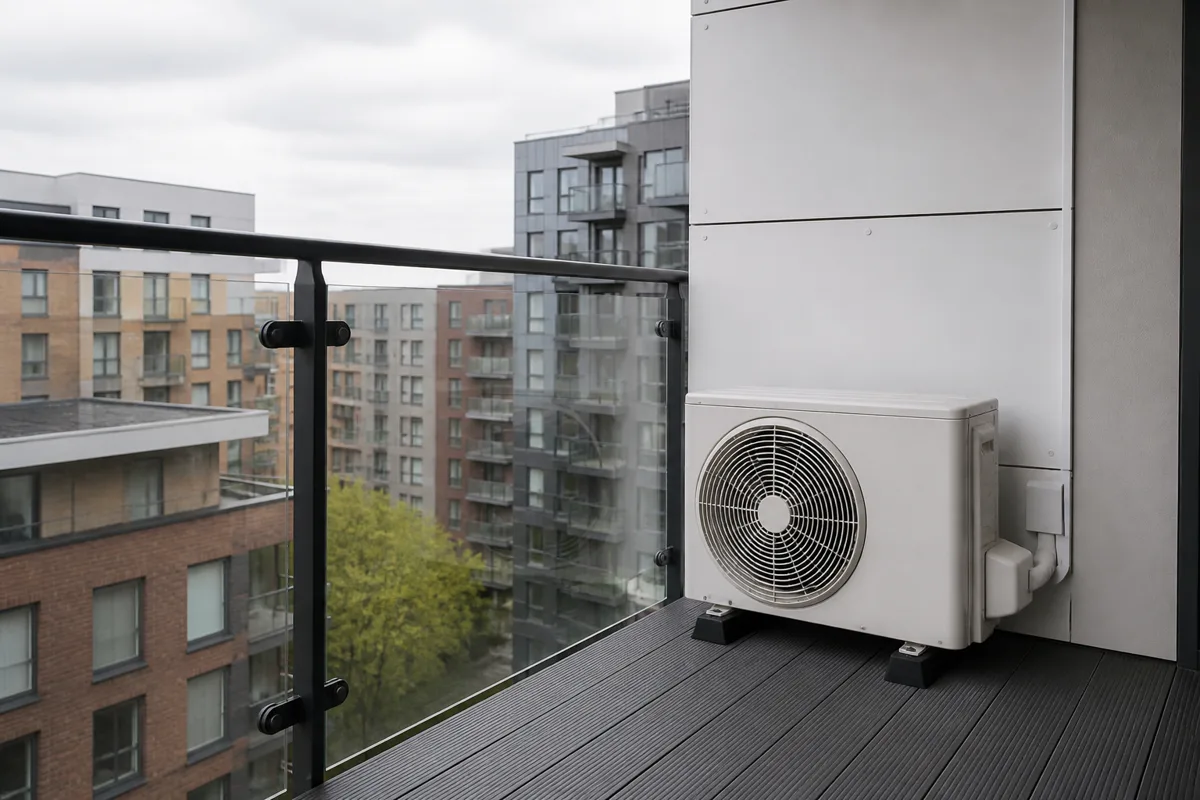
Ask for the reasons in writing, then change the proposal to answer them. Where your lease allows alterations with consent, the landlord should give reasons and should not refuse without a reasonable one. That protection stops at the parts of the building the freeholder owns, so a refusal to let you fix an outdoor unit to an external wall is usually theirs to make. Most refusals are about the look of the building, noise or risk to the structure, and each has a practical answer: a different position, a through-wall unit with no outdoor box, or a water-cooled unit with no external openings at all. Do not install without consent.
First, work out what kind of refusal it is
Your position depends on two things in the lease: who owns the part of the building the work touches, and what the alterations clause says. The table sets out the common cases.
| Situation | Where you stand | Next step |
|---|---|---|
| Lease allows alterations with consent, and the work is inside your flat or on your own balcony | The landlord should not refuse without a reasonable reason and should give reasons | Ask for reasons in writing and answer them |
| The work fixes equipment to an external wall, roof or grounds the freeholder owns | The duty to act reasonably does not apply to their property | Offer a different position or a system with no outdoor unit |
| Lease bans alterations outright | The landlord does not have to consider the request | Ask whether they would agree to vary the lease, and take advice |
| No reply at all | Not a refusal yet | Chase in writing with a new date |
Ask for reasons, and offer something back
Write back, thank them for the reply and ask for the reasons in writing so you can see whether the proposal can be changed. Then list what you are willing to consider. A freeholder who has said no to one drawing will often say yes to another.
Offer inspection by their surveyor, conditions they would like attached, and a meeting at the flat. Keep the tone practical. If the lease bans alterations, you are asking for a favour, and if the work touches their wall, they are entitled to say no.
- A different position for the outdoor unit, out of sight of the street and neighbouring windows.
- A quieter model, an acoustic enclosure or a colour-matched cover.
- A through-wall unit with no outdoor unit.
- A water-cooled unit with no outdoor unit and no openings in the external wall.
- Undertakings on servicing, making good and removal.
Alternatives that remove the objection
If the objection is the outdoor unit itself, a through-wall unit removes it. The whole machine sits on the inside of an external wall and breathes through two openings of about 160 to 200 mm, finished with grilles. Olimpia Splendid Unico and Powrmatic Vision are the main UK ranges, from 1.8 to 4.1 kW. They are louder indoors than a split and cost more to run, but they give a freeholder far less to object to.
If the objection is any change to the outside of the building, a water-cooled unit removes that too. Powrmatic's Vision H2O needs no outdoor unit and no external holes or grilles: it needs a cold water mains connection and a waste drain. Ask the supplier for its water consumption before you commit.
If nothing fixed is allowed, a portable unit is the fallback. It needs no consent because nothing is altered, at the price of noise and a hose through a window.
When the refusal looks unreasonable
Section 19(2) of the Landlord and Tenant Act 1927 says that where a lease forbids improvements without consent, that consent is not to be unreasonably withheld. The landlord can still require payment of reasonable legal or other expenses, compensation for damage or loss of value, and, where reasonable, an undertaking to reinstate.
Whether a refusal is unreasonable depends on the wording of your lease and the facts, and the protection does not extend to the landlord's own parts of the building. If you believe you are within it and the landlord will not move, speak to a solicitor or the Leasehold Advisory Service before doing anything else. Do not go ahead and install.
What not to do
Do not fit the unit and hope nobody notices. The Leasehold Advisory Service warns that an alteration made without required permission can put you in breach of your lease, that the breach passes to later owners, and that unauthorised alterations can make a flat harder to sell, remortgage or insure. Retrospective consent is harder to get than consent asked for properly.
Frequently asked questions
Can my freeholder refuse air conditioning?
Yes, in two common cases: where the lease bans alterations, and where the work fixes equipment to parts of the building the freeholder owns, such as an external wall or the roof. Where the lease allows alterations with consent and the work is within your flat, the landlord should not refuse without a reasonable reason.
Does the freeholder have to give reasons?
Where your lease allows alterations with the landlord's consent, the Leasehold Advisory Service says the landlord must respond in writing and state their reasons for refusing. That does not apply if the alterations involve parts of the building the landlord owns or controls.
Is there air conditioning that does not need freeholder consent?
A portable unit needs none, because nothing is altered. Every fixed system changes something: a split needs an outdoor unit, a through-wall unit needs two openings in an external wall, and a water-cooled unit needs plumbing connections. A water-cooled unit changes the least, with nothing on or through the outside of the building.
Can I appeal a freeholder's refusal?
There is no simple appeal. If your lease allows alterations with consent and you believe the refusal is unreasonable, the route is legal advice and, if necessary, the courts. Take advice from a solicitor or the Leasehold Advisory Service first, and try a revised proposal before a dispute.
What if the managing agent just does not reply?
Silence is not consent. Chase in writing with a new reply-by date, ask whether anything is missing from your application and offer an inspection. Keep copies of everything you send.
Core buying guides
Start with these high-intent guides, then dig into the rest of the library.
Related guides
More planning guides
- Air conditioning for flats and apartments
- Fire-Stopping Air Conditioning Pipes in a Flat
- Air Conditioning in an Ex-Local-Authority House in the UK
- How Long Does a Split Air Conditioner Last in the UK?
- Air Conditioning in Rented Premises: Landlord Responsibilities and Tenant Consent
- How to Ask Your Freeholder for Air Conditioning Consent, With a Sample Letter
Sources and further reading
How this guide was prepared
This guide was written by the Local AC Installers Editorial Team. We compare official guidance, legislation and established consumer information, separate general information from project-specific advice, and show publication dates and sources. We do not accept installer accreditation claims at face value.