
Ask in writing, with a dated letter, and send everything the freeholder needs to decide in one go: a clear description of the work, photos of where each unit goes, the installer's quote and insurance, the planning position and a timetable. That is the list the Leasehold Advisory Service gives, and it is what a managing agent's surveyor will ask for anyway. Give a reasonable time to reply, three weeks is fair, and do not start work until you have consent in writing. A two-line email asking whether they would mind is easy to refuse and easier to ignore.
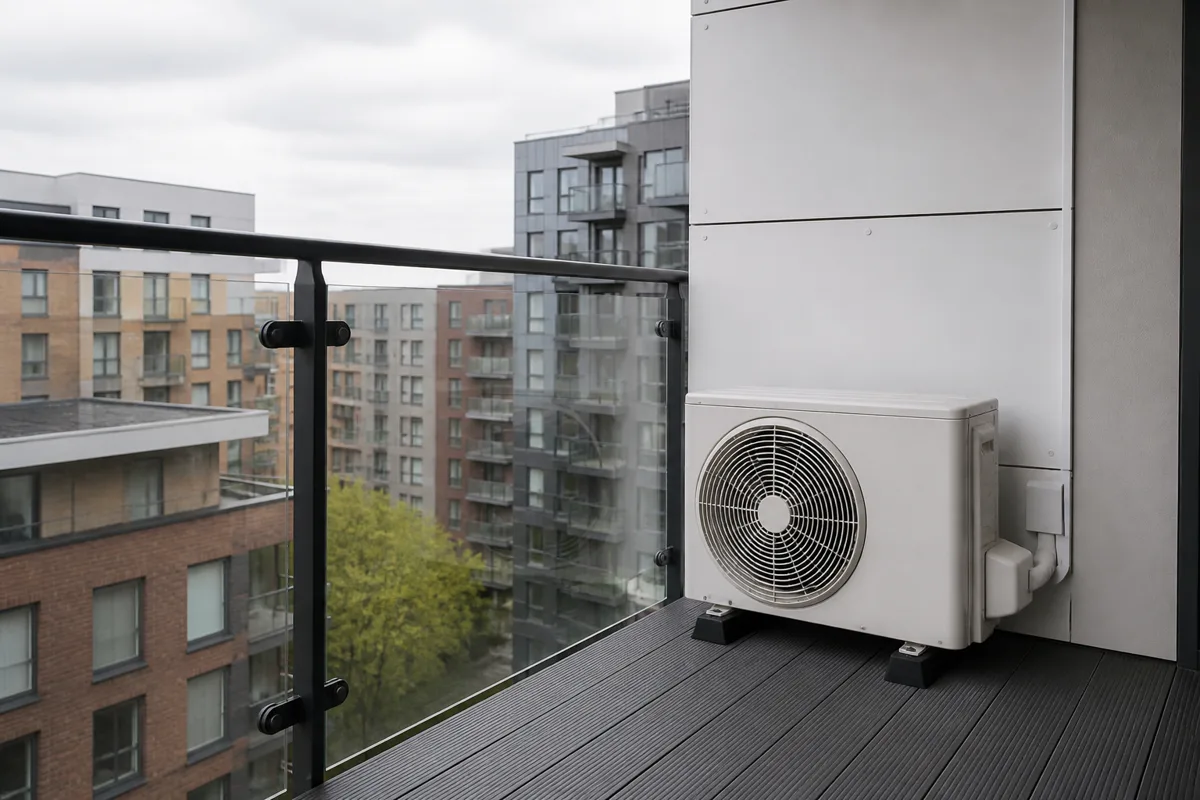
Before you write: two things to find in your lease
First, find what you own. The lease has a plan and a description of your flat, often called the demised premises. External walls, the roof and the grounds usually belong to the freeholder. An outdoor unit fixed to an external wall is therefore on the freeholder's property, not yours.
Second, find the clause on alterations. It will ban them, allow them, or allow them with the landlord's written consent or a formal licence. Where the lease allows alterations with consent, the Leasehold Advisory Service says the landlord must respond in writing, must give consent unless there is a reasonable reason to refuse, and must state their reasons. That duty does not apply to parts of the building the landlord owns, so a unit on your own balcony, with nothing fixed to the structure, is the strongest position to ask from.
What to enclose
A complete application is far more likely to be approved than a request for permission in principle. These seven enclosures answer the questions a freeholder's surveyor will ask.
| Enclosure | What it shows | Who provides it |
|---|---|---|
| Schedule of works | What will be fitted, where, the pipe route, the drain, the fixings and how common parts are protected | You, completed with the installer |
| Marked-up photographs | The exact position of each indoor unit and the outdoor unit | You |
| Manufacturer's data sheet | The size, weight and sound level of the equipment | The installer |
| Noise statement | The calculated level at the nearest neighbouring window, against the 42 dB(A) standard used for heat pumps | The installer |
| Planning position | Whether the work is permitted development or needs an application | You |
| Installer's quote, insurance and F-gas certificate | That a certified, insured business is doing the work | The installer |
| Undertakings | What you promise: servicing, making good, removal if required | You |
A short sample letter
Dear [freeholder or managing agent], I am the leaseholder of [flat address]. I am writing to apply for your written consent, under the alterations provisions of my lease, to install a reversible split air conditioning system with [number] indoor unit(s) and one outdoor unit.
The outdoor unit would be [on my private balcony, on anti-vibration feet, with nothing fixed to the balustrade]. The installer is [company name], which holds an F-gas company certificate and public liability insurance. The work is expected to take [number] working day(s) within the hours you allow.
I enclose a schedule of works, marked-up photographs, the manufacturer's data sheet, a noise statement with the installer's sound calculation, a note of the planning position, the installer's quotation and insurance, and the undertakings I am offering. I understand that you may be entitled to recover reasonable costs where the lease provides for it. Please tell me the likely amount before any cost is incurred.
Please let me have your decision in writing by [date three weeks from now]. I will not start any work until I have your written consent. Yours sincerely, [your name].
Planning: say where you stand
Freeholders often refuse because they assume planning permission will be a problem. Deal with it in the letter. Since 29 May 2025, England's permitted development right for air source heat pumps has covered blocks of flats, with conditions: only one unit on the whole block, an outdoor unit of no more than 0.6 cubic metres, and a unit that heats as well as cools. In Wales the right applies to houses only, so a flat needs a planning application.
If your block already has a unit, or the building is listed, say that you will apply for permission and will not start until it is granted. Planning and the freeholder's consent are separate, and you need both.
What the freeholder can charge
If the lease allows, the landlord can charge for legal or surveyor's costs of dealing with your request. The Leasehold Advisory Service describes these as administration charges: they must be payable under your lease and reasonable, and a demand must come with a summary of your rights. Where structural work affects parts of the building the landlord owns, the landlord may also ask for a premium, which has no legal limit. Ask for every figure in writing before you agree to anything.
Sending it
Send the letter and enclosures by email and by post, dated, and keep copies. Do not rely on a verbal yes. Tell your neighbours at the same time: an objection that arrives after the unit is fitted is much harder to deal with than one raised before.
- Get the installer's survey first, so the schedule and noise figures are real.
- Give a clear reply-by date. Three weeks is reasonable.
- Chase politely in writing if the date passes.
- Keep the consent with your lease. A buyer's solicitor will ask for it.
Frequently asked questions
Do I need my freeholder's permission for air conditioning in a flat?
Almost always. Most leases restrict alterations, and an outdoor unit or a hole through an external wall usually involves parts of the building the freeholder owns. Check the alterations clause and the plan in your lease, then apply in writing.
Can a freeholder refuse air conditioning?
If your lease allows alterations with consent, the landlord should not refuse without a reasonable reason and should give reasons in writing. That duty does not cover parts of the building the landlord owns, such as an external wall or the roof, where they can refuse. If the lease bans alterations outright, they do not have to consider the request.
How long should I give the freeholder to reply?
Your lease may say. If it does not, give a reasonable period. The Leasehold Advisory Service gives two weeks as an example, and three weeks is a fair date to put in the letter. The landlord does not have to meet your deadline, so chase in writing if it passes.
What is a licence to alter?
A formal legal document recording the landlord's permission for an alteration and any conditions attached, such as approved contractors or proof that the work meets building standards. Some leases require one; others accept written consent by letter.
What happens if I install air conditioning without consent?
You could be in breach of your lease. The Leasehold Advisory Service notes that unauthorised alterations can make a property harder to sell, remortgage or insure, and the breach passes to later owners. Apply first.
Core buying guides
Start with these high-intent guides, then dig into the rest of the library.
Related guides
More planning guides
- Air Conditioning in Rented Premises: Landlord Responsibilities and Tenant Consent
- How to Ask Your Landlord for Air Conditioning in a Rented Home, With a Sample Letter
- How Long Does a Split Air Conditioner Last in the UK?
- Licence to Alter for Air Conditioning in a Flat: What It Is and What It Costs
- Air Conditioning for a Georgian Townhouse
- Lost Your TM44 Report? How to Find or Replace an Air Conditioning Inspection Report
Sources and further reading
How this guide was prepared
This guide was written by the Local AC Installers Editorial Team. We compare official guidance, legislation and established consumer information, separate general information from project-specific advice, and show publication dates and sources. We do not accept installer accreditation claims at face value.