

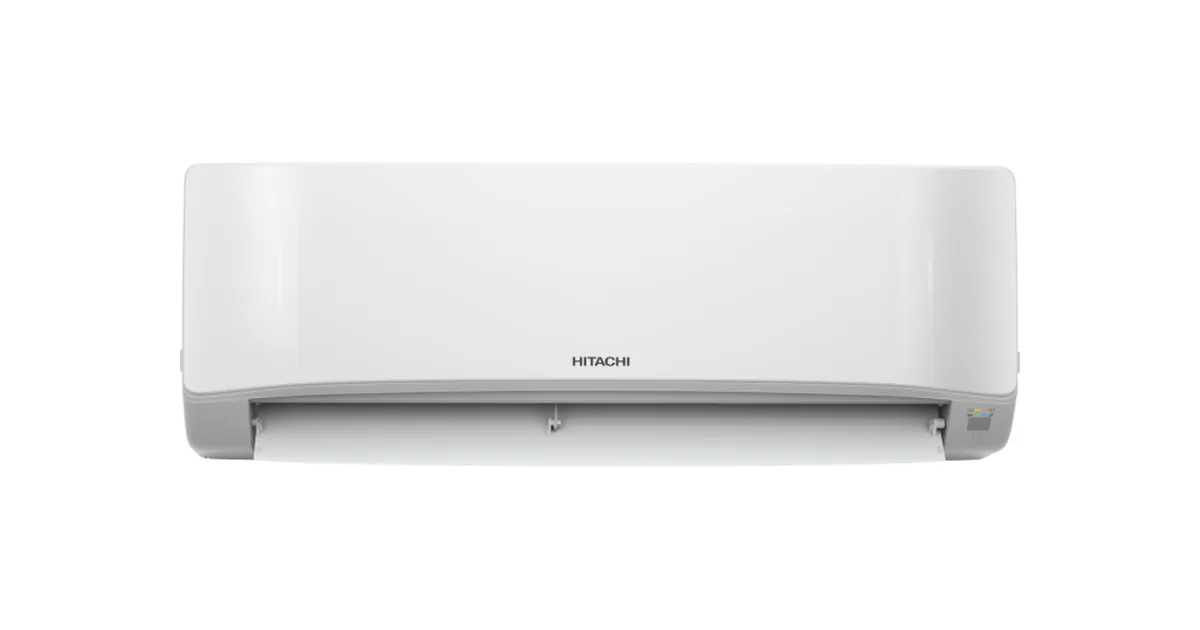
airHome 400 is Hitachi's mainstream wall heat pump for UK homes: R32, Wi-Fi through airCloud Home, FrostWash coil cleaning and a mould-guard routine. On the 2.5 kW class the trade datasheet lists SEER 7.5, SCOP 4.6 and indoor sound from 20 dB(A), with 20 metres of pipe and 10 metres of height. That is a solid everyday split, a step below the A+++ flagships on the label, with a self-clean story aimed at people who forget filters. The 7 kW sizes exist and carry lower seasonal numbers, so the suffix on the quote matters.
What you are buying besides the badge
FrostWash is Hitachi's freeze-and-defrost wash of the indoor heat exchanger, meant to keep airflow closer to the day it was fitted. Mould Guard is the companion routine for a coil that spends summer wet. Both are maintenance aids. They still sit alongside a human rinsing the pre-filter and a yearly look at the outdoor unit.
airCloud Home is the app for schedule and remote control. If the router is far from the indoor unit, say so on the survey. An app that cannot see the house is a remote control with extra steps.
The Hitachi brand guide on this site is the company context. This page is the 400 series wall unit, which is the one that shows up when a UK merchant prints RAK-DJ model codes.
The 2.5 kW class, then the big brothers
Distributor sheets for RAK-DJ25 list nominal cooling 2.5 kW (about 0.9 to 3.1), heating 3.4 kW (about 0.9 to 4.4), SEER 7.5, SCOP 4.6, energy class A++ cooling and A++ heating, sound pressure from 20 dB(A) upward, and a 20 metre / 10 metre pipe limit. Cooling operation is listed from about -10 deg C outdoors, heating from about -15 deg C. Refrigerant is R32.
The same family continues through 3.5 and 5.0 kW with SEER still around 7.5 to 7.0, then to larger 6 and 7 kW indoors on later sheets where SEER falls toward the low 6s and SCOP toward 4.0. A 7 kW airHome is a big-room tool. Quoting its existence as if it shared the 2.5 kW label is how comparisons go slippery.
Model suffixes move (PHAE, RHAE and similar). Match the code on the quote to the datasheet in the pack. A 2023 brochure and a 2026 trade line can both say airHome 400 and differ in the small print.
Who it fits
A main bedroom or a living room that wants a known Japanese manufacturer, a self-clean feature, and a pipe run up to 20 metres. Terraces where the outdoor unit is a long way from the indoor head are a fair brief. The WindFree Elite comparison is there because Elite stops at 15 metres and posts a higher label with a lower silent figure, in a smaller size range.
If the quote is really a value shoot-out against Daikin Sensira, put both model codes on one survey and compare SCOP, sound at the fan speed you will use, and who stocks parts in January. Sensira has its own page. airHome does not become Sensira by being the cheaper line on the day.
Outdoor sound on the small airHome class is in the mid to high 40s dB(A) on the sheets. Neighbours hear that, not the 20 dB(A) indoor number. Planning Portal rules in England still apply.
Install and aftercare
F-gas company, dedicated electrics, a drain that falls or a pump with an alarm you can hear. FrostWash does not empty a blocked condensate tray. Include the drain in the quote in the same sentence as the model code.
Ask for the energy label that matches the size, the pipe length allowed, and whether airCloud is included or an extra adaptor. Then ask what the visit costs in year two. A self-clean feature is a gift to a busy house and a poor substitute for a company that will come back.
Parts availability is the Hitachi question to ask locally. A keen price from a firm that rarely fits the brand can be a lonely warranty. The approved-installer idea on the Daikin and Mitsubishi pages has a cousin here: who, near your postcode, actually commissions these.
Frequently asked questions
Is airHome 400 as efficient as a Perfera or an AY?
On published seasonal numbers the 2.5 kW airHome 400 sits at SEER 7.5 and SCOP 4.6, A++/A++. Several flagship 2.5 kW rivals post A+++ and higher SEER. You may still prefer Hitachi for FrostWash, pipe length or the local installer.
Does FrostWash mean I never clean a filter?
FrostWash looks after the heat exchanger. The pre-filter still wants a rinse. The outdoor coil still wants a service.
Will a 2.5 kW unit do a large kitchen?
Use a larger size, and read that size's own SEER. The 7 kW models are in the range and they are not the same efficiency story.
Can I fit the outdoor unit 18 metres away?
The 2.5 kW class sheets list 20 metres and 10 metres of height. Stay inside the figure for the exact code, with extra refrigerant if the sheet requires it.
Core buying guides
Start with these high-intent guides, then dig into the rest of the library.
Related guides
More homes guides
- Hitachi airHome 400 vs 600 vs 800: Which to Buy
- Hisense vs Daikin Air Conditioning in the UK
- Hitachi airHome 800: Hitachi's Top Wall Unit in the UK
- Hisense Energy Pro X: A Budget Split With Premium Figures
- Hitachi vs Mitsubishi Electric Air Conditioning in the UK
- Air conditioning for a UK holiday cottage
Sources and further reading
How this guide was prepared
This guide was written by the Local AC Installers Editorial Team. We compare official guidance, legislation and established consumer information, separate general information from project-specific advice, and show publication dates and sources. We do not accept installer accreditation claims at face value.