

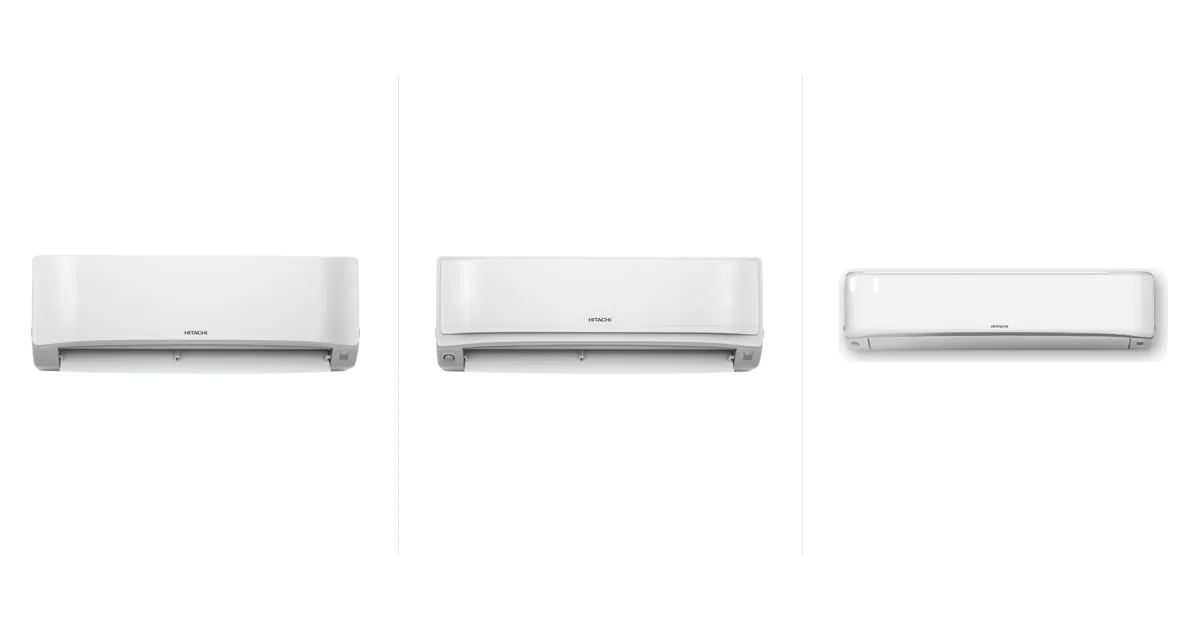
Buy the airHome 600 for most bedrooms and living rooms: at 2.5 kW it rates SEER 8.5 and SCOP 4.9 against the 400's 7.5 and 4.6, with the same 20 dB(A) quiet setting. Choose the 800 (SEER 9.50, SCOP 5.20) if the unit will heat a room through winter. The 400 is the budget option for a room used only on hot days.
The three ranges at 2.5 kW
Figures for airHome 400 and 600 are from Hitachi's UK technical tables. The airHome 800 figures are from its Eurovent certificate and Hitachi's UK range page. Running costs use the price cap of 26.32p per kWh.
| airHome 400 | airHome 600 | airHome 800 | |
|---|---|---|---|
| Model (indoor) | RAK-DJ25PHAE | RAK-VJ25PHAE | RAK-XJ25RHAE |
| SEER / cooling class | 7.5 / A++ | 8.5 / A+++ | 9.50 / A+++ |
| SCOP / heating class | 4.6 / A++ | 4.9 / A++ | 5.20 / A+++ |
| Indoor sound, quietest to highest | 20 to 41 dB(A) | 20 to 41 dB(A) | From 21 dB(A) |
| Cooling per hour at full output | About 8.8p | About 7.7p | About 6.9p |
| 100 hours at 60% load | About £5.30 | About £4.60 | About £4.20 |
| Heat per kWh | About 5.7p | About 5.4p | About 5.1p |
Features that differ
All three have Wi-Fi control through the airCloud Go app, FrostWash coil cleaning, Mold Guard, the ViroSense Z1 filter and the AQtiv-Ion ioniser listed on Hitachi's UK tables. The 600 adds a Nano Titanium pre-filter. The 800 adds a motion sensor for Smart Eco and SleepSense, FrostWash 3.0 and Mold Guard 2.0, and a heating range Hitachi states down to minus 20°C outside.
- airHome 400: the lowest price, fine for summer cooling in a bedroom or study.
- airHome 600: a clear efficiency step for little extra; the sensible default.
- airHome 800: for rooms heated through winter, or where the lowest running cost matters.
Sizes available
Hitachi's UK tables list the 400 in 1.8, 2.5, 3.5 and 5.0 kW sizes (RAK-DJ18 to DJ50) and the 600 in 1.8, 2.5, 3.5, 4.2 and 5.0 kW (RAK-VJ18 to VJ50). Efficiency drops on the larger sizes: the 5.0 kW airHome 400 rates SEER 7.0 and SCOP 4.5, and the 4.2 kW airHome 600 rates 7.5 and 4.6. Size the unit to a heat-gain survey, not to the biggest room you can imagine.
How to compare quotes
Ask every installer to name the indoor and outdoor model codes. A quote for an airHome 400 at the price of a 600 is common when the range is not written down. Compare the same capacity: a 3.5 kW unit is not a cheaper 2.5 kW unit.
Frequently asked questions
What is the difference between Hitachi airHome 400 and 600?
At 2.5 kW the 600 rates SEER 8.5 and SCOP 4.9 against the 400's 7.5 and 4.6, so it uses about 12% less electricity for cooling. Both publish a 20 dB(A) quiet setting.
Which Hitachi airHome is the quietest?
The 400 and 600 both publish 20 dB(A) on their quietest setting at 2.5 kW, and the 800 publishes 21 dB(A) in silent mode.
Is the Hitachi airHome 800 worth the extra?
For year-round heating, yes: SCOP 5.20 and a stated heating range down to minus 20°C. For summer cooling only, the airHome 600 is close enough on running cost.
Core buying guides
Start with these high-intent guides, then dig into the rest of the library.
Related guides
More homes guides
Sources and further reading
- Hitachi Cooling & Heating UK: airHome 400 range and technical table
- Hitachi Cooling & Heating UK: airHome 600 range and technical table
- Hitachi Cooling & Heating UK: airHome 800 range
- Eurovent certificate: Hitachi RAC-XJ25WHAE / RAK-XJ25RHAE (airHome 800, 2.5 kW)
- Ofgem: energy price cap, 1 October to 31 December 2026
How this guide was prepared
This guide was written by the Local AC Installers Editorial Team. We compare official guidance, legislation and established consumer information, separate general information from project-specific advice, and show publication dates and sources. We do not accept installer accreditation claims at face value.