

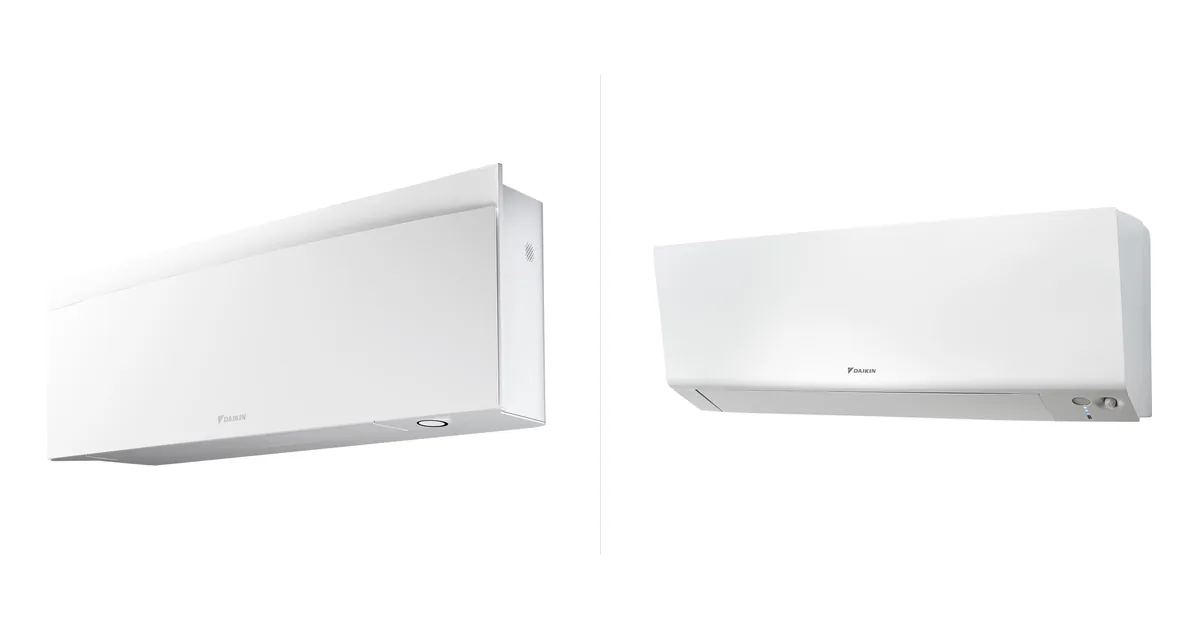
Perfera is the Daikin most installers quote for a bedroom or living room. Emura is Daikin's designer wall unit, bought because it will be seen. At 2.5 kW the Perfera FTXM25A publishes SEER 9.47 and SCOP 5.20, and the Emura FTXJ25AW publishes SEER 8.74 and SCOP 5.15. Both are A+++ for cooling and heating, and Emura's quiet mode is 19 dB(A). So you are not giving up efficiency for the design. You are paying more for a curved front and a choice of finishes. Buy Emura when the look matters. Buy Perfera when it does not.
What you are actually choosing between
Perfera is the middle of Daikin's residential range, above Sensira and Comfora. It has Daikin's Flash Streamer air cleaning, occupancy sensing and Onecta app control, in a standard white wall unit. Most Daikin installers default to it.
Emura is the designer unit in the third generation of the range, the FTXJ-A. It has a curved front in white, silver or black and is meant to sit on a wall people look at. The comparison with Stylish, Daikin's other design-led unit, has its own guide.
Both heat and cool. Both need an outdoor unit, a pipe route and a drain. The install labour is the same, so most of the price gap is the indoor unit.
Published figures at 2.5 kW
Perfera figures are from Daikin's FTXM-A table with the RXM-A9 outdoor unit. Emura figures are from Daikin's FTXJ-AW table and the Eurovent certificate for RXJ25A with FTXJ25AW. Both are single-split pairs. Multi-split figures are lower.
| Perfera FTXM25A | Emura FTXJ25AW | |
|---|---|---|
| SEER / cooling class | 9.47 / A+++ | 8.74 / A+++ |
| SCOP / heating class (average climate) | 5.20 / A+++ | 5.15 / A+++ |
| Quietest indoor step | The silent step on the FTXM-A sheet | 19 dB(A) in quiet mode |
| Front | Standard white wall unit | Curved front in white, silver or black |
| App | Onecta | Onecta |
| Refrigerant | R32 | R32 |
| Usually bought for | Bedrooms and living rooms | Rooms where the unit is on show |
Where the money goes
Perfera's cooling figure is higher, but both sit well inside A+++. Over a UK summer the difference is small. Heating is almost level: 5.20 against 5.15. You will not choose between these two on running cost.
The price gap is the indoor unit. Ask each installer to price the same outdoor position, pipe length and drain route, so the only line that changes is the indoor model. If the gap is larger than the difference in equipment, ask why.
Bigger sizes change the picture. Designer ranges often lose a label class sooner than the core range at 5 kW and above. Read the row for the size in your quote.
How to decide
Stand in the room. If the unit goes above a bed, on a bedroom wall behind the door or in a study, buy Perfera and spend the difference on a better outdoor position. If it goes on the main wall of a living room, Emura can be worth it.
Ask the installer to confirm the finish and colour suffix on the quote. Emura finishes have different model codes.
If you are also weighing Stylish, read the Emura versus Stylish guide. If you want the Daikin ladder below Perfera, read the Perfera, Stylish and Sensira guide.
Frequently asked questions
Is Emura more efficient than Perfera?
No. At 2.5 kW Perfera publishes SEER 9.47 and SCOP 5.20, and Emura publishes SEER 8.74 and SCOP 5.15. Both are A+++ for cooling and heating. Perfera is slightly ahead on cooling.
Is Emura quieter?
Emura's quiet mode is 19 dB(A) at 2.5 kW. Compare it with the silent step on the Perfera FTXM-A sheet for the same size. Both are quiet enough for a bedroom when the installer sizes them correctly.
Does Emura cost more to install?
The labour should be the same. The outdoor unit, pipework, drain and electrics are the same job. The difference should be in the indoor unit line on the quote.
Do both work with the Onecta app?
Yes. Both current ranges use Daikin's Onecta app. Check the unit has a Wi-Fi signal where it is mounted.
Core buying guides
Start with these high-intent guides, then dig into the rest of the library.
Related guides
More homes guides
Sources and further reading
How this guide was prepared
This guide was written by the Local AC Installers Editorial Team. We compare official guidance, legislation and established consumer information, separate general information from project-specific advice, and show publication dates and sources. We do not accept installer accreditation claims at face value.