
 vs

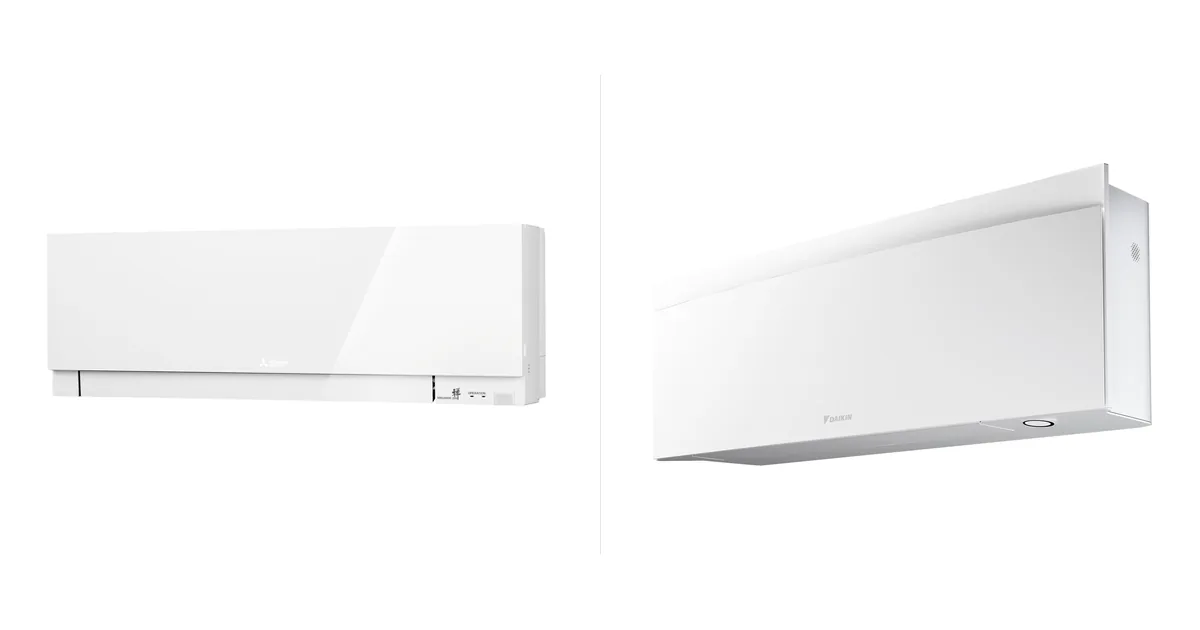
Choose Zen or Emura when the indoor unit is part of the room, not a white box to hide behind a door. Zen is Mitsubishi Electric's MSZ-EF: flat, 195 mm deep, black, silver or white, with published SEER 9.1 and SCOP 4.7 at 2.5 kW. Emura is Daikin's curved designer wall unit, with Onecta and a finish range of its own. This page puts Zen's published table next to the cells you should read on the Emura sheet, so the prettier brochure does not win by default. The Zen review and the Emura versus Stylish guide hold the rest.
Two different ideas of a pretty indoor unit
Zen is a shallow slab. It disappears by being flat and by matching a metal finish to the room. Emura curves. It disappears by looking like an object someone chose, closer to furniture than to an appliance. Stand in your room and decide which trick you want before you compare a single decibel.
Both heat and cool. Both need their own outdoor unit. A Zen indoor on a Daikin condenser is not a clever saving. It is a warranty problem. The quotes should be complete pairs.
Depth decides some walls on its own. Zen's 195 mm is published and slim. Emura's depth is on the FTXJ drawing for the year of the quote. Tape both on the plaster. A curved unit that collides with a cornice is a failed design, however high the SCOP.
What is published, and what you still ask for
Zen's figures are from Mitsubishi Electric's MSZ-EF sheet. Emura's current SEER moves with the generation, so the figure that counts is the one on the datasheet in your quote, not a number remembered from a showroom three summers ago.
| Zen, published 2.5 kW | Emura FTXJ25AW, 2.5 kW | |
|---|---|---|
| Face | Flat, black, silver or white | Curved Daikin panel and finish |
| Depth | 195 mm | The FTXJ drawing for that code |
| SEER / class cooling | 9.1 / A+++ | 8.74 / A+++ |
| SCOP / class heating | 4.7 / A++ | 5.15 / A+++ |
| Quiet cooling | 19 dB(A) | The low fan step on the sheet |
| App | MELCloud | Onecta |
| Small multi-split sizes | 1.8 and 2.2 kW indoors exist | Ask which Emura sizes are multi-only |
Heating class is where designer units drift apart
Zen at 2.5 kW is A++ for heating, SCOP 4.7, and A+++ for cooling. Some Daikin designer sizes post A+++ heating as well. If you will run the unit from October to April in a room the boiler never liked, that heating cell is worth more than the finish. If you will cool a spare room for ten nights a year, buy the face you prefer and sleep well.
The 5 kW Zen drops to 30 dB(A) and a lower label. Ask whether the Emura size you need does the same. Designer ranges are kindest at 2.5 and 3.5 kW. Large rooms should see the large-room data before the large-room fascia.
Wi-Fi is built into Zen's current story and is part of Emura's Onecta story. Both need a signal at the indoor unit on the day. A dead spot behind a thick wall is a site issue, not a brand failure.
Who will come back
Mitsubishi Electric and Daikin both have deep UK installer networks, and your town may have one and not the other. Parts in a cold week are the test. Ask each company how they register the warranty and what the call-out looks like after year one.
Noise outside still belongs to the neighbour. Compare outdoor sound on the two pair units at the size you want, then the bracket position. Indoor beauty with a condenser in a lightwell is indoor beauty with a complaint.
If you are also looking at LN or Stylish, those guides exist so this one can stay a two-horse race. Bring a third unit in only after these two datasheets have been read.
Frequently asked questions
Which is more efficient?
At 2.5 kW, Zen publishes SEER 9.1 and SCOP 4.7. Put the Emura SEER and SCOP for the same nominal size beside those. Heating class is the likely gap. Cooling is often close.
Which is quieter?
Zen's 2.5 kW low cooling step is 19 dB(A). Read Emura's low step on the same size. Then listen, if the showroom will run both on low. The sheet is the contract. Your ear is the check.
Can I mix the indoor units later on one outdoor?
Only inside one manufacturer, and only on a multi-split outdoor that lists those indoors. Zen's smallest sizes are already multi-only. Ask before you plan a second room.
Does the colour change the performance?
On Zen, black, silver and white share the performance table. Confirm Emura finishes the same way on the Daikin sheet. You are choosing paint and plastic, then checking the label has not quietly changed size.
Core buying guides
Start with these high-intent guides, then dig into the rest of the library.
Related guides
More homes guides
- Mitsubishi Electric vs Panasonic air conditioning
- Monobloc Air Conditioning vs a Split in the UK
- Mitsubishi MXZ Multi-Split Outdoors in the UK
- The Most Reliable Air Conditioning Brands in the UK: What the Evidence Shows
- Multi-Split Outdoor vs Two Condensers in the UK
- Air Conditioning on a Narrowboat or Widebeam: What Works
Sources and further reading
How this guide was prepared
This guide was written by the Local AC Installers Editorial Team. We compare official guidance, legislation and established consumer information, separate general information from project-specific advice, and show publication dates and sources. We do not accept installer accreditation claims at face value.