

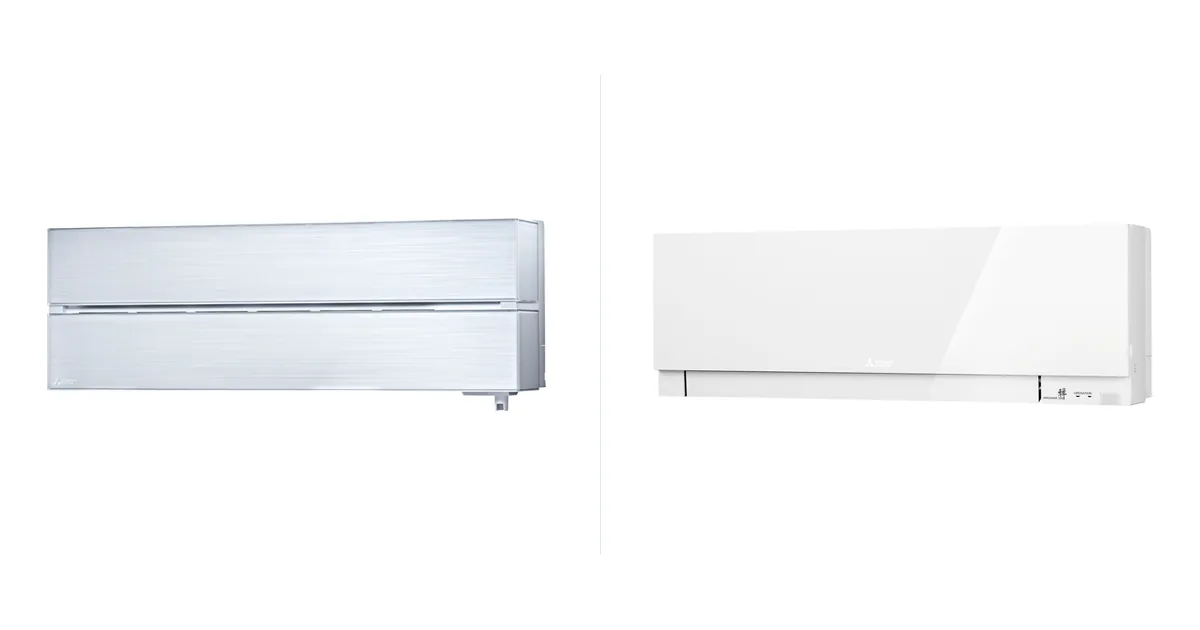
Both are Mitsubishi Electric's premium wall splits, and both are quiet. They are bought for different reasons. MSZ-LN is the efficiency and sensor unit: at 2.5 kW it publishes SEER 10.5 and SCOP 5.2, A+++ for cooling and heating, with a 19 dB(A) silent step, a 3D i-See sensor and the Plasma Quad Plus filter. MSZ-EF, sold as Zen, is the flat designer unit: 195 mm deep against LN's 233 mm, SEER 9.1 and SCOP 4.7, which is A++ for heating. Pick LN if the unit will heat through winter. Pick Zen if the wall or the look decides it.
Same badge, two different jobs
LN is the unit Mitsubishi puts its best seasonal numbers into. It has a curved front, a choice of colours and a sensor that looks for people and the warm and cold parts of the room. It is the one to buy when running cost and comfort matter more than how flat the box is.
Zen is a slab. It hides by being shallow and by matching a black, silver or white finish to the room. Its numbers are good, not the best in the range. People buy it because the indoor unit is on a wall everyone looks at.
Neither is a bigger cooler. A 2.5 kW LN and a 2.5 kW Zen move the same nominal heat. The survey sets the size. The model choice is about label, depth and look.
The published figures side by side
LN figures are from Mitsubishi Electric's MSZ-LN25VG2 technical sheet. Zen figures are from the UK MSZ-EF data sheet. Both are for the 2.5 kW single-split pair. Read the same rows on the sheet for the size in your quote, because bigger sizes drop a class or two.
| MSZ-LN25 | MSZ-EF25 (Zen) | |
|---|---|---|
| SEER / cooling class | 10.5 / A+++ | 9.1 / A+++ |
| SCOP / heating class (average climate) | 5.2 / A+++ | 4.7 / A++ |
| Quietest indoor step, cooling | 19 dB(A) | 19 dB(A) |
| Indoor unit, H x W x D | 307 x 890 x 233 mm | 299 x 885 x 195 mm |
| Indoor unit weight | 15.5 kg | 11.5 kg |
| Room sensing | 3D i-See sensor | Without the 3D i-See sensor |
| Filtration | Plasma Quad Plus | Without Plasma Quad Plus |
| Refrigerant | R32 | R32 |
Heating is where the gap is worth money
Both units carry an A+++ cooling label, and you will not notice the cooling difference in a UK summer. Heating is different. SCOP 5.2 against 4.7 means the LN delivers about 10 percent more heat per unit of electricity over an average season. If the split will heat a room from October to April, that difference repeats every winter.
If the room needs cooling for a few weeks a year and the boiler does the heating, the label gap barely registers on a bill. Then depth and look are fair reasons to choose.
Depth decides some walls on its own. 38 mm sounds small until the unit sits next to a curtain pole, a cornice or a sloping ceiling. Tape the outline of both on the wall before you choose.
What to ask before you sign
Ask for the exact model code on the quote, including the colour suffix, and the matching outdoor unit. A cheaper outdoor unit paired with a premium indoor unit can change the published figures.
Ask where the outdoor unit goes and what it publishes for sound at that size. A quiet indoor unit does not help a neighbour with a condenser outside their bedroom window.
If you are also looking at the MSZ-AY, read the AY versus LN guide first. AY is the everyday unit both of these sit above.
Frequently asked questions
Which is more efficient, LN or Zen?
At 2.5 kW the LN publishes SEER 10.5 and SCOP 5.2, A+++ in both seasons. Zen publishes SEER 9.1 and SCOP 4.7, A+++ for cooling and A++ for heating. The heating figure is the gap that matters if the unit heats through winter.
Which is quieter?
Both publish 19 dB(A) on the quietest cooling step at 2.5 kW. Check the low fan step on the sheet for your size as well, because that is the one you will hear most nights.
Why is Zen thinner?
Zen is designed as a flat panel. It is 195 mm deep against LN's 233 mm, and it weighs 11.5 kg against 15.5 kg. LN carries more inside the case, including the 3D i-See sensor and the Plasma Quad Plus filter.
Can I put an LN and a Zen on one outdoor unit?
Only on a Mitsubishi Electric multi-split outdoor unit that lists both indoor units. Ask the installer to confirm the combination on the manufacturer's table before you plan a second room.
Core buying guides
Start with these high-intent guides, then dig into the rest of the library.
Related guides
More homes guides
Sources and further reading
How this guide was prepared
This guide was written by the Local AC Installers Editorial Team. We compare official guidance, legislation and established consumer information, separate general information from project-specific advice, and show publication dates and sources. We do not accept installer accreditation claims at face value.