
 vs

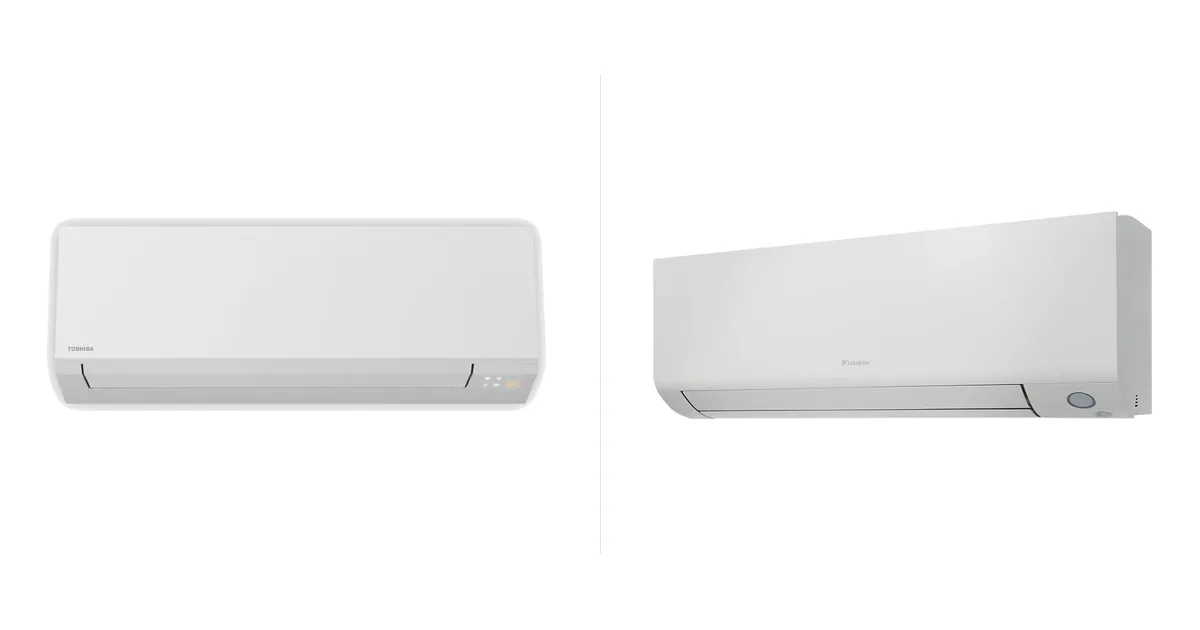
Toshiba and Daikin are both first-tier brands, and their wall ranges line up closely. At 2.5 kW, Toshiba's Shorai Edge publishes SEER 8.6 and SCOP 5.1 with a 19 dB(A) low step. Daikin's Perfera FTXM25A publishes SEER 9.47 and SCOP 5.20. Both are A+++ for heating. Perfera is ahead on cooling, and Daikin has the larger UK installer network. Toshiba often prices a little below Daikin for a similar unit. Choose on the installer, the outdoor position and the written quote, then the badge. Update, 29 November 2026: Toshiba UK no longer lists the Shorai Edge among its wall units; its current matt black and white unit is the Shorai Curve, so a new quote will usually name the Curve. Ask the installer for the Curve's figures at your size before comparing.
Ranges that line up
Daikin's residential ladder runs Sensira, Comfora, Perfera, then the design-led Stylish and Emura, with Ururu Sarara at the top. Toshiba's runs Seiya, Shorai Edge, the textile-covered Haori and the premium Daiseikai 10.
The fair pairings are Seiya with Sensira, Shorai Edge with Perfera, and Haori with Stylish. Each pairing already has its own guide or table on this site.
Both brands also make light-commercial and VRF systems. Daikin's VRV and Toshiba's SMMS are both common in UK offices.
Core units at 2.5 kW
Shorai Edge figures are from Toshiba's brochure. Perfera figures are from Daikin's FTXM-A table with the RXM-A9 outdoor unit. Both are single-split pairs.
| Toshiba Shorai Edge | Daikin Perfera FTXM25A | |
|---|---|---|
| SEER | 8.6 | 9.47 |
| SCOP (average climate) | 5.1 | 5.20 |
| Heating class | A+++ | A+++ |
| Lowest indoor step | 19 dB(A) | The silent step on the FTXM-A sheet |
| Front | Matt black or white | White |
| Refrigerant | R32 | R32 |
Where they differ in practice
Heating is almost level, 5.1 against 5.20, so winter running costs will be close. Perfera's cooling figure is higher, but both are A+++ and the gap will be small on a UK bill.
Daikin has the larger domestic installer base in most UK towns. That usually means more companies willing to quote, and easier servicing later. Toshiba is well supported, especially by installers who also do commercial work.
Price. Toshiba often comes in a little below Daikin for a similar unit. Make sure the quotes are for the same size, outdoor position, pipe length and drain, or the comparison is meaningless.
What to ask both installers
Ask for the exact indoor and outdoor model codes, the published sound figures for both units, and where the outdoor unit will go.
Ask how the warranty is registered, how long it lasts on that model, and what servicing keeps it valid. Both brands tie the longest cover to registration and installer status.
Ask who will service it. A cheaper brand that nobody local services can cost more over ten years than the dearer brand everyone fits.
Frequently asked questions
Is Toshiba cheaper than Daikin?
Often a little, for a similar unit. The equipment gap is usually smaller than the gap between installers, so compare complete written quotes for the same job.
Which is more efficient?
At 2.5 kW, Daikin Perfera publishes SEER 9.47 and SCOP 5.20, and Toshiba Shorai Edge publishes SEER 8.6 and SCOP 5.1. Heating is close. Perfera leads on cooling.
Which is quieter?
Shorai Edge publishes 19 dB(A) on its lowest step at 2.5 kW. Compare it with the silent step on the Perfera sheet for the same size. Both suit bedrooms when sized properly.
Which has better UK support?
Daikin has more domestic installers in most UK towns. Toshiba is well supported, especially through installers who also do commercial work. Ask who will service it locally.
Core buying guides
Start with these high-intent guides, then dig into the rest of the library.
Related guides
More homes guides
Sources and further reading
- Toshiba UK: RAS Shorai Curve Black & White high-wall (current range, checked 29 Nov 2026)
- Toshiba UK: Shorai Edge brochure
- Daikin Europe: Perfera FTXM-A / RXM-A9 technical table
- Toshiba Carrier UK: Daiseikai 10 launch
- Energy Saving Trust: Air-to-air heat pumps
- GOV.UK: certification for companies working on equipment containing F-gas
How this guide was prepared
This guide was written by the Local AC Installers Editorial Team. We compare official guidance, legislation and established consumer information, separate general information from project-specific advice, and show publication dates and sources. We do not accept installer accreditation claims at face value.