
 vs

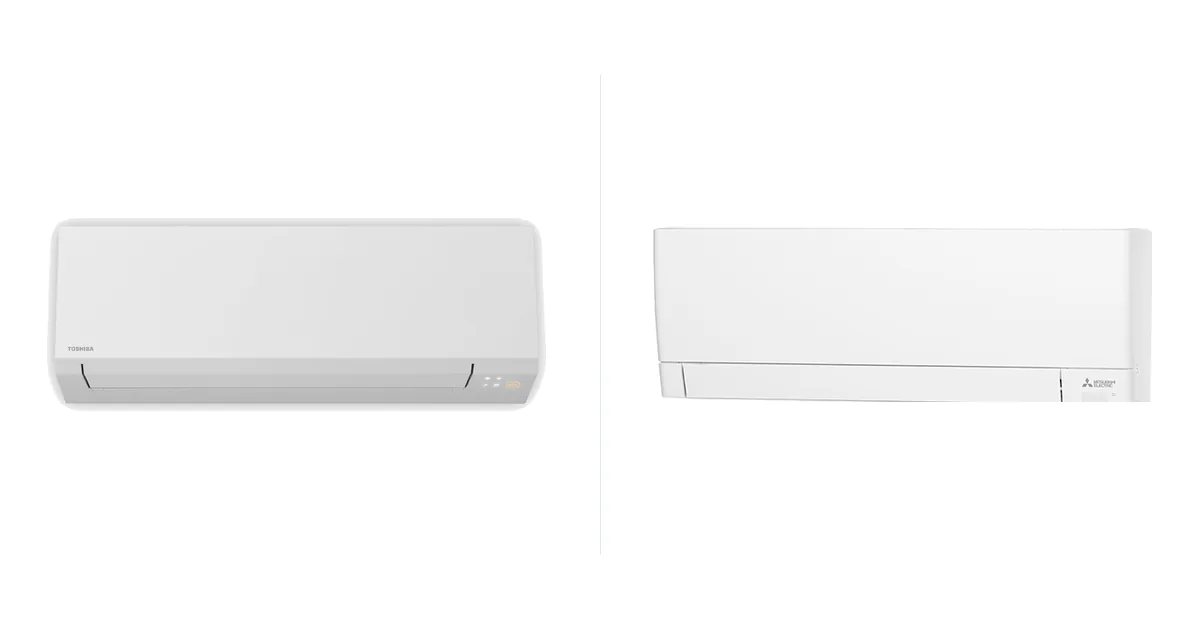
Toshiba and Mitsubishi Electric are both first-tier Japanese brands with long UK track records, and their wall splits line up closely. At 2.5 kW, Toshiba's Shorai Edge publishes SEER 8.6 and SCOP 5.1 with a 19 dB(A) low step. Mitsubishi Electric's MSZ-AY publishes SEER 8.70 and SCOP 4.80 with an 18 dB(A) low step. Edge has the better heating label. AY is a decibel quieter and has the larger UK installer and parts network. For most rooms the installer and the outdoor position will matter more than which badge you choose. Update, 29 November 2026: Toshiba UK no longer lists the Shorai Edge among its wall units; its current matt black and white unit is the Shorai Curve, so a new quote will usually name the Curve. Ask the installer for the Curve's figures at your size before comparing.
The ranges that line up
Both brands have an entry unit, a core unit and design-led units above them. Toshiba's Seiya is the entry wall unit, Shorai Edge is the core high-efficiency unit, Haori has a textile cover, and Daiseikai 10 is the premium range. Mitsubishi Electric's MSZ-HR is the entry unit, MSZ-AY is the core unit, and MSZ-LN and Zen (MSZ-EF) are the premium and designer units.
Compare like with like. A Seiya against an LN is not a brand comparison. It is an entry unit against a flagship, and the price gap is expected.
Both make light-commercial and VRF systems too. Toshiba's reputation in the UK is stronger in commercial work, and Mitsubishi Electric's is stronger in homes.
Core units at 2.5 kW
Shorai Edge figures are from Toshiba's Shorai Edge brochure. MSZ-AY figures are from Mitsubishi Electric's AP and AY data sheet. Both are 2.5 kW single-split pairs.
| Toshiba Shorai Edge | Mitsubishi Electric MSZ-AY | |
|---|---|---|
| SEER | 8.6 | 8.70 |
| SCOP (average climate) | 5.1 | 4.80 |
| Heating class | A+++ | A++ |
| Lowest indoor step | 19 dB(A) | 18 dB(A) |
| Front | Matt black or white | White |
| Refrigerant | R32 | R32 |
What the numbers mean in a UK home
Cooling is level. 8.6 against 8.70 makes no difference you will notice over a British summer.
Heating favours Toshiba. SCOP 5.1 against 4.80 is about 6 percent more heat per unit of electricity. That matters if the split heats a room through winter, less if the boiler does.
The one-decibel gap at the lowest step is real but small. Check the low and medium fan steps too, because those are what you hear most nights.
What usually decides it
Installer support. Mitsubishi Electric has one of the largest domestic installer networks in the UK, so in many towns more companies will quote and service it. Toshiba is well supported, but home buyers usually meet it through an installer who already fits it.
Warranty. Both brands tie their longest warranties to registration and, often, to the installer's status. Ask each installer for the written warranty terms, how they register the system, and what servicing is needed to keep the cover.
Look. Edge comes in matt black or white. If colour matters and you want Mitsubishi, the comparison is with the LN or Zen, which cost more.
Frequently asked questions
Is Toshiba as good as Mitsubishi Electric?
Yes. Both are first-tier manufacturers. At 2.5 kW Toshiba's Shorai Edge has a better heating label than the Mitsubishi MSZ-AY, while the AY is slightly quieter and has more UK installers.
Which is more efficient?
For cooling they are level, SEER 8.6 against 8.70. For heating Shorai Edge is ahead, SCOP 5.1 against 4.80. Compare the figures for the size in your quote.
Which has the better warranty?
Both tie their longest cover to registration and installer status, and the terms change. Ask each installer for the current written terms before you sign.
Can I mix Toshiba and Mitsubishi indoor and outdoor units?
No. The indoor and outdoor units must be from the same manufacturer and listed as a matching pair or multi-split combination.
Core buying guides
Start with these high-intent guides, then dig into the rest of the library.
Related guides
More homes guides
Sources and further reading
How this guide was prepared
This guide was written by the Local AC Installers Editorial Team. We compare official guidance, legislation and established consumer information, separate general information from project-specific advice, and show publication dates and sources. We do not accept installer accreditation claims at face value.