
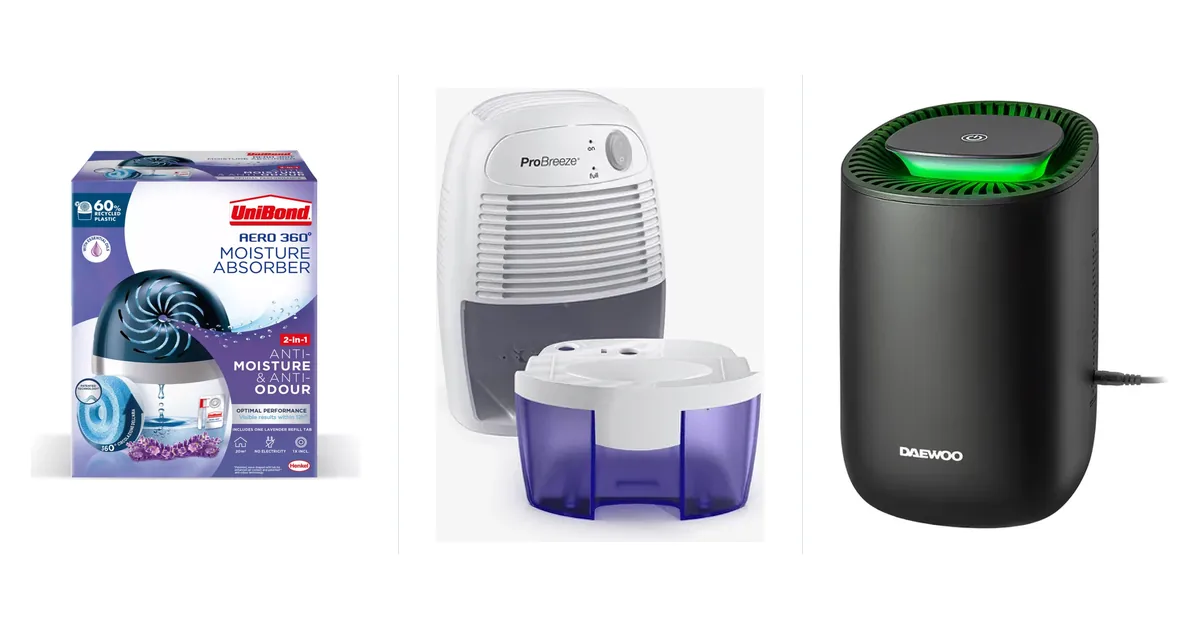
For a damp wardrobe in a heated room, a 500 ml plug-in mini dehumidifier or a calcium chloride absorber tub on the wardrobe floor is enough: Pro Breeze rates its 500ml mini at about 250 ml a day, and UniBond's Aero 360 tab takes up about 1 litre over 1 to 3 months. If the wardrobe stands on a cold outside wall, or there is mould on the wall behind it, move it off the wall and dry the whole room with a room dehumidifier, because the plug-in minis are rated to work only above 15°C.
A wardrobe of air holds only about 12 g of water at 20°C and 60% humidity, so the damp comes from the room air and the cold wall, not from the wardrobe itself. Below are the picks, what each type removes on its maker's figures, what it costs to run at the Ofgem cap of 26.32p per kWh, and why wardrobes on outside walls go mouldy. We have not tested any of these products.
Wardrobe dehumidifier picks, on makers' figures
Each pick suits a different wardrobe. The figures are the makers' own; we have not tested these products. The Pro Breeze 500ml (PB-02) is compared below but is not a pick: it was sold out at Pro Breeze on 28 November 2026.
Cold wardrobe or no socket
UniBond Aero 360 Moisture Absorber
About 1 litre per 450 g tab, up to 1.3, no electricity
Keeps working down to 10°C, below where the plug-in minis stop. Stand it on the wardrobe floor, away from clothes and shoes, because the brine damages fabric and leather.
Check price on AmazonPhoto: Henkel (UniBond)
Wardrobe in a heated room, with a socket
Daewoo 600ml Dehumidifier COL1668GE
23 W, 600 ml tank, under 35 dB
About 0.6p an hour. Daewoo names wardrobes as a use but does not publish a litres a day figure. Its manual says to run it above 15°C with 15 cm of free space on all sides.
Check price on AmazonPhoto: Daewoo Electricals
Damp bedroom or mould on the wall behind
MeacoDry Arete One 6L
3.5 litres a day at 27°C and 60%, 101 W, from 32 dB
About 3p an hour while running. Dries the room the wardrobe takes its air from; leave the wardrobe doors open while it runs.
Check price on AmazonPhoto: Meaco
If there is mould on the wall behind the wardrobe, no wardrobe-sized product will fix it: move the wardrobe off the wall and dry the room.
Which type for which wardrobe
There are three kinds of wardrobe dehumidifier, and a fourth answer when the problem is bigger than the wardrobe. Pick by where the wardrobe stands and whether there is a socket. Our dehumidifier bags vs electric dehumidifier guide compares absorber tubs and bags with room machines in more detail; this page is about the wardrobe itself.
| Product | Type | Water, maker's figure | Works from | Running cost at the cap | Buy |
|---|---|---|---|---|---|
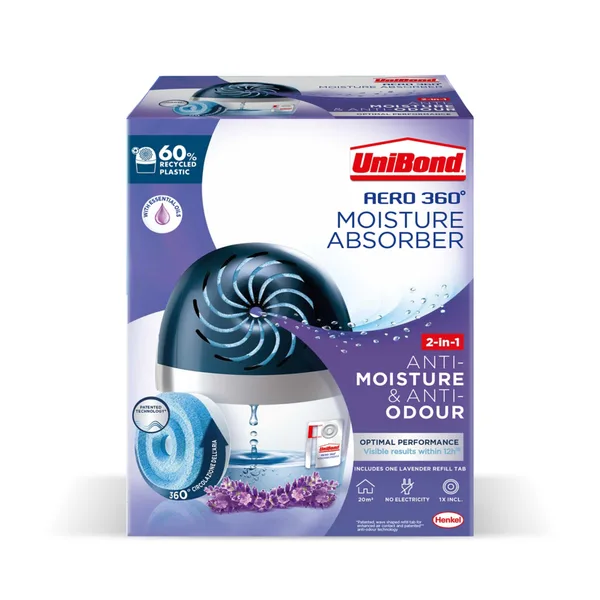 UniBond Aero 360 Moisture Absorber | Calcium chloride tab, no power | About 1 litre per tab, up to 1.3, over 1 to 3 months | Above 10°C | None; tabs are replaced | Check price |
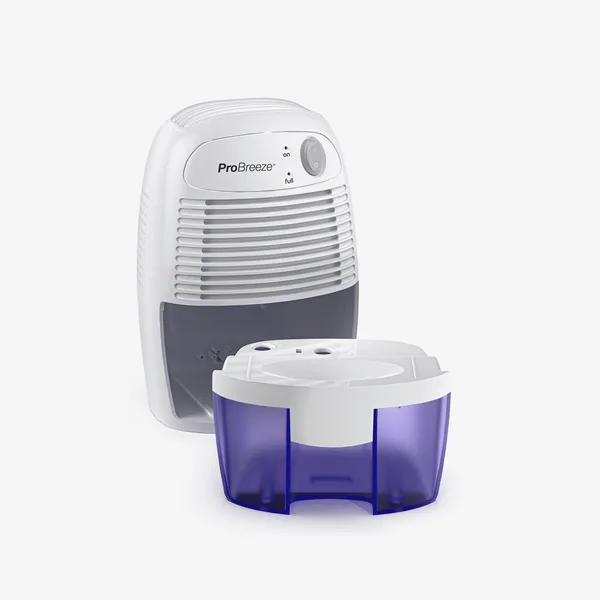 Pro Breeze 500ml Mini Dehumidifier (PB-02) | Peltier, plug-in | About 250 ml a day at 30°C and 80% humidity | 15°C to 30°C | 13p a day if left on (21 W) | |
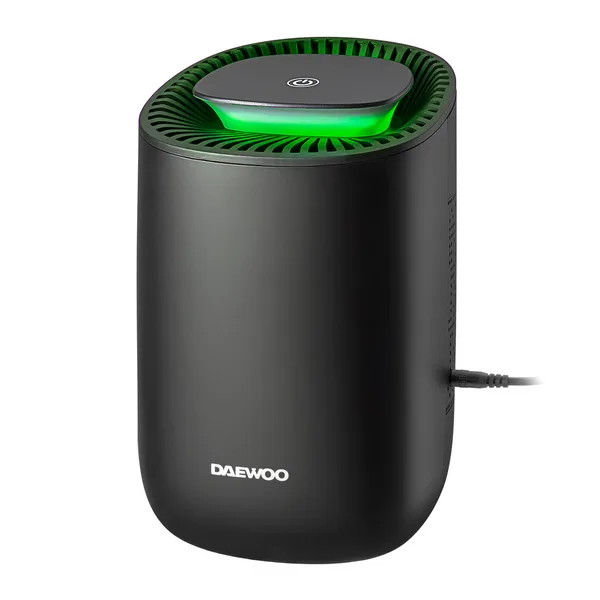 Daewoo 600ml Dehumidifier COL1668GE | Peltier, plug-in | Not published by Daewoo; 600 ml tank | Above 15°C and 40% humidity | 15p a day if left on (23 W) | Check price |
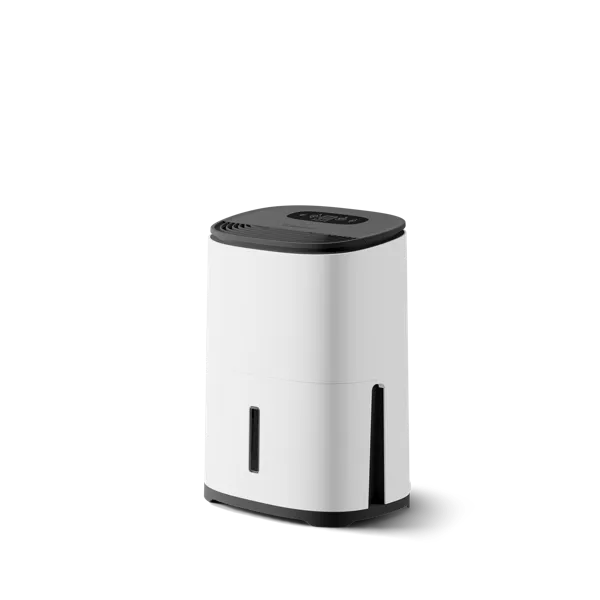 MeacoDry Arete One 6L | Compressor room dehumidifier | 3.5 litres a day at 27°C and 60% | Not in our data | 64p a day if left on (101 W) | Check price |
Why a wardrobe gets damp when the room seems fine
Most damp wardrobes are a condensation problem. GOV.UK's damp and mould guidance for England says moisture made inside the home cools and condenses on colder parts of the building, and names low points on walls behind sofas or wardrobes. NHBC's condensation leaflet names the inside of cupboards and the space behind furniture placed against an outside wall as places where air circulation is restricted and condensation is most likely.
The reason is temperature. A wardrobe on an outside wall shuts out the warm room air, so the air inside it, and the wall behind it, sit cooler than the room. Air that cools keeps the same water but its relative humidity rises, because cooler air can hold less. It does not need any extra moisture to reach the damp levels at which clothes smell musty and mould starts.
The table works this through with the Magnus formula published by the National Physical Laboratory. Room air at 20°C and 60% humidity has a dew point of about 12.0°C. If that air drifts into a wardrobe that sits at 16°C, its humidity rises to about 77%; at 14°C it reaches about 88%; and any surface at 12°C or colder, such as the wall behind the back panel, gets wet. The wardrobe temperatures are illustrations, not measurements; a wardrobe on a solid outside wall in a cold spell can be cooler still.
| Wardrobe air temperature | Room at 20°C, 60% humidity | Room at 20°C, 50% humidity |
|---|---|---|
| 20°C | 60% | 50% |
| 18°C | 68% | 57% |
| 16°C | 77% | 64% |
| 14°C | 88% | 73% |
| 12°C | 100% | 83% |
What that means for a wardrobe dehumidifier
The air in a wardrobe holds very little water. A double wardrobe of about 1.2 cubic metres (our example: 1 m wide, 0.6 m deep, 2 m high) holds about 12 g of water vapour at 20°C and 60% humidity, about a tablespoon. Any of the products above takes that out quickly. The work is keeping up with the damp room air that leaks in every time the doors open and through the gaps, and with the cold wall that keeps cooling it.
That is why the room matters more than the wardrobe. Bring the room down from 60% to 50% humidity and its dew point drops from about 12.0°C to about 9.3°C. The same 14°C wardrobe then sits at about 73% humidity instead of 88%. The Centre for Sustainable Energy suggests setting a dehumidifier to under 60% where possible.
The 15°C catch with plug-in mini dehumidifiers
The 500 ml mini dehumidifiers sold for wardrobes use a Peltier module: a small electronic chip with a cold side that water condenses on, and no compressor. Pro Breeze gives a working range of 15°C to 30°C for its 500ml model, and Daewoo's manual for the COL1668 says to use it over 15°C and over 40% humidity.
Pro Breeze's figure of about 250 ml a day is measured at 30°C and 80% humidity, much warmer and damper than a UK bedroom in winter, and neither maker publishes a figure for cooler air. Daewoo does not publish a litres a day figure; its 600 ml is the tank size. Expect less than the headline in a real wardrobe, and none at all in a wardrobe below 15°C, which is the cold outside-wall wardrobe that most needs help.
Both also need air round them. Pro Breeze's PB-02 manual says the unit must have at least 50 cm clear on all sides and must not be placed against a wall, and Daewoo's manual asks for at least 15 cm of free space on all sides. Most wardrobes are not deep enough for 50 cm, so stand the unit on an open part of the wardrobe floor with nothing packed round it, away from the back panel, and leave the doors ajar if you can.
They are cheap to leave running: at 21 W the Pro Breeze costs about 0.6p an hour, 13p a day or about £3.98 a month if left on all the time, and the Daewoo at 23 W about £4.36 a month. Both switch off when the tank is full. Our dehumidifier running cost guide has the same sums for room machines.
Absorber tubs and rechargeable silica units
Calcium chloride tabs need no power and keep working in cooler spaces: Henkel says to use the UniBond Aero 360 above 10°C. Henkel's data sheet gives about 1 litre of brine from a 450 g tab on average, up to 1.3 litres depending on humidity and temperature, and UniBond rates one device for a room of about 20 m² with poor air circulation, lasting 1 to 3 months there. In a wardrobe, a small fraction of that volume, one device is plenty.
Henkel also says to place the device at least 10 cm from the wall and to keep the tab and the brine away from metal fittings, leather, fabrics and carpets. In a wardrobe that means the floor, at the front, not on a shelf among folded clothes, and emptied before the tank is full.
Rechargeable silica units hold much less. Pro Breeze's manual for its PB-04 gives a capacity of 150 ml, after which you plug it in for 12 to 15 hours at 20 W to drive the water out, about 6p to 8p of electricity each time. The manual says the surface gets warm while recharging and to keep it at least 10 cm from other objects, so recharge it outside the wardrobe. It suits a drawer, a small cupboard or a car more than a full wardrobe.
When the answer is a room dehumidifier
A wardrobe product treats the symptom inside the doors. If any of these apply, the room is the problem and a room dehumidifier with the wardrobe doors left open will do more:
- Black mould on the wall behind or beside the wardrobe, or on the back panel.
- Condensation on the bedroom window most mornings. Our dehumidifier for window condensation guide works out the humidity a room needs to stay below for its glazing.
- Washing dried indoors in the same room or flat.
- Clothes still musty after a tub or mini unit has been in for a few weeks.
What a room dehumidifier does for a wardrobe
The MeacoDry Arete One 6L is rated by Meaco at 3.5 litres a day at 27°C and 60%, drawing 101 W, about 3p an hour at the cap. At that rate it removes a full Pro Breeze mini tank's worth (500 ml) in about 3.4 hours, and a whole UniBond tab's worth in about 6.9 hours. These figures are from our specs file, read from Meaco's page on 21 November 2026; Meaco's site was not reachable when we re-checked on 28 November 2026.
Run it in the bedroom with the wardrobe doors open for a few hours, set to the humidity you want, and the room air the wardrobe draws on is drier. For a bedroom that is also cold, a desiccant room dehumidifier copes better than a compressor model; our compressor vs desiccant dehumidifier guide explains why, and our best dehumidifier comparison lists every model we have figures for.
Fixes that cost nothing
These come from council, NHBC and Centre for Sustainable Energy advice, and they deal with the cause rather than the moisture.
- Move the wardrobe to an inside wall if you can. NHBC suggests putting free-standing wardrobes against internal walls rather than external ones.
- If it has to stay on an outside wall, leave a gap behind it so air can move. NHBC, Bassetlaw Council and GOV.UK's guidance all say to leave a gap between furniture and outside walls.
- Do not pack it tight. NHBC's leaflet says air should be able to circulate around the contents of cupboards, wardrobes and drawers.
- Put clothes away fully dry. The Centre for Sustainable Energy says clothes should be completely dry before they go into wardrobes and drawers.
- Keep the room evenly warm. Bassetlaw Council suggests low background heat all day in cold weather rather than short bursts of high heat, which keeps the wall behind the wardrobe warmer.
The picks again
The same products as at the top of this guide, for when you have read the detail.
Cold wardrobe or no socket
UniBond Aero 360 Moisture Absorber
About 1 litre per 450 g tab, up to 1.3, no electricity
Keeps working down to 10°C, below where the plug-in minis stop. Stand it on the wardrobe floor, away from clothes and shoes, because the brine damages fabric and leather.
Check price on AmazonPhoto: Henkel (UniBond)
Wardrobe in a heated room, with a socket
Daewoo 600ml Dehumidifier COL1668GE
23 W, 600 ml tank, under 35 dB
About 0.6p an hour. Daewoo names wardrobes as a use but does not publish a litres a day figure. Its manual says to run it above 15°C with 15 cm of free space on all sides.
Check price on AmazonPhoto: Daewoo Electricals
Damp bedroom or mould on the wall behind
MeacoDry Arete One 6L
3.5 litres a day at 27°C and 60%, 101 W, from 32 dB
About 3p an hour while running. Dries the room the wardrobe takes its air from; leave the wardrobe doors open while it runs.
Check price on AmazonPhoto: Meaco
If there is mould on the wall behind the wardrobe, no wardrobe-sized product will fix it: move the wardrobe off the wall and dry the room.
Frequently asked questions
Do wardrobe dehumidifiers work?
Yes, in a wardrobe in a heated room. A calcium chloride tub takes up about 1 litre per tab over 1 to 3 months on UniBond's figures, and a 500 ml Peltier mini is rated at about 250 ml a day at 30°C and 80% humidity. They cannot fix mould caused by a cold outside wall, and the plug-in minis are rated only above 15°C.
What is the best dehumidifier for a wardrobe?
With a socket and a wardrobe on an inside wall, a 500 ml plug-in mini such as the Pro Breeze 500ml Mini Dehumidifier (PB-02). In a cold wardrobe or one with no socket, a calcium chloride absorber such as the UniBond Aero 360 Moisture Absorber, which works above 10°C. If the bedroom itself is damp, a room dehumidifier such as the MeacoDry Arete One 6L with the wardrobe doors open.
Why is there mould in my wardrobe?
Usually condensation. Room air cools inside a wardrobe on an outside wall and its humidity rises: air at 20°C and 60% reaches about 88% if it cools to 14°C, and wets any surface below about 12.0°C. Move the wardrobe off the wall, do not overfill it, and dry the room.
How much does a wardrobe dehumidifier cost to run?
At the Ofgem cap of 26.32p per kWh, a 21 W Pro Breeze 500ml mini costs about 13p a day if left on, and a 23 W Daewoo COL1668GE about 15p. A Pro Breeze PB-04 rechargeable unit uses about 6p to 8p per recharge. Absorber tubs use no power but need new tabs.
Can I put a dehumidifier inside a wardrobe?
A mini plug-in unit or an absorber, yes: Pro Breeze and Daewoo both name wardrobes as a use. Their manuals also ask for space round the unit, though: Pro Breeze says at least 50 cm clear on all sides of its 500ml PB-02 and not against a wall, and Daewoo says 15 cm of free space on all sides of the COL1668. Stand a plug-in mini on an open part of the wardrobe floor with nothing packed round it, away from the back panel. Keep absorber tubs on the floor away from clothes and leather, and recharge silica units outside the wardrobe because they get warm. A room dehumidifier should stand in the room with the wardrobe doors open, not shut inside.
Core buying guides
Start with these high-intent guides, then dig into the rest of the library.
Related guides
- Dehumidifier Bags and Moisture Absorbers vs an Electric Dehumidifier
- Best Dehumidifiers UK: 54 Compared, Including for Bedrooms, Bathrooms and Mould
- Does a Dehumidifier Stop Condensation on Windows? A Dew Point Guide
- How Much Does a Dehumidifier Cost to Run? UK Cost per Hour, Day and Month
- Compressor vs Desiccant Dehumidifier: Which One for Which Room
More homes guides
Sources and further reading
- Henkel: UniBond Aero 360 Device technical data sheet, 1 litre average per 450 g tab, up to 1.3, rooms of 20 m², above 10°C, 10 cm from the wall (checked 28 Nov 2026)
- UniBond UK: Aero 360 Moisture Absorber with Refill Tab, 1 to 3 months in a 20 m² room (checked 28 Nov 2026)
- Pro Breeze: 500ml Mini Dehumidifier, energy use 0.021 kWh, 0.25 L max extraction, 15 to 30°C, 33 dB, up to 20 m² (EU store, checked 28 Nov 2026)
- Pro Breeze: PB-02 instruction manual (UK), about 250 ml a day at 30°C and 80%, Peltier module, adapter rated DC 9 V 2.5 A, 500 ml tank, minimum 50 cm clearance on all sides (checked 28 Nov 2026)
- Pro Breeze: PB-04 rechargeable mini dehumidifier instruction manual (UK), 20 W, 150 ml, recharge 12 to 15 hours (checked 28 Nov 2026)
- Daewoo Electricals: 600ml Dehumidifier COL1668GE, 600 ml tank, up to 15 m², under 35 dB (checked 28 Nov 2026)
- Daewoo Electricals: COL1668 user manual, 23 W, over 15°C and over 40% RH, 15 cm free space on all sides (checked 28 Nov 2026)
- Meaco: dehumidifier specifications, MeacoDry Arete One 6L (read 21 November 2026)
- Ofgem: energy price cap, 1 October to 31 December 2026
- National Physical Laboratory: dew point and relative humidity, Magnus formula over water (checked 28 Nov 2026)
- GOV.UK: Understanding and addressing the health risks of damp and mould in the home (checked 28 Nov 2026)
- NHBC: Condensation in your home, 2024 leaflet (checked 28 Nov 2026)
- Centre for Sustainable Energy: damp and condensation advice (checked 28 Nov 2026)
- Bassetlaw District Council: mould, damp and condensation (checked 28 Nov 2026)
How this guide was prepared
This guide was written by the Local AC Installers Editorial Team. We compare official guidance, legislation and established consumer information, separate general information from project-specific advice, and show publication dates and sources. We do not accept installer accreditation claims at face value.