
Air conditioning installation for one wall split in a UK home runs set-out, core hole, indoor unit, outdoor unit, pipes, drain and cable, a nitrogen leak test, a vacuum, releasing the refrigerant, then commissioning; most installers finish in half a day to a full day. Each step has rules in the maker's installation manual, from the hole size and the pipe length allowed to how deep the vacuum must go and how much extra refrigerant a long run needs.
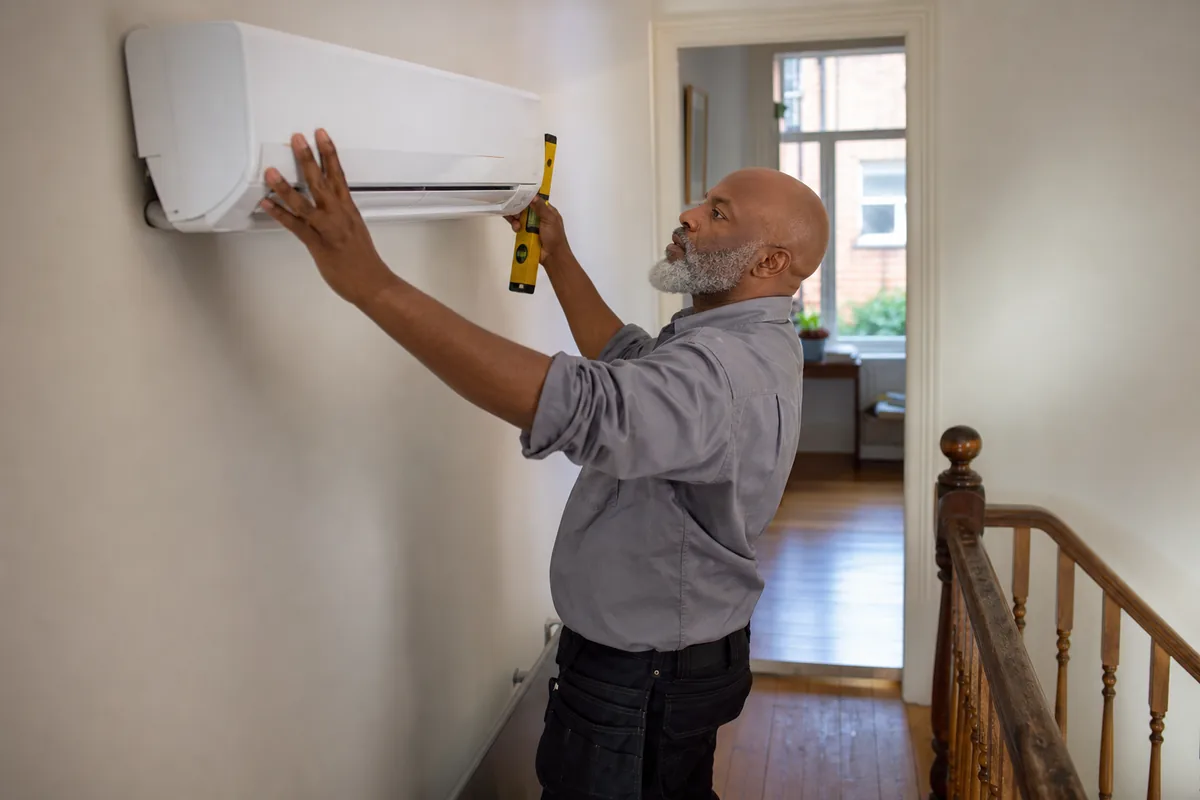
Install day for a single wall split, step by step
The times below are Be Cool Refrigeration's published stage times, the only installer page we found that times each stage. The right-hand column is what the makers' installation manuals ask for at that stage. Your installer will follow the manual for your exact model, so the details vary a little. For the time question on its own, see our guide to how long domestic air conditioning installation takes.
The core hole sizes come from the Mitsubishi Electric MSZ-LN and Toshiba Seiya manuals (65 mm), the Panasonic BZ and smaller Etherea manuals (70 mm, 80 mm on the 2.0 to 2.5 HP Etherea) and the Daikin FTXM60 and FTXM71 manual (80 mm). Every one says the hole should fall towards the outside so rain and condensate cannot run back in; Mitsubishi gives 5 to 7 mm of fall across the wall.
| Stage | Typical time | Manual requirement |
|---|---|---|
| Set out and protect | 30 to 60 min | Level plate, agree positions |
| Core hole | 60 to 90 min | 65 to 80 mm, falling outwards |
| Indoor unit | 1 to 2 hours | Plate level, pipes taped |
| Outdoor unit | 1 to 2 hours | Brackets or feet, anti-vibration mounts |
| Pipes, drain, cable | 2 to 3 hours | Within max run, drain to gully, drain or pump |
| Supply and isolator | Within the above | Own circuit, isolator by outdoor unit |
| Leak test | About 1 hour with vacuum | Nitrogen, at least 2 bar (Daikin) |
| Vacuum | Included above | To -0.1 MPa, then a hold |
| Open valves, add gas | Minutes | Extra gas past free length |
| Commission, hand over | 1 to 2 hours | Test run, temperature check |
| Tidy and trunking | End of day | Trunking, seal hole, clear up |
Why the leak test and vacuum can take 15 minutes or three hours
After the pipes are joined, the installer proves they are tight and then pulls the air and moisture out before releasing the refrigerant held in the outdoor unit. The makers do not all ask for the same thing.
Daikin's RXM outdoor manual asks for nitrogen at a gauge pressure of at least 200 kPa (2 bar) and recommends 3000 kPa (30 bar) to find small leaks, with a bubble test on every joint. The vacuum then goes to -0.1 MPa (-1 bar) and is left for 4 to 5 minutes. If the gauge does not move, the pipes are dry and the job is done. If it rises, there is moisture, and the manual asks for at least 2 hours of vacuum followed by at least 1 hour with the pump off to prove it holds. A wet day or a pipe left open overnight can therefore add three hours.
Panasonic's BZ and UZ manual pulls a vacuum to -0.1 MPa or 500 microns, which it says takes about ten minutes, then fills the pipes with inert test gas to at least 1.04 MPa (10.4 barg), watches for any drop, and evacuates again before opening the valves. Toshiba's Seiya manual allows about 15 minutes of evacuation for a 20 m run with a 27 litre a minute pump, to -101 kPa. Mitsubishi Electric's MSZ-LN manual marks -760 mmHg on its gauge diagram.
So when a quote or a firm's page says the test and vacuum take an hour, that fits a dry system and most manuals, but not every case. Ask which manual your installer is following and whether they hold the vacuum before opening the valves. Industrial Cooling Equipment's overnight pressure test is the slow, cautious end of the same step.
How long air conditioning installation takes
We read ten published pages that give install times: eight from UK installers and energy firms, plus BOXT and Daikin's own advice page. For one wall split, the most common figure is 4 to 8 hours, and every page except one lands between half a day and one full day. The exception is Industrial Cooling Equipment, which says one day for a back-to-back install but two days for a split with a standard pipe run, because in many cases it leaves the pressure test on overnight.
Multi-split times spread wider, from Daikin's 6 to 12 hours to four days for three indoor units at Industrial Cooling Equipment. Most pages put two rooms at one to two days and three to five rooms at two to four days. Only five of the ten pages give a ducted figure, so treat that one as thin: they range from two days to over a week, with three to five days the most common.
| Source | Single split | Multi-split |
|---|---|---|
| Be Cool Refrigeration | 4 to 8 hours | 1 to 2 days (2 units) |
| Industrial Cooling Equipment | 1 to 2 days | 4 days (3 units) |
| LW Gas | 4 to 6 hours | 1 to 2 days |
| AN Heating | 1 full day | 2 to 3 days |
| iHeat | Often 1 day | 2 days or longer |
| British Gas | About 1 day | Longer, no figure |
| BOXT | 4 to 8 hours | Not given |
| West London Plumbing | Half to full day | Not given |
| OVO | 4 to 8 hours | 1 to 2 days (2 to 3 rooms) |
| Daikin (advice page) | 4 to 8 hours | 6 to 12 hours |
Pipe length and extra refrigerant
Each outdoor unit leaves the factory with enough refrigerant for a set length of pipe. Past that, the installer weighs in extra gas. For example, a 12 m run on a Daikin RXM needs (12 - 10) x 20 g = 40 g, and the same run on a Panasonic BZ25 needs (12 - 7.5) x 10 g = 45 g. A run longer than the maximum is outside the manual, so a far-away outdoor position can mean a bigger model or a different system rather than just more pipe.
The figures below are from each manual's own table. Free length means no gas is added up to that one-way pipe length.
- Minimum runs matter too: Daikin RXM 1.5 m, Toshiba Seiya 2 m, Panasonic BZ 3 m and Daikin 2MXM 3 m per room. A back-to-back install may need a loop of pipe.
- Height limits between indoor and outdoor units: Daikin RXM 15 m, Toshiba Seiya 12 m, Mitsubishi MSZ-LN25 and LN35 12 m.
- The condensate hose has no fixed figure in these wall split manuals. Toshiba and Mitsubishi say it must fall all the way, with no sag or upward loop, and its end must not sit in water. It usually runs to a gully, a drain or, where it cannot fall, a condensate pump.
| Outdoor unit | Free length | Extra gas | Max run |
|---|---|---|---|
| Daikin RXM20 to 35R | 10 m | 20 g/m | 20 m |
| Mitsubishi MUZ-LN25/35 | 10 m | 20 g/m | 20 m |
| Panasonic BZ25/35 | 7.5 m | 10 g/m | 15 m |
| Toshiba RAS-10E2AVG | 15 m | None needed | 15 m |
| Toshiba RAS-18E2AVG | 15 m | 20 g/m | 20 m |
| Daikin 2MXM (2 rooms) | 20 m total | 20 g/m | 20 m a room |
What the installer needs from you before the day
A survey comes first. The installer measures the room, looks at glazing and use, and checks the outside wall, the pipe route, the drain route and the consumer unit. Loughborough Air Conditioning says its domestic surveys record room layout, insulation, electrics, measurements and photos, with a quote within two working days. Be Cool Refrigeration puts the whole path from enquiry to working system at two to five weeks, mostly waiting for equipment.
The quote should name the exact indoor and outdoor model, the pipe allowance, the drain method, the electrical work and what happens to the walls. For what each of those costs, see our air conditioning installation cost guide.
Most homes do not need planning permission if the outdoor unit meets the permitted development limits. OVO notes the usual exceptions: listed buildings, some conservation areas and certain flats. Leaseholders usually need the freeholder's written consent too. Our air conditioning planning permission guide covers the limits.
- Clear access to the indoor wall and move fragile items and pictures (LW Gas).
- Easy access to the consumer unit, and expect the power to be off for short spells (LW Gas for access; iHeat for short power-off spells).
- A firm, agreed outdoor unit position with room for the maker's clearances, and a word with neighbours if it sits near a boundary.
- Parking and access for the van, ladders and any scaffold; Loughborough Air Conditioning asks about these in a pre-works questionnaire.
- Someone at home at the start to confirm positions and at the end for the handover (iHeat says for at least part of the day). BOXT says its engineer usually confirms an arrival time the day before.
The commissioning checklist
Commissioning is the proof the system works as the maker intended. Daikin's checklist before commissioning and Panasonic's check items cover the same ground. You can ask to see each point ticked off.
- No refrigerant leaks at the flare joints, tested again after the gas is released (Daikin asks for a method sensitive to 5 g a year).
- Gas and liquid stop valves fully open.
- Outdoor unit level on its wall brackets or ground feet, with anti-vibration mounts.
- Pipes and flare joints insulated, and the correct pipe size used.
- Water poured into the drain tray runs out of the hose outside.
- Earth connected, the right fuse or breaker fitted, an isolator in place, and the supply voltage matching the label.
- Test run: Daikin's remote test run stops on its own after about 30 minutes.
- Performance: Panasonic asks for at least 15 minutes of running, then a temperature drop of more than 8°C across the indoor unit in cooling, or a rise of more than 14°C in heating.
- Remote or app paired, and you shown the modes, filters and schedule.
Paperwork to keep
A new circuit from the consumer unit is notifiable electrical work in England and Wales. The installer either uses a registered electrician or is registered themselves, and you should receive an electrical certificate and, where needed, Building Regulations notification.
The company opening or connecting the refrigerant circuit must hold F-gas company certification, and the engineers need the matching personal qualification. GOV.UK says anyone installing F-gas equipment must label it with the gas name, its mass in kg, its weight in tonnes of CO2 equivalent and its global warming potential, and Daikin's manual asks the installer to write the extra gas charged on that label.
The legal record-keeping duty starts at 5 tonnes of CO2 equivalent. A single domestic split is far below that: Toshiba's RAS-10E2AVG holds at most 0.49 kg of R32, which at the 675 global warming potential printed in Daikin's manual is about 0.33 tonnes. Ask for the figures on the commissioning sheet anyway; they are what the next engineer needs.
Keep the commissioning sheet, the electrical certificate, the manual and the warranty registration details. Register the warranty with the manufacturer straight away if the installer has not done it. Many extended warranties depend on registration within a set period and on annual servicing.
How multi-split and ducted installs differ
A multi-split runs one outdoor unit to two or more rooms, so there are more core holes, more pipe and more joints to test. Daikin's 2MXM two-room manual allows up to 20 m to each indoor unit and 30 m in total, at least 3 m per room, and the vacuum pump is connected to both gas service ports. Extra gas starts above 20 m of total liquid pipe, at 20 g a metre. Daikin's 2MXM commissioning list also adds a wiring check before the test run, which catches a room's cable connected to another room's pipes.
Ducted systems hide the indoor unit in a loft or ceiling void and feed rooms through ductwork and grilles, so the work includes ceiling openings, duct runs and often a condensate pump. That is why published times run from two days to over a week. For the design choices, see our guides to single split vs multi-split and ducted air conditioning.
Frequently asked questions
What are the steps in an air conditioning installation?
Set out the positions, drill the core hole, fix the indoor and outdoor units, run the pipes, drain and cable, pressure test with nitrogen, pull a vacuum, release the refrigerant and add any extra the pipe length needs, then commission, hand over and tidy up.
How long does air conditioning installation take?
One wall split usually takes half a day to a full day. Multi-splits usually take one to three days and ducted systems three to five, based on ten published installer and maker pages checked on 27 November 2026.
What size hole does an air conditioner need?
Usually 65 to 80 mm, depending on the model. The Mitsubishi Electric MSZ-LN and Toshiba Seiya manuals say 65 mm, Panasonic says 70 mm, or 80 mm on larger Etherea models, and the larger Daikin FTXM60 and FTXM71 say 80 mm, always falling slightly to the outside.
Why do installers pressure test with nitrogen?
To prove the joints are tight before refrigerant is released. Nitrogen is dry and inert. Daikin's RXM manual asks for at least 2 bar and recommends 30 bar to find small leaks.
How long should the vacuum be held?
It depends on the manual. Daikin asks for -0.1 MPa and a 4 to 5 minute check, then at least 2 hours of vacuum and a 1 hour hold if moisture shows. Panasonic says about ten minutes to -0.1 MPa or 500 microns, and Toshiba about 15 minutes for a 20 m run.
Will my installer need to add refrigerant?
Only if the pipe run is longer than the outdoor unit's free length, for example 10 m on a Daikin RXM or Mitsubishi MUZ-LN25, or 7.5 m on a Panasonic BZ25. Past that it is 10 to 20 g a metre.
Is installing air conditioning messy?
There is one core hole through the wall and some dust. Good installers use dust extraction and sheets and tidy up. Pipe routes through the house add more disruption.
Do I need to be at home on install day?
Usually yes, at least at the start to confirm positions and at the end for handover and commissioning.
Core buying guides
Start with these high-intent guides, then dig into the rest of the library.
Related guides
More installation guides
Sources and further reading
- Daikin: RXA-A9, RXM-R9, ARXM-R9 outdoor unit installation manual (checked 27 Nov 2026)
- Daikin: FTXM60 and FTXM71 indoor unit installation manual (checked 27 Nov 2026)
- Daikin: 2MXM40 and 2MXM50 multi-split installation manual (checked 27 Nov 2026)
- Mitsubishi Electric: MSZ-LN VG2 installation manual (checked 27 Nov 2026)
- Panasonic: CS/CU-BZ and UZ CKE installation instructions, via Ocean Air (checked 27 Nov 2026)
- Panasonic: Etherea CS-Z indoor unit installation instructions (checked 27 Nov 2026)
- Toshiba: Seiya RAS-B10E2KVG-E and RAS-10E2AVG-E service manual with installation section (checked 27 Nov 2026)
- Be Cool Refrigeration: how long does air conditioning installation take (checked 27 Nov 2026)
- Industrial Cooling Equipment: how long does it take to install air conditioning (checked 27 Nov 2026)
- LW Gas: how long does AC installation take (checked 27 Nov 2026)
- AN Heating: how long does air conditioning installation take (checked 27 Nov 2026)
- iHeat: air conditioning installation process (checked 27 Nov 2026)
- British Gas: how to install air conditioning (checked 27 Nov 2026)
- BOXT: installing home air conditioning (checked 27 Nov 2026)
- West London Plumbing: air conditioning installation guide (checked 27 Nov 2026)
- OVO: how to install air conditioning (checked 27 Nov 2026)
- Daikin: how long does it take to install air conditioning (checked 27 Nov 2026)
- Loughborough Air Conditioning: domestic home survey (checked 27 Nov 2026)
- GOV.UK: labelling F gas equipment you produce, import or install (checked 27 Nov 2026)
- GOV.UK: record F gas in equipment you own or service (checked 27 Nov 2026)
- GOV.UK: Approved Document P, electrical safety in dwellings
- GOV.UK: certification for companies working on equipment containing F-gas
- Planning Portal: air source heat pumps
How this guide was prepared
This guide was written by the Local AC Installers Editorial Team. We compare official guidance, legislation and established consumer information, separate general information from project-specific advice, and show publication dates and sources. We do not accept installer accreditation claims at face value.